‘Don’t sweep it under the carpet’
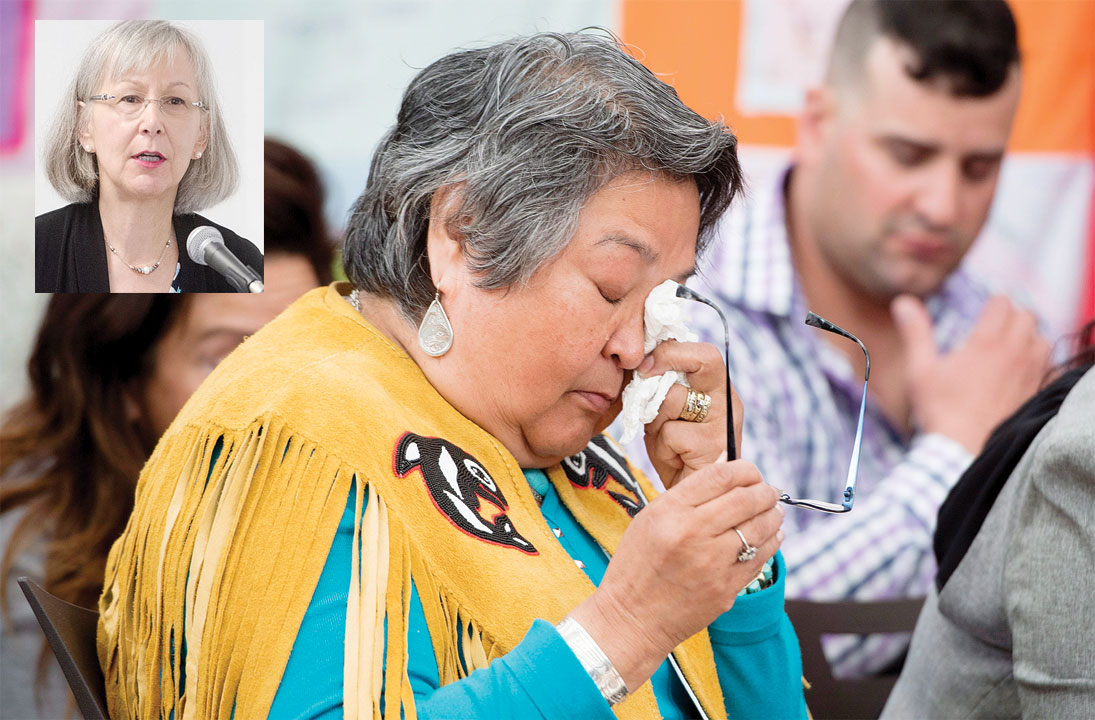
Frances Neumann went “where no one should ever go” in search of her sister-in-law, who had disappeared on Vancouver’s Downtown Eastside.
By Sidney Cohen on May 31, 2017
Frances Neumann went “where no one should ever go” in search of her sister-in-law, who had disappeared on Vancouver’s Downtown Eastside.
Accompanied by friends from Carcross, Neumann visited run-down hotels and rooming houses looking for her brother’s wife.
She had fled the Yukon in 1975 after the sudden death of her baby and the deterioration of her marriage.
“I was so scared, but someone had to do it,” Neumann told commissioners of the National Inquiry into Missing and Murdered Indigenous Women and Girls on Tuesday in Whitehorse.
Neumann was the first to speak publicly at the inquiry, which began its hearings yesterday.
Neumann’s sister-in-law, Mary Smith Johns, was found dead in Vancouver in 1982, poisoned by alcohol.
The family said she had been killed by Gilbert Paul Jordan, an alleged serial killer known as the “Boozing Barber.”
It’s believed Jordan plied women with alcohol and provoked them to drink until they died.
An APTN news report, submitted to the inquiry as evidence, links Jordan to eight women who died under similar circumstances, seven of whom were indigenous.
Johns was buried in an unmarked grave long before her family members were notified of her death.
On Tuesday, Neumann sat with members of her family under a large white tent behind the Kwanlin Dün Cultural Centre.
She told the commissioners about the life of her beloved relative, and the devastation left in the wake of her death.
Neumann described Johns as “a young mother, full of life and full of promise.
“I’m a grandmother, a great-grandmother, a mother. Mary and I should have shared that privilege,” said Neuman.
Johns’ disappearance was particularly disturbing for her son, Charlie-Peter.
“I was his aunt, but he was more like a son to me,” said Neumann.
Tracy Camilleri, Neumann’s daughter, spoke about Charlie-Peter’s pain in the absence of his mother.
“He always felt displaced,” she said.
Charlie-Peter would also wind up on Vancouver’s Downtown Eastside, and die there after a drug overdose.
“We need your help and we ask you for your help,” Neumann told the commissioners, with tears in her eyes.
“I am not a brave woman, but I want justice done. My brother is gone, my nephew is gone; I promised I would see it through.”
Commissioner Marilyn Poitras said Tuesday morning everyone who shares their story is brave.
She said the inquiry has become a reality because indigenous women and their supporters across Canada asserted that indigenous voices matter.
Poitras acknowledged that “a lot of tears are going to flow over this … and they’re necessary.”
Indeed, tears wet many faces on the cultural centre grounds as family, friends and observers listened to the stories of loved ones lost, and families traumatized by the forced removal of children, and the brutalities of residential school.
Anticipating this, the commissioners endeavoured to make the tent as comfortable as possible.
Packets of tissue were readily available and cotton quilts made by volunteers in Saskatchewan hung from the walls.
The blankets are inscribed with messages offering hope and strength:
“All my relations support each other, walk together, pray together.”
“You are never forgotten.”
“Praying you find peace, wherever you are.”
In an interview following her testimony, Camelleri said it took a lot of mental, emotional and spiritual energy to tell her story in public.
“My little cousin that was supporting me didn’t know the whole story, didn’t know all those details,” she said.
“Those aren’t necessarily stories you share on facebook and over coffee with your friends.”
Camilleri is aware of the criticism the commissioners received ahead of the hearings, but said her experience has been positive.
She said lawyer Karen Snowshoe, who guided her hearing, was a comforting presence.
“I hope that (the commissioners) are able to honour all of these women, and they’re able to provide the supports that they did to myself and my mother and our family. Ongoing, long-term supports for trauma,” said Camilleri.
Chief Doris Bill of the Kwanlin Dün First Nation echoed Camilleri’s wish for aftercare for families and survivors following the hearings.
“We’ve had a lot of citizens who have been affected by this issue over and over, and we know the supports that are needed,” she said. “So give us the resources
to do it.”
Bill was glad to see families turn out for the hearings, but said for some, the wounds are still too raw.
“They find it very difficult to be here,” she said.
“I know that there’s been a lot of criticism (of the inquiry) but you know, this is the family’s time,” said Bill.
“They’ve worked so hard to get to this point.”
To the commissioners on Tuesday, Neumann said she hopes the inquiry’s work leads to real change for indigenous women in Canada.
“This is what I’m looking for,” she said.
“That my daughter, granddaughter and great-granddaughter can walk the streets in safety… that no harm can come to them.
“We must stand up for justice for these women that have walked before us,” she said.
“Please, please see this through. We have come up and waited for many years to see the results. Don’t sweep it under the carpet.”
Chief commissioner Marion Buller said in an interview with The Canadian Press she agrees with Neumann, and the commissioners will work hard to present practical recommendations.
“I’m with her on that 100 per cent,” Buller said. “We don’t want this work swept under the rug. It’s too important to all Canadians.”
– With a file from The Canadian Press. See more coverage.
Comments (3)
Up 24 Down 3
north_of_60 on Jun 1, 2017 at 7:41 pm
One good thing emerging from this inquiry is documenting the growing inadequacies of the self-serving justice business. It ranges from biased policing; to lawyers on both sides cultivating aboriginal offenders as 'cash-cows'; to so-called judges handing down 'slap-on-the-wrist' sentences for horrific crimes.
Hopefully this inquiry will trigger a thorough and independent review of the failing justice system. Unfortunately I have my doubts that will ever occur.
Up 26 Down 4
north_of_60 on Jun 1, 2017 at 7:34 pm
This inquiry, just like the last inquiry is little more than a venue to give people an opportunity to tell their sad stories. None of this addresses the fundamental cause of the problem. That is the abusive and exploitative relationships in many aboriginal communities that cause their children to drop out of school, join gangs, do drugs and crimes to pay for them, engage in risky behavior and eventually go missing or commit suicide. Those problems are driven by the huge income disparity that exists in most aboriginal communities. Those who are related to Chief & Council are treated like royalty, the rest are treated like serfs. Address the income disparity and raise healthy kids, or these inquiries will just go on forever as people have more sad stories to tell.
Up 36 Down 8
Kraka on May 31, 2017 at 8:47 pm
So after all the storytelling is over new evidence will suddenly appear? I hear the pain, the suffering etc but to me it's as if this commission has promised that somehow the suspects will somehow be found and justice done. I'm no rocket scientist but I don't think it works that way. These people I suspect have been telling their terrible stories for years and appears all this commission is doing is setting them up for promises that simply the commission can't keep.