Photo by Whitehorse Star
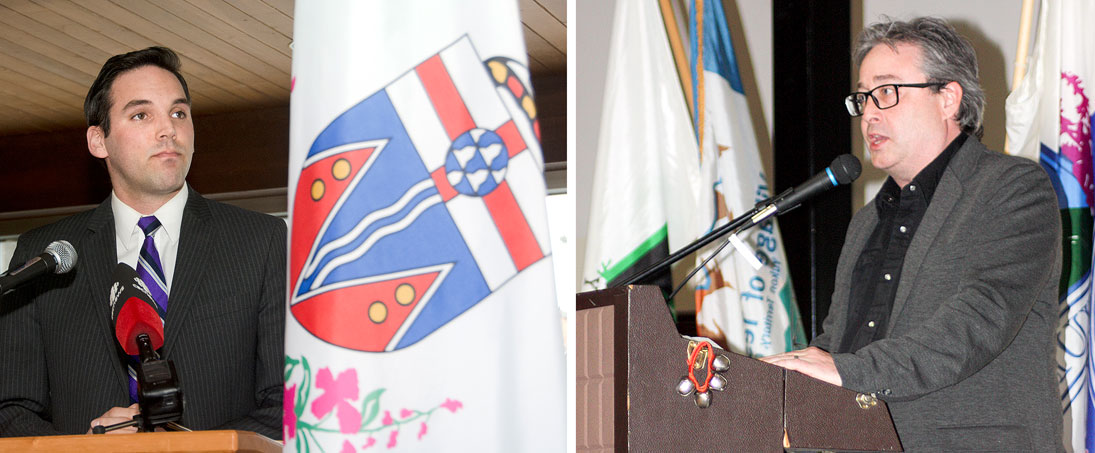
Community Services Minister Currie Dixon and AYC president Wayne Potoroka
Photo by Whitehorse Star
Community Services Minister Currie Dixon and AYC president Wayne Potoroka
Community pools, rinks, recreation centres and other popular community spots could soon be the focus of a new territorial government committee.
WATSON LAKE – Community pools, rinks, recreation centres and other popular community spots could soon be the focus of a new territorial government committee.
On Friday, inside the Watson Lake Recreation Centre, Community Services Minister Currie Dixon told approximately 100 delegates gathered for the Association of Yukon Communities’ (AYC’s) annual conference a plan for recreation infrastructure throughout the territory needs to be developed in light of recent federal funding announcements.
In its 2016-17 budget tabled in March, Ottawa announced changes to infrastructure funding.
The government is making cash available to infrastructure initiatives through a new Build Canada Fund worth $14 billion over the next decade, in addition to the federal gas tax program and GST rebate worth another $32 billion.
A separate fund for water and waste water projects will also be put in place.
“This infrastructure funding is critical,” Dixon told reporters.
The changes could mean more funding coming to the territory for recreation infrastructure, but the territory needs to know first what the priorities are.
“We need to come up with a plan,” Dixon said.
He wants the AYC as part of the committee to get a clear sense of what communities need and want for recreational infrastructure.
In the past, he told reporters, infrastructure funding from the federal government has been needed to go to projects that ensure Yukoners have clean drinking water, roads and other such necessitates.
The new funding from the federal government and the way it is doled out – including having a separate fund for water and waste water projects – will free up some funds for spending on recreational facilities in the territory, Dixon explained. He stressed the importance of planning where that money should go with the communities.
“Let’s see where that money is most needed,” he said.
It is not only recreation needs the territory will be exploring over the coming months in light of federal infrastructure announcements.
The money may be good news for the territory, but Dixon also stressed it will test the territory’s own resources and capacity.
“It will be a challenge,” he said.
The federal funds require territorial jurisdictions receiving the cash to match it by 25 per cent, he added.
And the territory is not prepared to go into debt, Dixon emphasized.
“We need to work together to come up with priorities,” he said.
The demand for the funding is certainly there, he commented.
“We certainly have a lot of projects that need to be done,” he said. “We’re going to do as much as we can.”
While infrastructure funding topped the focus of Dixon’s presentations to the communities gathered in Watson Lake, he also confirmed the territory will continue to provide $50,000 annually to each municipality for fire services for another five years.
The money can go to anything fire-related, from purchasing equipment to training for firefighters.
The funding had been set to end next year, but will continue after the AYC made the request on behalf of municipalities, Dixon said.
Solid waste was another big focus of the minister’s presentation.
AYC president Wayne Potoroka questioned Dixon on behalf of the organization on the future of solid waste in the territory.
Potoroka pointed to the territory’s solid waste strategy – adopted in 2009 – wondering why it hasn’t moved past the discussion phase.
He also questioned why petroleum containers weren’t included in a new list of designated materials residents will pay a deposit on to be handled at the landfill in Whitehorse.
As Dixon explained, the territory is continuing its work to respond to the plan.
That includes moving toward a more regional model for transfer stations, having signed two agreements already that will see a more regional model followed for solid waste.
As a number of delegates pointed out, there is a significant issue of neighbouring municipalities using other transfer stations where fees are not in place.
Bob Sharp, a Mount Lorne local advisory committee member, said it’s a particular concern in his area where a number of Whitehorse residents seem to be dropping off waste at their site to avoid paying tipping fees at the Whitehorse landfill.
Dixon acknowledged the issue is a challenge with no easy answers, as the territory just doesn’t have the resources to staff each transfer station in the Yukon.
He suggested there may need to be a discussion on tipping fees to come up with some sort of solution.
The AYC conference continued over the weekend, wrapping up early Sunday afternoon.
In order to encourage thoughtful and responsible discussion, website comments will not be visible until a moderator approves them. Please add comments judiciously and refrain from maligning any individual or institution. Read about our user comment and privacy policies.
Your name and email address are required before your comment is posted. Otherwise, your comment will not be posted.
Comments (4)
Up 1 Down 0
Salar on May 20, 2016 at 2:31 pm
There are enough cabins in the bush with outfitters allowed 18! Trappers and First Nations can pretty much put them anywhere and then there are the Quartz and placer free-for-all cabins. God knows EMR don't do a thing to enforce any of the above so why would Yukon residents want more areas removed from their use by cabin construction?...cabins make areas exclusive use for the owners and everybody else has to live with it, or without it as it were....Get out of My Yukon
Up 5 Down 0
What a farce on May 18, 2016 at 8:50 pm
Consulting here, consulting there, consulting everywhere, must be an election coming soon!
Up 2 Down 4
SR on May 17, 2016 at 12:29 pm
Trails and shelter cabins! Good for mountain bikers, runners, cross country skiers, dog mushers, dirt bike riders, and for hosting events such as ultra marathons, and for encouraging tourism.
You can get a lot of bang for your buck in building trails. People can be renting out cabins at trail heads, selling meals, guiding, outfitting visitors with tents and packs and so on, selling books that map the trails and describe the land and wildlife and history of the area.
So there's my ten cents.
Up 10 Down 4
Wilfred on May 16, 2016 at 10:00 pm
"“We need to come up with a plan,” Dixon said." First he's asking.
“We certainly have a lot of projects that needs to be done,” he said. “We’re going to do as much as we can.” Then he's telling.
Blatant vote buying. Who cares about upkeep just elect us irresponsibles!