Photo by Whitehorse Star
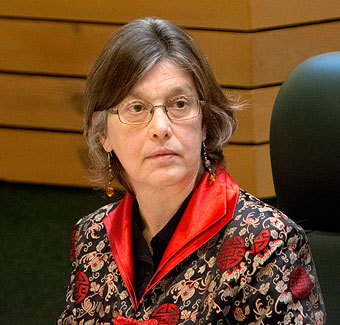
Lois Moorcroft
Photo by Whitehorse Star
Lois Moorcroft
The Yukon NDP questioned the government recently about what the party calls its inaction on issues surrounding Fetal Alcohol Spectrum Disorder (FASD) at the territory's correctional centre.
The Yukon NDP questioned the government recently about what the party calls its inaction on issues surrounding Fetal Alcohol Spectrum Disorder (FASD) at the territory's correctional centre.
"Their support of Bill C-583 while at the same time rejecting the need to address issues within the Yukon's corrections system show their disregard for people living with FASD in the Yukon,” Lois Moorcroft, the official Opposition's Justice critic, said last Wednesday during question period.
"The Yukon Party is perfectly content to support improving legal rights for people with FASD in the courts and then to send them into a correctional system that assumes they have no cognitive disability.”
Moorcroft referred to the government's support of one aspect of an NDP motion related to FASD – to support MP Ryan Leef's Bill C-583, which calls for amendments to the Criminal Code related to the disorder.
However, the government amended the motion to remove a clause that urged it to introduce amendments to the Yukon's Corrections Act to better meet the needs of inmates with FASD and to accommodate FASD as a disability in the Yukon's corrections system.
In response to Moorcroft's comments, Justice Minister Mike Nixon noted the government is undertaking an FASD prevalence study within the correctional system.
"We take that very seriously. In fact, it was this Yukon Party government that implemented this and is on the centre stage across Canada — all of the other jurisdictions are looking at what this prevalence study does,” he said.
The minister went on to note that it was the Yukon Party government that undertook the correctional redevelopment strategy that was implemented and approved in December 2008 at the Yukon Forum.
Moorcroft retorted that the minister is using the FASD prevalence study to avoid tackling issues surrounding the disorder today.
"FASD is a major problem in our correctional system. I know it; the community knows it; and the minister certainly knows it, yet he doesn't act,” she said.
"We are expecting prisoners with FASD to meet certain levels of behaviour and conduct that their disability prevents them from meeting,” said Moorcroft, an NDP justice minister in the late 1990s.
"The justice system presumes that when people break the law or disobey authority, they are doing it consciously. This is why they are punished,” she said.
"But FASD can prevent people from differentiating between right and wrong, thus making them unable to meet the rigorous behaviour standards at WCC.”
The minister did not address Moorcroft's question regarding the punishment of people with FASD for not meeting behavioural standards.
"We do take individuals who are at the correctional facility and who have FASD very seriously,” said Nixon.
He again highlighted the prevalence study, his government's support of Leef's bill and the 2008 correctional redevelopment study.
"We will continue to work on services for victims of crime as well. We have a great track record there, and we need to keep victims involved in the criminal justice system as well,” he said.
In order to encourage thoughtful and responsible discussion, website comments will not be visible until a moderator approves them. Please add comments judiciously and refrain from maligning any individual or institution. Read about our user comment and privacy policies.
Your name and email address are required before your comment is posted. Otherwise, your comment will not be posted.
Comments (1)
Up 6 Down 6
Dear Minister on May 20, 2014 at 11:58 am
You can do better, you want to do better so stop hiding behind the "prevalence study". It is simply going to tell you something you already know ... and it won't be done for at least 2 years. Stop mindlessly reading the speaking notes some policy wonk has written for you - it makes you sound disconnected from the questions being asked. It makes you sound weak and it makes you sound non-caring.
Within the correctional system you have made all types of accommodations (changes to the environment) for persons with visible physical disabilities - sight and mobility impairments as examples.
You made those changes so they could function within the jail. It was the right thing to do.
What changes have you made to the environment to accommodate a person with an invisible permanent brain injury - since birth? Why do you refuse to recognize this invisible physical disability and act accordingly - act humanely?
We expect more from you. Do the right thing and stop playing petty political games at the expense of persons with disabilities. Stop paying lip service to this issue. Stand up to your more uninformed colleagues, stop reading meaningless and hollow "talking points" ... be the advocate we know you can be.