Photo by Sarah Vanderwolf
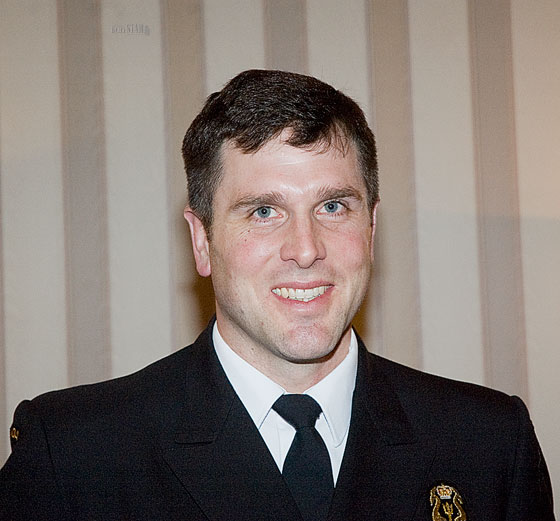
Lt.-Com. Angus Topshee, seen in Whitehorse, this week, says he never expected to encounter piracy while with the Canadian Navy.
Photo by Sarah Vanderwolf
Lt.-Com. Angus Topshee, seen in Whitehorse, this week, says he never expected to encounter piracy while with the Canadian Navy.
The executive officer of HMCS Toronto regaled Whitehorse Chamber of Commerce luncheon delegates Tuesday with accounts of piracy, terrorism, and humanitarian missions conducted during a five-month journey around the horn of Africa and through the Red Sea to the Mediterranean.
The executive officer of HMCS Toronto regaled Whitehorse Chamber of Commerce luncheon delegates Tuesday with accounts of piracy, terrorism, and humanitarian missions conducted during a five-month journey around the horn of Africa and through the Red Sea to the Mediterranean.
Lt.-Com. Angus Topshee, 36, is giving this presentation in many Canadian cities to raise the profile of the Canadian Navy.
"We don't do enough bragging about what we do," Topshee said in an interview following his presentation. "We're very keen to get the message out, (but) we can't send a ship to Whitehorse or Regina."
Topshee said he will be addressing audiences in cities such as Yellowknife, Edmonton, Kingston, Ont. and Ottawa during the tour.
HMCS Toronto circumnavigated Africa last fall while patrolling for piracy and fishing infractions, said Topshee.
"I never thought I would encounter piracy (while in the Navy)," said Topshee. "My only knowledge of piracy was of Johnny Depp and Pirates of the Caribbean."
But Topshee said he learned very quickly that 21st-century pirates are heavily-armed, modern criminal gangs who present a "real problem," particularly off the coast of Somalia.
Topshee said that modern pirates carry weapons such as rockets and machine guns.
"They're very determined," said Topshee. "We're very worried about the threat. Piracy is a real problem."
Topshee said cruise ships off the coast of east Africa are forced to take costly and time-consuming detours to avoid being hijacked by pirates.
Moreover, said Topshee, any military ships in the area must pay sky-high insurance rates because of the risk of piracy.
"If you're a Somali fisherman, you're a subsistence fisherman," said Topshee. "You're not making any profit. You're providing for your family."
Many Somali men who live in such impoverished conditions choose the more lucrative career path of piracy, making the practice difficult to stop, said Topshee.
"Somalia has to take charge of the coastline," said Topshee.
He said that while HMCS Toronto was patrolling these waters, there were no pirate attacks on vessels. In the weeks following their departure, said Topshee, four vessels were hijacked.
If provided with another mandate from the North Atlantic Treaty Organization (NATO), the Navy will return to the Somali coastline, said Topshee.
In October 2007, HMCS Toronto was travelling through the Red Sea when it rescued nearly two dozen military personnel who had jumped off an island to escape a volcanic eruption, Topshee told the Westmark Whitehorse Hotel audience.
The island was located between the coasts of Yemen (on the Arabian peninsula) and Eritrea (in east Africa). Volcanic ash rose 300 metres (1,000 feet) in the air after the eruption, said Topshee, and triggered a massive landslide.
HMCS Toronto rescued 21 military personnel and later rescued two more, one of whom had been in the water for 20 hours, said Topshee.
A combat camera crew on HMCS Toronto shot footage of the incident which was telecast around the world.
Still pictures of the island following the eruption showed an ashen waste land.
The volcanic eruption left the island looking "pretty devastated," said Topshee.
HMCS Toronto's next stop was the Mediterranean Sea, where it participated in Operation Active Endeavour (OAE), a NATO-endorsed operation intended to deter, defend, and disrupt terrorism in the eastern Mediterranean, particularly off the coasts of Syria and Lebanon, said Topshee.
HMCS Toronto ensured it had a "very overt presence" in the Mediterranean waters, said Topshee.
They made themselves highly-visible and questioned the crews aboard many vessels about their plans.
Topshee explained that HMCS Toronto then left the area, but not without first planting a submarine which they were then able to use to observe changes in behaviour in the area they had been patrolling.
"Ships have no idea they're being photographed," said Topshee.
Suspicious vessels are boarded and inspected in accordance with international law, he said.
While on patrol in the Mediterranean, HMCS Toronto boarded a vessel after it failed to respond to radio messaging. The vessel was also without a flag.
"A ship without a flag is like a car without a licence plate," said Topshee. "All ships must be registered."
There were 51 people aboard the ship, none of whom had any identification nor offered any reason for being on the water, said Topshee. The conditions on the ship were terrible, with no food, no radar, and no working radio.
The vessel was held up for several days, but the crew of HMCS Toronto eventually had to release it because they had no legal justification to delay it further. There were no weapons or evidence of terrorist activity on the ship, said Topshee.
But the ship is still being monitored and NATO has been notified of the incident, said Topshee.
"I think we really achieved a global effect," Topshee said of the eventful five-month mission, which he described as the most interesting of his career.
"The Navy protects Canadian interests here and abroad. We always bring Canadian culture with us wherever we go," said Topshee.
He said the Navy raised $6,000 during a Terry Fox run they organized while on the Seychelles islands, an archipelago north of Madagascar in the Indian Ocean.
"(The Terry Fox run) really resonated with them," said Topshee.
Topshee said he couldn't speak highly enough of having a career with the Navy, because the opportunities to travel and make a difference in the world are unparalleled.
He added that HMCS Toronto is "one of the most capable warships in the world." It will be undertaking a fisheries patrol off the coasts of Newfoundland later this year before heading north on an Arctic sovereignty mission near Iqaluit.
"If young people turn out anything like (Topshee), we're winning," said chamber president Rick Karp.
In order to encourage thoughtful and responsible discussion, website comments will not be visible until a moderator approves them. Please add comments judiciously and refrain from maligning any individual or institution. Read about our user comment and privacy policies.
Your name and email address are required before your comment is posted. Otherwise, your comment will not be posted.
Be the first to comment