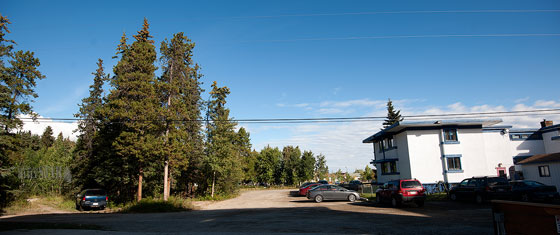
Photo by Vince Fedoroff
WORK PLANNED – The lots behind the Sarah Steele Building are to be examined for grave sites by the Yukon government.
Photo by Vince Fedoroff
WORK PLANNED – The lots behind the Sarah Steele Building are to be examined for grave sites by the Yukon government.
As the city prepares to hand five Steele Street lots back to the Yukon government, the territory is getting closer to investigating what is on the site.
As the city prepares to hand five Steele Street lots back to the Yukon government, the territory is getting closer to investigating what is on the site.
Last week, council approved first and second readings of the bylaw for the land transfer of lots 607 to 611.
Before the vote, members were informed by city staff that the Yukon government "has committed to identifying any potential grave sites and ensuring that, if graves are discovered, the contractors will take all due care to minimize damage and will take proper action, including immediate notification of the appropriate authorities.”
The government is seeking the land with plans to redevelop the Sarah Steele Building.
The land came to the city from the government in 2008 when it was identified as one of a number of areas that could be used for new homes.
"Prior to releasing these lots, it was determined that there may be historical, unmarked grave sites within the subject lots due to the proximity to the historic (Pioneer Cemetery),” Pat Ross noted in a report to council.
"In preparation for land disposition, the city undertook a ground-penetrating radar survey to determine if there were any unmarked graves.
"The survey found 12 ‘sites of interest' that could potentially be grave sites. Given the complexity of exhuming graves, the city focused efforts on residential intensification elsewhere.”
Ross pointed out that while it's possible the "sites of interest” could be graves, he said more work would have to be done to determine if that is, in fact, the case.
Christian Thomas, a development assessment archaeologist, said Wednesday his government department has applied for a permit to do some test excavations in the area to find out if there are graves.
It's anticipated a small back hoe will be used to dig down about five feet with shovels and other such tools going down another foot or so – with most graves being about six to eight feet below the ground – in the areas where the "sites of interest” were found in the radar work.
As he explained, the only way to be 100 per cent sure about what's beneath the surface is to dig into the ground.
It's expected that the work would be done "before the snow flies,” Thomas said.
With the permit process still happening, he noted, work would most likely be done over about a one-week period at the end of September or early October.
"That's as far as we've imagined it now,” he said when questioned about the process that would be followed should resting places be found.
It remains unknown what may happen on the site – if anything – should grave sites be unearthed.
"That's a decision-making process,” Thomas said.
There would have to be a discussion and consultation led by the property owner – whether it's the city or territory – before any decision is made.
When ancient graves were found on the site for the new sewage treatment plant in Dawson
City in late 2010, Thomas noted, the decision was made to move the burial spots to a proper cemetery.
In this case, though, the graves would be in a place that may have once been part of the Pioneer Cemetery.
Research is underway to see if the cemetery's boundaries may have been larger at one point.
It was in July that the government contacted the city about getting the three properties back in order to redevelop its Sarah Steele Building.
The land would be transferred for a $1 fee, the same amount the city acquired it for five years ago.
If the site is developed, road work would be needed, but the question of whether it would be the city or territory responsible for the upgrades is still being worked out.
"It is important to note that while the Steele Street right-of-way extends to the subject lots, the road surface west of Sixth Avenue has not yet been upgraded to city standards,” Ross said.
"While it has not been decided whether the city or Yukon government will be responsible for the road upgrades, discussions are ongoing.
"However, if the city were to retain this lot and release it to the private market, the city would either need to complete road upgrades or price the lots accordingly and require a private developer to do road upgrades.”
Third reading of the bylaw on the land transfer will come forward next month after council reconvenes from its summer break.
In order to encourage thoughtful and responsible discussion, website comments will not be visible until a moderator approves them. Please add comments judiciously and refrain from maligning any individual or institution. Read about our user comment and privacy policies.
Your name and email address are required before your comment is posted. Otherwise, your comment will not be posted.
Be the first to comment