Photo by Whitehorse Star
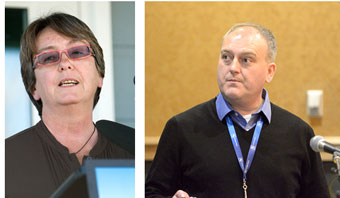
Claire Derome and Don Strickland
Photo by Whitehorse Star
Claire Derome and Don Strickland
Ten years ago, one could have fired a cannon ball through the Yukon Geoscience Forum and not hit anybody.
Ten years ago, one could have fired a cannon ball through the Yukon Geoscience Forum and not hit anybody.
The exploration industry in the territory was on life support. Not a single hardrock mine was operating.
The Town of Faro was for sale.
And gold was stagnant at $318 an ounce.
What a difference a decade makes.
It was standing room only Tuesday afternoon at the 40th annual Yukon Geoscience Forum when representatives of the Yukon's three producing mines presented their business plans and a commitment to long-term success in the territory.
Ten years ago, in the first nine months of 2002, the Yukon's wholesale sector generated $57 million in sales.
In the first nine months of this year, it turned over $121 million, representing a 117 per cent increase in the same period back in 2002, according to statistics from the Yukon Bureau of Statistics.
Yukon Zinc alone has spent $25 million in the Yukon so far this year just buying goods and services for its Wolverine Mine, Wolverine general manager Don Strickland told delegates attending the presentation.
Claire Derome, the executive director of the Producers Group, said expenditures by Yukon Zinc, Capstone Mining and its Minto Mine, and Alexco Resource for its operations in the Keno silver district, totalled 238 million last year.
It's expected to ring out at $349 million this year, and average $323 million annually for the next five years, Derome told the audience.
She said the number of employees at all three mines is hovering around 977, with a payroll of $63 million last year, and $75 million anticipated for this year. Of that, $31 million goes directly to Yukoners.
"On a go-forward basis, it will be in excess of 1,000 workers at all three mines,” Derome said.
Just as representatives of the three mines emphasized the importance of local training to increase the number of qualified Yukoners available, so did Derome.
"There is a big cost having workers who do not live here fly in and fly out,” she said. "The transportation cost for a non-Yukon employee is $1,310 a month.”
Monthly transportation costs to move Yukoners back and forth to the mine sites is $227, she pointed out.
Derome said the three companies spend about $9 million annually transporting non-Yukoners in and out.
That compares to just over $1 million for Yukoners, for a total transportation cost of $10.1 million.
"That amount is about 12 per cent of their payroll, and that is a significant cost,” she said. "We would be more than happy to have more people living here, working in the operations.”
Representatives of the three mines took turns explaining their mining operations, and future plans and efforts to expand local hire.
Strickland told the audience the Wolverine Mine completed an in-house heavy equipment course for six employees last year. They all graduated, and they're all still employed at the mine, he said.
Ron Light, general manager for the Minto Mine, pointed out in addition to the joint initiatives among the three producers to strengthen training opportunities, the Minto Mine is implementing its own course to train underground miners.
The program, he said, is 700 hours long. It's meant to provide locals with the basic skill set to work underground, as Minto prepares to begin underground production to augment its existing open pit operations.
As it is, of the 316 employees at the Minto Mine, just over half live in the Yukon, a quarter are of First Nations ancestry and just over 20 are members of the Selkirk First Nation, Light said.
To end Tuesday afternoon's presentation by the three mines, the Minto Mine's rescue team was called to the front. There, it was recognized for its second-place showing at a prestigious mine rescue competition in Yellowknife this past summer.
They were, as rescue co-ordinator Mark Goebel put it, competing with best of the best – world class rescue teams.
The representatives from all three companies said they're here for the long haul.
Yukon Zinc, said Strickland, is just now moving into full production, having completed construction at the site southeast of Ross River.
Jobs from here on are long-term, he said, pointing to the 10-year-old mine live at Wolverine, and the possibility of the company finding more deposits in the huge area it has staked in southeast Yukon.
Alexco's Brad Thrall said the company is already preparing to open up to more mines in the Keno silver district to add to the production already coming out of the Bellekeno mine.
The Keno district and its 100 years of history is truly part of the Canadian mining heritage as a silver producer, and Alexco wants to see that status maintained, in addition to its work cleaning up a century of environmental liability, he said.
"We can't continue with one single mine,” Thrall said of Alexco's plans to expand into two more ore bodies.
"The whole history of this district is several mines feeding one central mill, and that's the plan going forward.”
Thrall said there are constraints to increasing the amount of local hire from a the relatively small workforce in the Yukon, but the more local hire the larger the benefit to the company.
"Almost 50 per cent of our costs are for people,” he said.
Thrall said of the 122 Yukoners who do work for Alexco, most come from Whitehorse.
Of the 977 people employed at the three mines, Derome pointed out, 404 or 41 per cent are Yukoners. Of the 404, 142 are of First Nations ancestry, she said.
Derome said of the total workforce, the Yukon supplies 41 per cent of the employees, followed by 38 per cent coming out of British Columbia.
Newfoundland-Labrador provides 7.7 per cent, Ontario 5.7 per cent, New Brunswick 5.2 per cent and 4.9 per cent come from Alberta, she said.
See letter on Alexco's operations.
In order to encourage thoughtful and responsible discussion, website comments will not be visible until a moderator approves them. Please add comments judiciously and refrain from maligning any individual or institution. Read about our user comment and privacy policies.
Your name and email address are required before your comment is posted. Otherwise, your comment will not be posted.
Be the first to comment