Delegates brainstorm planned climate centre
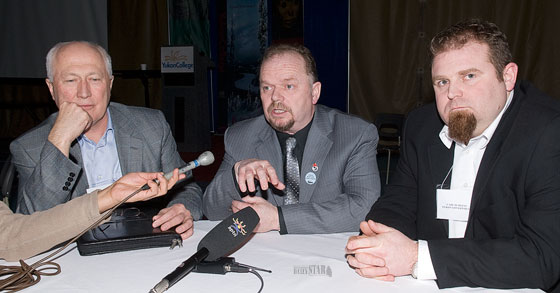
Another initiative to make the Yukon more attractive for research into climate change and what to do about it took a step toward fruition on Tuesday at Yukon College.
By Chuck Tobin on February 13, 2008
Another initiative to make the Yukon more attractive for research into climate change and what to do about it took a step toward fruition on Tuesday at Yukon College.
College president Terry Weninger said he hopes there will be enough concrete developments that a formal government funding request could be made as early as this summer.
Community Services Minister Glenn Hart, on the other hand, doesn't expect there'll be enough on paper to require funding prior to the spring 2009 territorial budget.
They do agree, however, that there is an opportunity and a need to build upon the Yukon government's desire to establish a northern research centre to focus on adaptation to climate change.
They also agree, the time is now.
Weninger said there were a lot of the right people at Tuesday's symposium. He described them as people who know what goes into the creation of research institutes because they built them before.
"We had a lot of good people in the room to help us firm up a concept," he said.
"We have some good people here, we had government, representatives of the Council of Yukon First Nations, from the college, people who are leading this project."
While Yukoners made up the large majority of participants in the symposium, there were academics from nine universities from across Canada.
Well-represented, for instance, was the research arm of the University of Calgary, which is working with Yukon College to establish a cold climate research initiative based at the college.
Whether the research centres will share the same roof, or how they might meld together, are questions still to be answered, Weninger said.
The focus of the research centre being advanced Tuesday will be compiling existing research, advancing new initiatives, all with an ultimate goal of guiding measures of adapting to climate change.
There are, for instance, numerous questions related to permafrost and its loss, from the impact on buildings to vegetation and subsequently wildlife, Weninger said.
"But also, how do we build on receding permafrost?"
Admittedly, Weninger acknowledged, research funding is always an issue. If a credible research institute comes from the early steps taken Tuesday, and Weninger believes it will come, there will always be ways to attract research money, he said.
Carl Burgess, project advisor with the Department of Environment, said developing an institute with a focus on guiding adaptation is knowledge-intensive, and will take time, though there is also awareness that there is some urgency to the issue.
There was general support yesterday for the direction the initiative is moving in, he said.
"We really do feel that addressing our questions will be contributing to similar questions across the country and the circumpolar North."
Chief Eddie Skookum of the Little-Salmon Carmacks First Nation welcomed Tuesday's participants by emphasizing the importance of aboriginal partnership in the research centre.
Aboriginal communities, he said, are already being affected by climate change, and they must be involved in the creation and operation of the research centre.
The commitment to a climate change research centre at the college was included in the Yukon Party's 2006 campaign promises.
When federal Liberal Leader Stephane Dion visited Whitehorse in December, he pledged financial support for the centre if his party forms the next government.
Comments (1)
Up 0 Down 0
Terry Halifax on Feb 14, 2008 at 4:39 am
Why would they put a climate change centre south of the Arctic Circle, with no access to sea ice?