Photo by Whitehorse Star
Dorothy Bradley
Photo by Whitehorse Star
Dorothy Bradley
With work on the city's next major subdivision of Whistle Bend already underway,
With work on the city's next major subdivision of Whistle Bend already underway, the Yukon Conservation Society's executive director is suggesting the city focus its efforts there instead of pondering another new subdivision near McIntyre Creek.
"That area is already impacted,” Karen Baltgailis said of Whistle Bend in an interview Wednesday afternoon.
Whitehorse residents have already given up "extremely popular” recreation sites in Whistle Bend's development, she noted.
Physical work has begun on phases one and two of Whistle Bend, with the first lots expected to be available in the fall of 2012.
The city only recently signed the agreement to begin planning work on phases three to five of the new subdivision.
Baltgailis said she would rather see work on that speed up than have it begin on the development of Porter Creek D.
Baltgailis was responding to a proposed $500,000 agreement between the city and Yukon government to begin planning for Porter Creek D, near McIntyre Creek.
Such agreements see the city do the planning work for a subdivision while the territory acts as the developer.
Council is set to vote on the agreement for Porter Creek D next week.
Baltgailis was quick to point out the long-standing opposition to the Porter Creek D development.
The area, between the Alaska Highway and Mountainview Drive, represents a heavily used recreational site and is important to education programs at Yukon College and area schools, she said.
Is the last major east-to-west wildlife corridor, she said, as she argued the development would "choke off” animals' movement.
Steep bluffs and other residential sites like Raven's Ridge also take their toll on how wildlife make their way through the area, Baltgailis pointed out.
"Wildlife movement is really constricted,” she said.
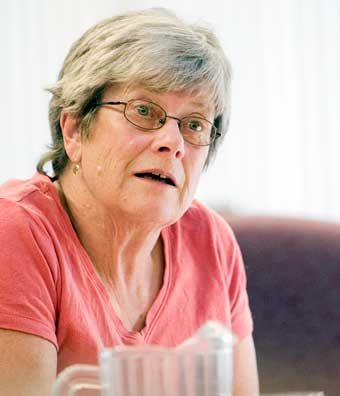
Dorothy Bradley, who heads up the Friends of McIntyre Creek group, also pointed to the impact on wildlife and in turn the impact that will have on residents.
"(Wildlife) have used the area for centuries,” she said, pointing to Anchorage as an example of what happens when you build in such areas.
There, it's not uncommon to see moose in city streets and at times in people's yards.
Another incident in a subdivision in Carcross saw a moose and her calf move into the area to get away from wolves.
Residents found themselves staying inside their homes often, not allowing their kids out to play as the moose protected her calf.
While the moose and calf eventually moved on, it took two weeks for them to do so.
"I can see us having that same kind of issue here,” Bradley said.
With Porter Creek D identified in the city's most recent Official Community Plan (OCP) as a "priority planning area”, city planning manager Mike Gau said officials will first have to look at the environmental and cultural issues.
That means the planning could take a phased approach, he told council at a council and senior management meeting Wednesday.
The priority planning would be the first step where concerns around such issues as the environmental impact could be looked at first.
The city, in consultation with the government, would then decide whether to continue with the project or end it there, Gau said.
If that is indeed the case, Baltgailis said, it would make the conservation society much more of a participant in consultation on the planning, though the group would be part of any consultation on it.
As she noted, it would show the city is at least listening to what residents have been saying.
While the city did take the step in the OCP of proposing a designated park area around McIntyre Creek, Baltgailis argued it would be inappropriate to stick a new subdivision so close to that.
Bradley noted the Friends of McIntyre Creek are also willing participants in any consultation done on Porter Creek D when it happens.
She believes, however, that once the environmental issues are looked at in more detail, it will show the area needs to remain as it is.
The group is also planning to explore exactly what wildlife uses the area and the animals' needs, with a workshop on that planned for Feb. 18.
At Wednesday's meeting, Gau noted the city would essentially be starting from scratch in its planning.
The city may use a 2005 design as a basis for the potential number of units the area could accommodate (about 400 lots at that time).
However, Gau stressed it's important for people to know so much has changed since then; it would essentially be a new project.
If it goes ahead, he said, the city would hand the project to the territory to take over development in 2012 at the earliest, with lot sales happening in 2014 at the earliest.
Council members, however, wondered about the city taking on the entire project, acting as the developer.
After Coun. Doug Graham pointed to the length of time it will take for the development to happen, he noted the city's and territory's land development protocol would allow for the city to do so.
The city has done smaller developments in recent years in Stan McCowan and Takhini North, and Gau commented the territory may be open to discussing it.
Questioned by Mayor Bev Buckway, Gau said the planning department would require no more than its current staff quotient for the planning of the area.
Engineering manager Wayne Tuck said his department would need another engineer, likely hiring a consultant for the role.
In an interview following Wednesday's meeting, Gau said it's up to council to decide whether it wants to move forward on the proposed agreement with the territory.
The arrangement would see the city recoup the costs of planning, with the territory acting as the developer or potentially take over the development.
If the city votes to accept the agreement Monday evening, then opts to look at doing the entire development, the agreement would be cancelled, Gau said.
In order to encourage thoughtful and responsible discussion, website comments will not be visible until a moderator approves them. Please add comments judiciously and refrain from maligning any individual or institution. Read about our user comment and privacy policies.
Your name and email address are required before your comment is posted. Otherwise, your comment will not be posted.
Comments (5)
Up 0 Down 0
brian on Feb 6, 2011 at 10:46 am
"Good planning involves an equitable and balanced distribution of housing throughout a community."
IF you can afford to buy a home in Whitehorse. This city really needs these lots and the COW is about 10 years too late. Seems like no one had a problem when Copper Ridge was developed and took away green space from those taxpayers.
Up 0 Down 0
DG on Feb 1, 2011 at 11:03 am
As a young adult I commend the city for improving on the housing lot shortage. I live near where much of the proposed development is expected to occur and also have no problems with development. I like the idea that I will be able to afford a house in my lifetime.
Up 0 Down 0
Stella on Jan 31, 2011 at 10:15 am
I live in PC and have no problem with the proposed developments.
Up 0 Down 0
YouMeUs on Jan 31, 2011 at 2:04 am
Good planning involves an equitable and balanced distribution of housing throughout a community. The way it is going now, development impacts and loss of green/rec space are going to be burdened by PC residents alone. PC'ers should be very concerned that the bulk of the new and proposed residential development in this city (Whistlebend, Porter Creek D, and 4 of 5 new infill areas) are in PC. It makes little sense to tilt the scales so much to one end of the city- esp. to a bedroom community/suburb that relies predominately on car commuting.
Up 0 Down 0
Yukoner on Jan 28, 2011 at 11:50 am
This will be an ideal housing development. Great location, as long as it isn't too big of a development. But there is enough room for housing and green space. You could develop half that area and there will still be miles and miles of trails and tons of green space in that area. How much do we need. If the need and want is there for lots and the ability to build, I don't see a reason this area shouldn't be developed. It's not 1980 anymore.