Photo by Vince Fedoroff
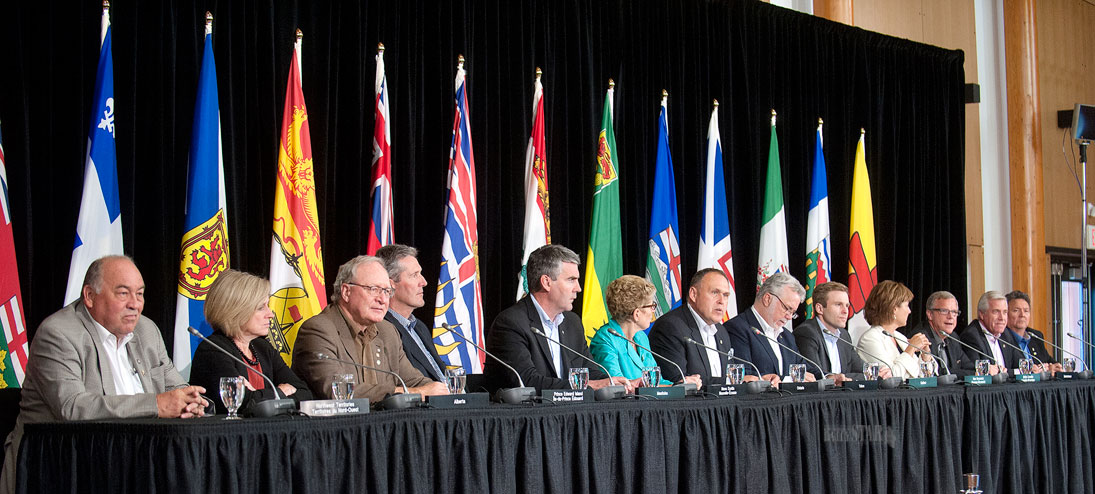
SUMMING UP THE ACCOMPLISHMENTS – Premier Darrell Pasloski is centred by six premiers on each side of him as the provincial and territorial leaders meet with reporters Friday afternoon in Whitehorse.
Photo by Vince Fedoroff
SUMMING UP THE ACCOMPLISHMENTS – Premier Darrell Pasloski is centred by six premiers on each side of him as the provincial and territorial leaders meet with reporters Friday afternoon in Whitehorse.
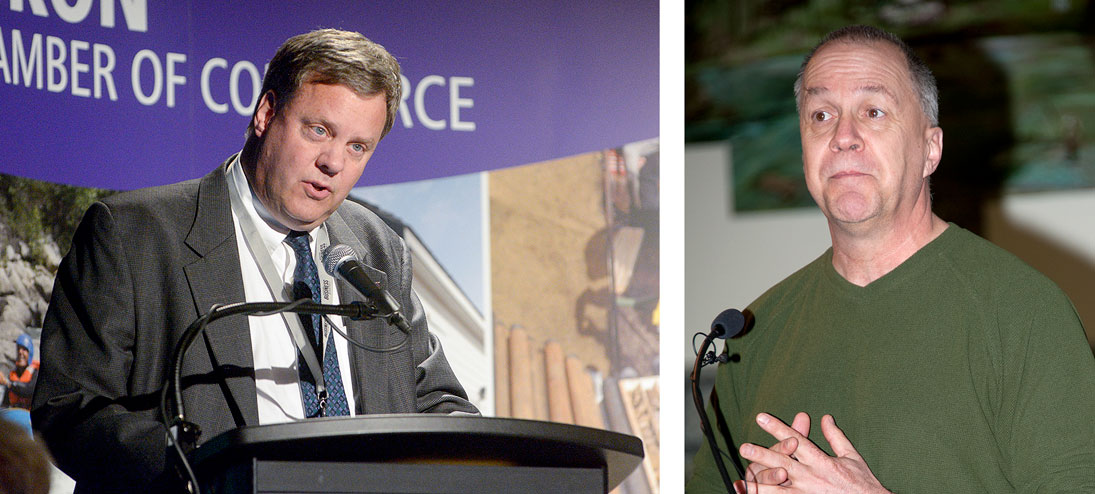
Photo by Whitehorse Star
Peter Turner and Bob Baxter
The Yukon Chamber of Commerce is “cautiously optimistic” about a new free trade agreement reached by the Canadian premiers on Friday.
The Yukon Chamber of Commerce is “cautiously optimistic” about a new free trade agreement reached by the Canadian premiers on Friday.
The pact will work to eliminate most barriers to the movement of goods, people, investments and services throughout the provinces and territories.
Peter Turner, the chamber’s president, said the reduction or removal of barriers for trading alcoholic beverages across provincial and territorial borders could work out “quite nicely” for Yukon Brewing.
However, there are still concerns about the Yukon losing out on bids for major public construction projects in the territory, and elsewhere in the North.
“We continue to have concerns about big companies from Alberta getting the RFPs (Requests for Proposals) for places like F.H. Collins (Secondary School) and major construction projects,” he said.
Recently, he added, an Alberta company (Parsons Corp.) was awarded the contract to clean up the abandoned Faro mine site.
On Friday, the last day of Council of the Federation meetings in Whitehorse, the 13 provincial and territorial leaders reached an agreement in principle on a Canadian Free Trade Agreement (CFTA), that will replace the more than two-decades-old Agreement on Internal Trade.
Specifics of the CFTA are sealed. Further negotiations are needed on the more contentious aspects, like the buying and selling of alcoholic beverages, before it is finalized by all the provinces, territories and the federal government.
The ratification date is to be determined.
What is clear is that the deal is broad in scope and, as Yukon Premier and Council of the Federation chair Darrell Pasloski said, it will cover virtually the entire Canadian economy.
“We need to make sure that trading within our jurisdictions, between our jurisdictions, can’t be worse or more difficult than it is with free trade agreements with other countries,” Pasloski said at the summit’s closing press conference on Friday afternoon.
He said CFTA achieves this by using a “negative list” approach.
That means all goods, services and sectors are covered under the agreement except under special circumstances where there is a specific exemption.
This latter point is important to the Yukon, which is not traditionally an export economy and where local businesses count on government contracts.
In recognition of the smaller economies in the territories, the old deal included special concessions to protect northern businesses.
In the Yukon, for example, the Business Incentive Program offers rebates to government-hired contractors who employ local workers and/or use products made in the Yukon.
Pasloski said the new agreement offers the Yukon the same protections that it had under the old one, including the continuation of the Business Incentive Program.
Right now, Turner said, the Yukon is at a disadvantaged position when it comes to local companies doing business in other jurisdictions.
Northwest Territories and Nunavut have stricter regulations than the Yukon does on outsiders who want to do business in those territories.
British Columbia, Alberta and Saskatchewan have had their own internal trade agreement – the New West Partnership Trade Agreement – since 2010.
“We’ve been a relatively free-trade territory being surrounded by somewhat more protectionist territories and western provinces,” he said.
N.W.T. has its own Business Incentive Program that is more stringent than the Yukon’s. It offers a favourable bid adjustment of 15 per cent for local companies on the first million dollars of a contract.
“If a Whitehorse company and Yellowknife company bid on the same project, the Yellowknife project would get a 15 per cent benefit, so that would make them the lowest bidder,” explained Drew Williams, a spokesperson for the N.W.T. Department of Industry, Tourism and Investment.
In order to take advantage of that benefit, a company must have an office in N.W.T. and be majority owned by an N.W.T. resident.
Turner noted that N.W.T. also places special value on local knowledge.
“A local construction company would know that you don’t pour concrete in January,” he said, by way of example.
“If that’s an element of future RFPs, that might level the playing field a bit more for local businesses.”
Turner said procurement can be done to recognize the specialized knowledge of Yukon companies.
What the new free-trade deal will mean for the Yukon’s craft brewers has yet to be seen.
There was much debate surrounding the buying and selling of alcoholic beverages leading up to the premiers’ summit in Whitehorse, the first ever held in a territory.
Alberta recently added a surcharge of $1.25 per litre of beer sold while offering grants to local brewers to offset the burden related to a decrease in sales.
Saskatchewan Premier Brad Wall railed against this move as contrary to the ethos of inter-provincial free trade.
The premiers agreed last week to establish a working group on alcoholic beverages with the hope that beer, wine and spirits can somehow be included in the CFTA.
Indeed on Friday, Quebec, Ontario and B.C. announced their own deal by which their residents will have greater access to wine from any of those provinces through online purchasing.
Bob Baxter, the owner of Yukon Brewing, said today there needs to be a “change in attitude” when it comes to stocking Canadian craft beers at liquor stores across the country.
He said there is a movement, especially among younger consumers, to buy from small, local producers.
Current systems for buying and selling alcohol vary from jurisdiction to jurisdiction and each has its own idiosyncracies, he said.
Baxter suggested that the provinces and territories agree to “create the space within the system that they already run to showcase beer from across canada, even if it’s on a rotational basis.”
See commentary.
In order to encourage thoughtful and responsible discussion, website comments will not be visible until a moderator approves them. Please add comments judiciously and refrain from maligning any individual or institution. Read about our user comment and privacy policies.
Your name and email address are required before your comment is posted. Otherwise, your comment will not be posted.
Comments (6)
Up 2 Down 1
Max Mack on Jul 29, 2016 at 2:36 pm
“A local construction company would know that you don’t pour concrete in January,”
I've worked plenty of construction jobs in the Yukon where concrete was poured in January. In fact, it seemed to me that concrete pours were more likely to have occurred in cold months than warm months.
Up 5 Down 0
Ol' Dosey on Jul 27, 2016 at 7:25 pm
The main benefit for the Yukon concerning these CFTAs is that the meetings were held here. And yes we do pour concrete here in January. I've seen it done - it's called " get her done " and one company that does such is doing very well here.
Up 4 Down 3
ProScience Greenie on Jul 26, 2016 at 6:45 am
Guessing the end result will be that we will see the price of beer go up because it never ever goes down.
Up 10 Down 3
June Jackson on Jul 25, 2016 at 9:55 pm
“If a Whitehorse company and Yellowknife company bid on the same project, the Yellowknife project would get a 15 per cent benefit, so that would make them the lowest bidder,” explained Drew Williams, a spokesperson for the N.W.T. Department of Industry, Tourism and Investment."
I fail to see a good deal for the Yukon in this. However, if Pasloski doesn't talk our way out of it, our beers could possibly do well.
The first candidate to say YUKON FIRST will get my vote in the next election.
Up 9 Down 2
Simple Man on Jul 25, 2016 at 7:14 pm
Sad to consider that we need to eliminate something that should never have existed to start with, sadder still that money gets squandered in such a manner.
Up 4 Down 4
Martin on Jul 25, 2016 at 4:39 pm
We must support free competition and this should and welcome news for all minded conservatives. Project's price will be cheaper and Yukon Co.s more efficient; now if we can get YTG's Departments to operate the same way.