Photo by Dan Davidson
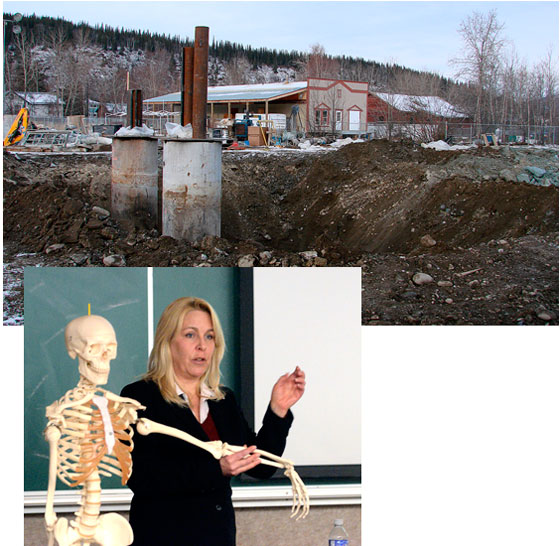
OPEN GRAVE – The bodies of four executed prisoners were found at an excavation site off of Dawson City's Fifth Avenue in 2010 (top). Susan Moorhead Mooney,
Photo by Dan Davidson
OPEN GRAVE – The bodies of four executed prisoners were found at an excavation site off of Dawson City's Fifth Avenue in 2010 (top). Susan Moorhead Mooney,
Two years ago, four bodies were found at an excavation site in Dawson City.
Two years ago, four bodies were found at an excavation site in Dawson City.
The resulting investigation saw local researchers digging through piles of human remains and historical documents, unearthing the stories of four Yukoners, long buried beneath the soil.
On Tuesday afternoon, Susan Moorhead Mooney, osteologist for the project, explained to a group of students at Yukon College the unique methods they used to identified and eventually rebury the four bodies.
On Nov. 4, 2010, a partial human skeleton was discovered about 2.7 metres underground by construction workers digging a foundation for the community's new secondary sewage treatment facility just off Fifth Avenue.
Construction was halted immediately. The RCMP, the City of Dawson, Tr'ondëk Hwëch'in, and Department of Highways and Public Works were contacted.
A truck, which had already left the property, was flagged down, human bones mixed into its load of soil and rock.
By the end of the day, two bodies had been identified.
The following day, another partial skeleton was found, and another on Nov. 15, all at the same depth: two in caskets, all with clothing fragments clinging to their bones.
Four bodies were found in total.
A team was assembled to determine their identities.
If bodies are determined to be older than 50 years, they become the responsibility of the Yukon Heritage Authority.
There is also a special caveat for First Nations to take part in the investigations if the body is found on their traditional territory.
A project, which included the heritage authority, Tr'ondëk Hwëch'in, the RCMP and the developer began within days, taking on the grim task of combing what some would jokingly refer to as the "pit of despair.”
It was over two weeks before they gave up looking.
The crew began sifting through mounds of soil, locating pieces of bones, wood from the coffins and cataloguing them, with the labels, burial A, B, C and D.
The next step was identifying who they were.
During the 1890s, the site where the bodies were located was called Fort Herchmer, a Northwest Mounted Police palisade.
The team was fairly certain that the bodies they had found were the remains of executed prisoners, buried alongside an old drainage slough, which once ran alongside the fort.
Anticipating the coming Gold Rush, police were brought to the Klondike from Fortymile and other regional settlements to police the community and curtail the type of frontier lawlessness they had seen in other Gold Rush communities.
"They were anticipating the kind of violence they had seen in the California gold fields, or Deadwood, South Dakota,” said Mooney.
Dawson, among the coldest, darkest and most remote of all, in the end, proved to be much tamer.
In the years between 1899 and 1932, just 13 people were hung in the entire Yukon Territory.
Two of those hangings occurred on Herschel Island, one in Whitehorse and the remaining ten in Dawson City.
The process was fairly uniform.
Prisoners were led to a standardized gallows, with specific height and design specifications. A hood was placed over their heads, their hands and feet were bound, so they would drop straight down. A noose was tied around their neck, the lever was pulled, they fell.
When they were buried, they were placed in a casket, covered with a highly corrosive quicklime and water solution to speed decomposition, then the lid was nailed shut and they were buried.
It was an effective system.
Four had been unearthed, and had to be identified and researchers had little to build on.
With century-old bones and a list of prisoner names in tow, researchers began work to determine the true identities of burials A, B, C, and D.
Osteologists – researchers who study bones and teeth – had an idea who each body may have been from the get go, but refused to let their preconceptions guide them.
"Bones tell our story,” said Mooney. "If we let them tell it, we'll find out more than we expect.”
The initial observation yielded little.
Burials A and B had been mixed together in many pieces. Burials C and D were separate, C still in its casket, and D cut in half, partially washed down the slough.
All the bodies were male and, in addition to the hoods on their heads, all were wearing wool undergarments and had leather bindings below and above their knees.
The first step was to determine a basic profile.
A and B were about the same size. One was a full adult, the other, as indicated by separations in the plates of his skull, was a youth. One body had light brown hair, the other black.
Researchers were able to determine that burial A was in his late 30s, while burial B was in his early 20s.
One step closer.
Body C was harder to determine. In his case, the bones just didn't match up. His teeth had been more developed than the skull, which led to some initial confusion. He was probably in his late teens though.
With advanced "bone-on-bone” arthritis, it was determined that burial D was over 50 years old when he died.
The next step was to determine ancestry.
In the Yukon, ancestry is vital to establishing whether a body should be buried locally, or in the case of First Nations, to be returned to its ancestral community for a culturally appropriate burial.
This is where the real Hollywood-style stuff came into play.
"Burial A had very interesting dental work,” said Mooney.
The body had a gold bridge, between the canine and molar. He also had dark staining on his teeth, indicating tobacco use. With access to good dentistry and a frequent supply of tobacco, he was probably from a city, and new to the Klondike when he was executed, Moorhead told her audience.
A ridge in his nose and the shape of his eye sockets indicated he was also probably Caucasian.
The shape of the jaw on burial B and a molar, which had erupted early were both indications that he was of First Nations ancestry.
He also had evidence of deep pitting on some of his bones, likely from infection.
Burial D was only available from the waist down. His legs, however, indicated that he had been short, about 5 feet, 4 inches, with powerful legs that would indicate heavy lifting. He was probably overweight.
Burial C was still a mystery, but his molars too indicated that he was likely young and First Nations. He also had a bad dental disease.
After comparing the information gathered by the osteologists with the historical execution records, the bodies were identified.
Burial A was thought to be Edward Henderson.
Henderson had come to the Yukon from the United States to find his fortune on the Trail of '98.
He arrived in the Klondike with a small group of prospectors, carrying the heavy burden of his gear, as well as a severe tumor or infection, which caused him to urinate frequently and painfully.
He carried with him a small tin cup, which he would fill throughout the nights in his tent. His fellow travellers teased him mercilessly and one night Henderson knocked over his pee cup while sleeping, spilling it all over a companion, who, after waking, struck him repeatedly. Henderson reached for his pistol and shot his companion down.
"Doctors were consulted and said it wasn't self-defence, and he was hung,” said Moorhead.
Burials B and C were probably Jim and Dawson Nantuck, two of four brothers from the Carcross-Tagish First Nation who shot two prospectors on the M'Clintock River in southern Yukon.
The ages of the young men matched, one 13, the other in his early 20s.
The researchers knew anecdotally, that two of the four had died of tuberculosis and scurvy, while being transported to Dawson City, which would also explain the condition of the teeth in burial C, evidence of scurvy, and the signs of infection in burial B.
The boys were hung and buried far from home.
Burial D was almost certainly Alexander King, a well-known gold prospector.
King shot a man after he repeatedly crashed their makeshift boat against the rocks of an Alaskan river, shouting, "you've bumbuzzled this enough!” before firing a lethal round into the man's back.
He was hanged soon after returning to the Klondike.
On June 11, 2011, the bodies were buried in the Dawson City cemetery.
Two years later, Moorhead reflects on the process:
"A lot of what we usually see are small parts of bones, nothing which can be historically relocated,” she says. "This time we were lucky that we were able to identify all four bodies and rebury them.”
In 2010, Parks Canada estimated that there could be several more bodies buried at the site.
In order to encourage thoughtful and responsible discussion, website comments will not be visible until a moderator approves them. Please add comments judiciously and refrain from maligning any individual or institution. Read about our user comment and privacy policies.
Your name and email address are required before your comment is posted. Otherwise, your comment will not be posted.
Comments (1)
Up 0 Down 0
Dan Davidson on Mar 5, 2012 at 8:27 am
Actually, this all happened about 16 months ago, not two years. It'll be two years this coming November.