Danger, exhilaration marked Greenland trek
After traversing Greenland from the southern to the northern tip on kite skis, a Whitehorse man is not calling the experience an adventure.
By Elizabeth Hames on August 14, 2009
After traversing Greenland from the southern to the northern tip on kite skis, a Whitehorse man is not calling the experience an adventure.
"There's sort of a saying, an adventure is a poorly planned expedition, and this was a good expedition," Devon McDiarmid said outside of the Icycle bike shop on Tuesday.
"It was a good expedition with hints of adventures," he told the Star.
In May, McDiarmid, along with Whitehorse's Derek Crowe and British adventurer Adrian Hayes, embarked on their Emirates NDB Greenland Quest.
They documented their day-to-day quest and kept in touch with the rest of the world through a PDA, a satellite phone and their website, www.greenlandquest.com.
By the time they completed the trip, the team had travelled more than 4,000 kilometres in 67 days, crossing a landscape few had ever seen.
"It was an epic trip. It was so far and so long," said Crowe.
"It really opened my eyes to what is possible."
The quest began on the south coast, when the general feeling amongst the crew was excitement.
"The first day was such a great day in that leaving this little town called Narsaq at the southern tip of Greenland, we got on an old Danish fishing boat with two local Inuit guys.
"Just the boat ride in through all these icebergs and down these massive fjords, just the three of us and all of our gear, it totally felt like the start of an expedition," said McDiarmid.
From there, the trio travelled nearly 3,000 kilometres to the northernmost tip of the country, where they awed at the vibrant crimson rocks of J.P. Cocks fjord, a sight only a handful of people have witnessed firsthand, said McDiarmid.
The team was caught in a whiteout that day, but as they approached the coast, the clouds turned into mountains, "and pretty soon we could see this magical fjord," said Crowe.
The day at the northern fjord was "pretty much burned into my mind,' said McDiarmid.
"That was spectacular."
After reaching the Arctic coast, they headed southwest to the nearest community, where they caught a flight to Denmark before heading their separate ways.
This type of voyage is nothing new to McDiarmid. For the past seven or eight years, he has made frequent ski trips to the South Pole.
It was during one of those South Pole expeditions that Hayes and McDiarmid developed the idea for the Greenland Quest.
They began talking about skiing east to west across the country and "it kind of blossomed from there," said McDiarmid.
"We started looking at expeditions that happened on Greenland and realized very few, only a couple of people, had ever gone from true south to true north. So we thought that'd be cool."
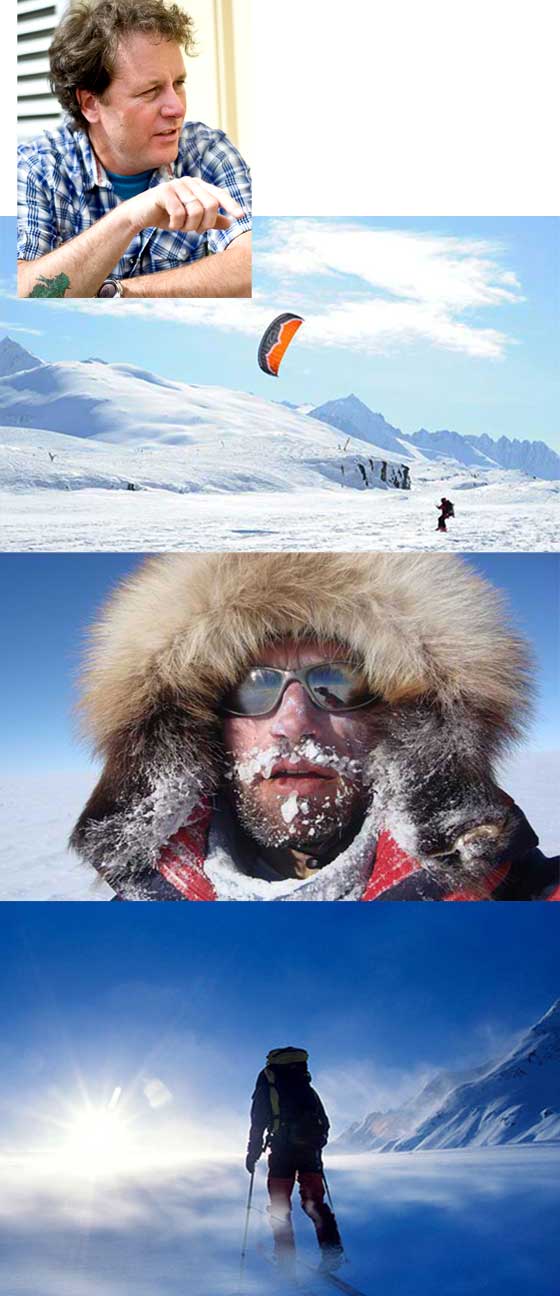
Unlike his other trips, McDiarmid crossed Greenland on kite skis. Most of inland Greenland is covered with a mammoth glacier, two kilometres thick of solid ice and snow. Because the surface is flat and smooth, kite skiing was the obvious mode of transportation.
Using the kite allows the skier to capture the power of the wind and propel themselves toward their destination. McDiarmid said they would not have been able to travel such a distance, while trailing behind them 130-kilogram sleds, if they had not had the help of the kites.
Although the kites were an aid along the way, McDiarmid had never kite skied with heavy sleds before, nor had he skied with a kite for such a long period of time, so he and the team were faced with some unfamiliar obstacles.
McDiarmid said the wind was one of the greatest difficulties.
"It's just like sailing, so if the wind's in the wrong direction you either have to wait or you have to try and tack and work your way up the wind. In some cases, we would actually ski, just walk into the wind."
But even with a favourable wind, the team was confronted with challenges.
Hard times came with the ascent and descent into the rocky fjords at the finish.
As the team pulled their sleds over a field of boulders during their last 10 kilometres, they questioned whether they would sentence their enemies to the experience, said Crowe.
"It was one of those things you would never do unless you absolutely had to," he said.
After leaving JP Cocks fjord on day 47 of the quest, ominous weather conditions hinted at the difficulties of the 20 days to come.
In the day 49 entry of their online blog, Hayes writes: "Snow was becoming soggy and deep and water was collecting everywhere."
McDiarmid fell into a slot in the snow and Crowe did the same a while later.
"You're just walking along and it's just poof! right through," said Crowe
"We had this uncanny feeling that the universe, or maybe old JP Cocks himself, was telling us ‘You've seen this small piece of frozen paradise and witnessed what's happening to it. Thank you, now it's time to leave,'" wrote Hayes.
During a whiteout the following day, McDiarmid was leading the team when he spotted something unusual about 20 metres ahead.
The snow was blowing around and around, and drifting down into a hole in the ground, causing a shadow on the surface.
"I knew that that shouldn't be there because, as far as I could tell, the ground was flat. So I stopped, stopped the team, and sure enough, it was a huge cravass," said McDiarmid.
Although they had rope and cravasse rescue gear, McDiarmid said that if one of them had fallen in, it would have been impossible for the others to rescue that person.
When the team peered down into the pit, it looked to be about four metres wide and a kilometre deep with a "raging river" carving its way through the ice at the bottom, McDiarmid said.
"A small house would have fit inside of it. It was massive."
Reinforcing the sense of danger, McDiarmid fell into another cravasse the following morning.
"I was able to get myself out, but it was a scary experience," he said.
McDiarmid said that, aside from a few encounters with crevasses, most of their experiences were expected, but they were surpassed when they were greeted by a local Inuit hunter, on the last day of their trip.
In talking with the hunter, the team gained valuable information about climate change.
"He would tell us about how even five years ago, that particular glacier that we just travelled down, how big it was," said McDiarmid.
"He was in a bay hunting seal, but there were no seals because it was too warm. It was the warmest summer that he'd ever remembered."
One goal of the quest was to raise awareness about climate change and sustainability, because Greenland is a "hot spot" for that topic right now, said McDiarmid.
"It's a lot of energy, it's a lot of time, money to do something like this just for yourself," said McDiarmid.
"With the way expeditions are going, with so many people wanting to watch and the Internet the way it is and digital photos, it just ends up lending itself to being such a great medium for raising awareness."
The team took samples from the snow and ice, and they took note of the local ivory gulls, a species of bird with a declining population.
McDiarmid said the samples they gathered will be valuable to scientists because it will be a long time before anyone does what the Greenland Quest team dared to do.
"They'll do something like it, but I don't think our route will get followed. If I knew it would be that hard I'm wondering if we would do it."
Crowe said he is pleased to be back in the territory, and has no plans for future expeditions. He said he is enjoying the comforts of a city, and not having to ration his food.
"We've really got it good," he said about Whitehorse residents.
McDiarmid also said he is glad to be home in Whitehorse, working at Icycle, although he missed most of the busy summer season.
Only days after shaving off more than two months' worth of beard growth, McDiarmid is already talking about plans for future expeditions.
Unlike his polar voyages, McDiarmid predicts the next trip will be hot and dry.
"I've only ever gone north and south, and I'd like to go somewhere totally different and kind of shake it up a bit. So the desert one might be the next one," he said.
"You get the remoteness, the uniqueness, the hardship of it. But part of it is I've never been there and it's kind of nice just to do things that make you uncomfortable."
McDiarmid said he continues to embark on these out of the ordinary trips because he loves the simplicity of the day-to-day life, the physical work, the challenges, the elements and the people.
"And I like how when I come back I feel much more clear about life and what's actually important and what's really not important," said McDiarmid.
"And I find today, there's so much crap that goes on and so much silly stuff that's really pointless and useless, and it kind of clears my head of that. So it's kind of one of the by-products of these trips, but I've ended up kind of getting addicted to that part of it too."
Comments (1)
Up 0 Down 0
Norval M Rhodes on Aug 20, 2009 at 10:43 am
Welcome Home Devon.
Erika and I have been following you all the way on yor Expedition, and giving us such pleasure. I'm really proud of you,and your 2 friends.
You are all in such excellent health, and physically fit.You set a wonderful example for the youth of today, and I hope that they will benefit from hearing about you as a roll model.
Good Friends are forever, and hope I'll see you in the future sometime soon
Much love and Hugs
Norval.