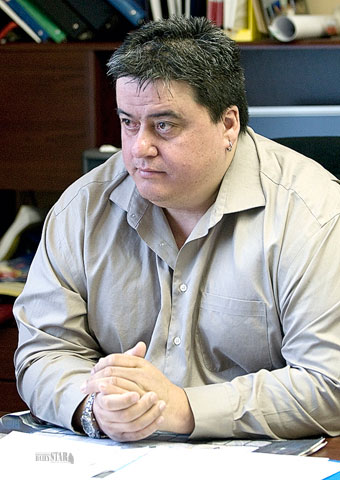
Photo by Vince Fedoroff
Andy Carvill, grand chief of the Council of Yukon First Nations, believes member first nations will emerge strong and unified from this year's general assembly.
Photo by Vince Fedoroff
Andy Carvill, grand chief of the Council of Yukon First Nations, believes member first nations will emerge strong and unified from this year's general assembly.
With 2008 come changing times for the Council of Yukon First Nations (CYFN), which is asking first nation members key questions, including whether the council is even necessary anymore.
With 2008 come changing times for the Council of Yukon First Nations (CYFN), which is asking first nation members key questions, including whether the council is even necessary anymore.
The CYFN, headed by Grand Chief Andy Carvill of the Carcross/Tagish First Nation, was founded primarily to assist Yukon first nations to settle their land claims. This role is largely fulfilled now for 10 of the 11 Yukon first nations that belong to CYFN, from a total of 14 Yukon first nations.
Those 10 have signed land claim agreements, and now work toward their implementation, with the help of the CYFN lobbying Ottawa for
requisite funding.
Indeed, Carvill said he and a group of chiefs will soon be travelling with Premier Dennis Fentie to Ottawa to meet with Indian and Northern Affairs Minister Chuck Strahl to discuss issues brought up at earlier tripartite meetings, including implementation.
Carvill said he also hopes to meet with Treasury Board President Vic Toews, Finance Minister Jim Flaherty and Auditor-General Sheila Fraser.
"I'd like to keep her informed and I'd be open to hear her opinion on implementation, or lack of implementation," he said of Fraser.
Before the Ottawa visit, however, Carvill will be armed with comments and questions from the CYFN leadership.
The council had planned its first leadership board meeting of 2008 this week, where chiefs were to begin discussing what kind of changes will affect the current CYFN structure. The cold spell has postponed the gathering.
"We're going to come out of this a very powerful first nation group," Carvill said about the meeting in an interview last week.
The change he refers to is an overall restructuring for the CYFN. The change was planned in 2007, but 2008 is bringing action.
Already, Carvill said, surveys have been completed with Yukon first nations to determine what sort of role members think the council should play.
"We've asked whether they think it's time for us to close the doors on CYFN," he said. "There is a need for us, that much is clear from the results we've seen."
He said two surveys are being studied. One survey, comprising 23 questions, was given out and filled out at the CYFN meetings in the first nation communities. A second, more intensive 436-question survey was left behind for members to fill out and mail in.
"We'll pull that information together and move forward with the general assembly," he said.
This assembly, which is slated to happen before spring, will be the forum at which first nation leaders and executive members will meet to discuss what the CYFN will look like and what role it will fulfill.
"We're going to come out a much stronger, unified body," he said.
Carvill said the CYFN will likely be concerned with moving first nation issues ahead, and working with other governments and agencies to promote such concerns.
"There are issues, such as poverty, homelessness, drugs...we've got to start working together," he said.
"We can't just be the Yukon government looking at these things. If we work together, we'll see results more expeditiously."
Carvill said last year as well that the CYFN would begin addressing more of these social issues that concern many first nations.
Its justice, health and social development departments are currently working to set up programming that Carvill said will be more pro-active than reactive.
"One thing I'm excited about is the mentorship program," he said. The program will see youth get on-the-job training, better preparing them for a career and a contributive role in their community.
"It's important that they know there are people that care about their well-being and their future," he said.
Carvill also described more youth-elder connections being fostered through programming, so youth will retain and appreciate the skills needed to live off the land, such as harvesting moose and smoking meat.
Once the leadership has decided on a firm course of action to take, Carvill said more health, justice and social programming will be enacted to meet the needs identified by members.
At the top of the CYFN's to-do list, however, is arranging for the council to be headquartered out of a new building. Its current office building on Nisutlin Drive is supposed to be turned over to the Kwanlin Dun First Nation in August of this year but Carvill said they may need more time.
"I hope by next spring to be moving into a new building," he said.
The CYFN has requested a lease extension from the federal government, which must grant Kwanlin Dun permission to give the extension.
He said they are looking at hiring contractors to build them a brand-new building that may share space with other business and organizations as tenants.
Restructuring the CYFN is a big task for its leadership, which has no similar organizations on which they can model themselves.
"We're in a unique situation here with our first nation governments," he said.
They have the ability to legislate just like the Yukon government for their communities.
Here in Whitehorse, territorial administration must include local first nation governments Kwanlin Dun and Ta'an Kwach'an, in discussions about issues such as land use, justice and health-any matter that would affect its land claim settlement or its citizens.
The Ta'an Kwach'an Council is a member of the CYFN, while Kwanlin Dun is run independently.
At a retrospective and prospective time of year, January moved fast for the CYFN, which, by year's end, will likely be a dramatically different organization.
In order to encourage thoughtful and responsible discussion, website comments will not be visible until a moderator approves them. Please add comments judiciously and refrain from maligning any individual or institution. Read about our user comment and privacy policies.
Your name and email address are required before your comment is posted. Otherwise, your comment will not be posted.
Be the first to comment