Photo by Vince Fedoroff
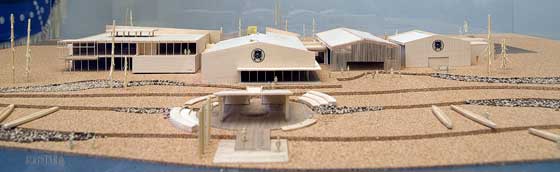
LOOKING AT THE FUTURE - This model displays the Kwanlin Dun First Nation's cultural centre it plans to build on the Whitehorse waterfront. Included in the centre is a new Whitehorse Public Library.
Photo by Vince Fedoroff
LOOKING AT THE FUTURE - This model displays the Kwanlin Dun First Nation's cultural centre it plans to build on the Whitehorse waterfront. Included in the centre is a new Whitehorse Public Library.
The Kwanlin Dun Cultural Centre set to be built on Whitehorse's waterfront could house the Whitehorse Public Library.
The Kwanlin Dun Cultural Centre set to be built on Whitehorse's waterfront could house the Whitehorse Public Library.
A model of the structure and plans show a multi-purpose longhouse, another longhouse that would accommodate 1,200 people, a main gallery, and Kwanlin Dun First Nation archive space.
It will also provide space for artists, a gift shop and meeting space for elders along with the new library, among several other features.
"Pretty much, the (Yukon) government approached us and said if we put a public library in this, the building itself, that they would pretty much give us a 40- to a 70-year lease," Kwanlin Coun. Ray Webb said at the first nation's administration building this morning. "So that, pretty much, is going to start paying for it itself."
The 1,775-square-metre library would sit at the end of the centre "behind a rammed earth wall reminiscent of the escarpments surrounding Whitehorse."
Ray Santa, the first nation's economic development director, said the lease for the library would mean having the anchor tenant in the structure the first nation needs to make the building viable in funding capital and operational costs.
"We think it's a very good fit," he said.
Pat Molloy, the territory's acting assistant deputy minister of the community development division, was out of the office and couldn't be reached for comment on the plans for the library by press time this afternoon.
As well, cabinet officials did not return several requests for an interview on the issue.
The current library was expanded in the early 1990s after the Yukon Archives, which had occupied the library building's north end, were moved to Yukon College.
Next to the library would be the 206.5-square-metre archive space for the first nation, with the first 658-square-metre longhouse being next to that and in the middle of the structure.
That longhouse would be closer to the Yukon River than other portions of the building with a fire pit area outside its doors.
On the other side of the space, closer to First Avenue and the trolley line would be the building's entrance with visitors coming into a main lobby and reception area. The gift shop and the elders' meeting room would be off to the sides of the lobby.
The other side of the centre would feature a 59-square-metre cafeteria, 95.7-square-metre artists area where visitors can see them working and a 233-square-metre multipurpose longhouse.
Connecting the different sections of the building will be a hallway.
"When you're walking down that long hallway, there's actually going to be our display cabinets of all our first nation artwork," Webb said.
The project, which has been in the works since before the first nation signed its land claims and self-government agreements in 2005, brings the first nation back to the waterfront, he said.
Webb pointed to the first nation's history of its citizens moving farther and farther away from the Yukon River area, going from Whiskey Flats (the current site of Rotary Peace Park) to the Marwell area and now up in the McIntyre neighbourhood.
"It's been a number of years since we've been down at the river so basically we're trying to get back to the river to take the river back in a sense," Webb said.
The property is among the Kwanlin Dun's settlement sites outlined in the first nation's land claim agreements.
It's expected the building would take up two years to build and cost just under $20 million, Webb said, stressing those are current estimates and there are still a
number of processes the first nation has to go through.
One of the biggest factors will be the approval of its $10.4-million Municipal Rural Infrastructure Fund application it filed with the federal government in August.
"We understand the (federal) election maybe threw a little bit of a curve at us, but now here we are ... in November and we still don't know when that application will be heard," Santa said.
The delay is now creating some problems in going ahead with the work that needs to be done before construction can start on the site.
"Right now we're at the concept stage, as you can see by the model, and we need to move forward to finalize the concept and that would be in consultation with the citizens of Kwanlin Dun as well as the Yukon government on their portion with respect to the library and moving forward basically to the point where we have full construction drawings," he said. "There is a lot of work that needs to be done."
Normally that process would take upwards of a year, but the first nation and the architectural firm it has hired for the work would fast-track it in order to break ground next spring.
"The quicker we know our funding is approved, the better off we'll be," Santa said.
The first nation would also like to see the project employ its own citizens, it was noted.
A program is underway through the Kwanlin Dun that has seen about 50 of its citizens hired to work in construction on renovating the first nation's homes.
"It's going great," Webb said.
The additional funds outside of MRIF for the centre would be coming from the first nation and financing, Santa said, noting the inclusion of the library will help show the project is viable when the first nation seeks financing.
This marks the third concept for the cultural centre, Webb said, noting this is the one that is expected to be constructed.
"The bottom line is that's the building that's going to go down on the waterfront," he said.
He admits there were some mixed emotions among the 80 or so citizens who came out for the first nation's general assembly where the concept was unveiled.
A few argued there should have been more involvement from the citizens, he said.
"What they didn't realize was we had a community meeting back in June 2008, on the 13th of June, and the mandate basically came from the citizens," he said.
"We took the direction from our citizens to move forward."
Along with the cultural centre, the Kwanlin Dun plan also shows a future commercial site on the property next to the library and a future hotel next to the side with the multipurpose longhouse.
"There is room on the site to do other things at some point in the future, but right now our focus is on the cultural centre," Santa said.
In order to encourage thoughtful and responsible discussion, website comments will not be visible until a moderator approves them. Please add comments judiciously and refrain from maligning any individual or institution. Read about our user comment and privacy policies.
Your name and email address are required before your comment is posted. Otherwise, your comment will not be posted.
Comments (4)
Up 0 Down 0
trevor daley on Nov 12, 2008 at 12:08 pm
and.. how about something that this city needs and wants. We always end up getting the same servces and centers. lets go big and get something we want
Up 0 Down 0
Francias Pillman on Nov 7, 2008 at 12:04 pm
Hey Yukon. We have are those facilitys. How about we build facilitys for ALL, not certain races. Keep the culture strong by representing ALL, not a certain race. Have selected facilitys for selected races continues to fuel the notion that we are all different, we arn't. We come into this world the same, we all leave the same. Stop playing the immature tune that natives are the only ones in need.
Up 0 Down 0
janet hume on Nov 6, 2008 at 9:15 am
There is a rumour as well.. a local pub being put in near this facility.. owned by kdfn.. go wonder
Up 2 Down 1
Yukon on Nov 6, 2008 at 6:31 am
Excellent idea.
Now I wonder when are they going to build a much needed treatment centre. I emphasize MUCH NEEDED.
I would love to see a three phase treatment facility designed for First Nations:
1. Detox
2. Healing/counselling/AA or NA
3. Training toward employment
Part of healing can be working on traditional activities, then taking these activities and sharing them with the community. Sharing traditional activities such as beading, singing, could also be geared towards the tourism industry in the Yukon.
Keep the culture strong and show outsiders what Yukon and our First Nations are really about.