Photo by Vince Fedoroff
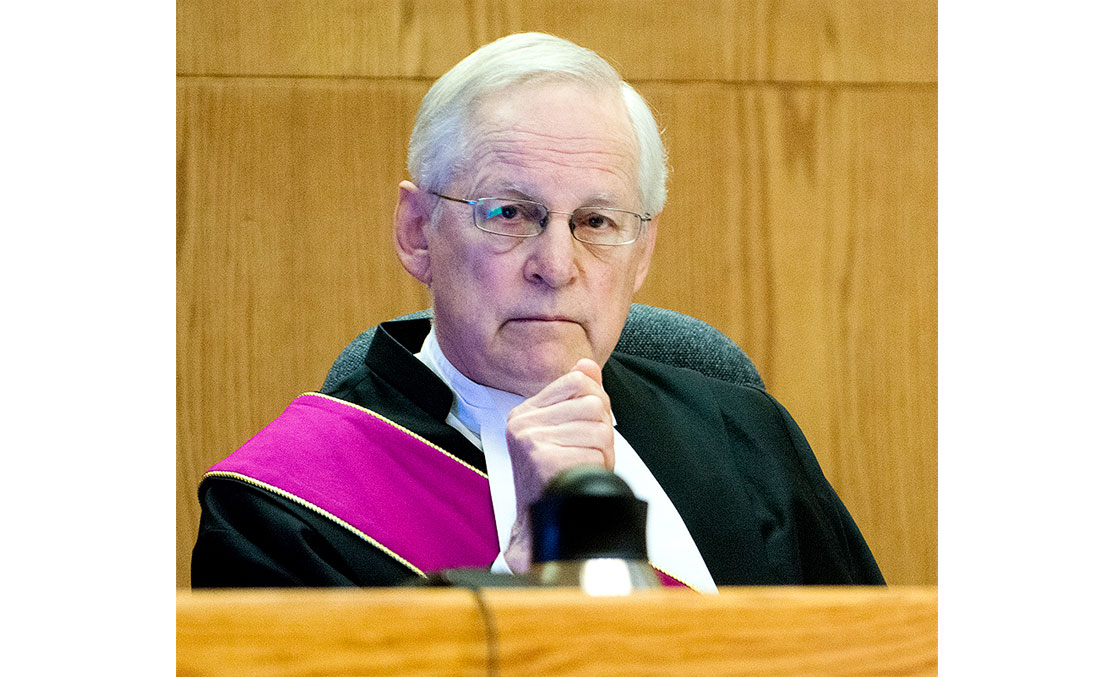
RESERVING JUDGMENT – Yukon Supreme Court Justice Ron Veale reserved his decision this morning in the battle over the Peel River watershed. The case wrapped up this morning.
Photo by Vince Fedoroff
RESERVING JUDGMENT – Yukon Supreme Court Justice Ron Veale reserved his decision this morning in the battle over the Peel River watershed. The case wrapped up this morning.
The territorial government’s head lawyer sunk his claws into the Peel planning commission Wednesday, tearing a strip off their approach to the future of the watershed.
The territorial government’s head lawyer sunk his claws into the Peel planning commission Wednesday, tearing a strip off their approach to the future of the watershed.
John Hunter said that nearly from the get-go the regional commission shrunk back from offending any parties to the process — two First Nations, a pair of environmental groups and the government — leaving the latter little choice but to move ahead with its own land-use plan that opens up the pristine expanse to resource development.
After proposing an initial plan, the arm’s-length body “never made a single hard decision — they never made any decision,” Hunter said in Yukon Supreme Court yesterday morning.
“Really you’ve got a commission that’s gone back into its shell very early on ... ‘Let’s just leave it to future generations to figure it out.’
“It’s kind of a non-planning plan,” he said.
A missed opportunity came in the form of a letter from the government to the commission in February 2011 that offered compromises balancing First Nations interests, environmental preservation and resource development, Hunter said.
“We believe a ban on surface access is not a workable scenario in a region with existing land interests and future development potential,” then-Minister of Energy, Mines and Resources Patrick Rouble wrote.
Citing the Umbrella Final Agreement, Hunter went on to address the balance of power between the government and First Nations in land-use planning consultations, at the heart of the issue on trial.
“The way the treaty has been structured, reconciliation is achieved by each of the groups having responsibility over particular areas (of land),” he said. “It doesn’t detract from the fact that at the end of the day, somebody has to make a decision.”
Justice Ron Veale, presiding over the nearly week-long hearing, questioned the apparently diminished voice of First Nations in deciding the fate of areas outside their settlement lands: “One side makes their pitch, the other side makes theirs. Nobody comes in at the end and says, ‘Oh, I have this plan which unfortunately we didn’t put to you.’”
Hunter responded that the power balance works both ways, with First Nations having ultimate authority over land use in areas granted them under land claim agreements and the Umbrella Final Agreement — a comprehensive framing document for modern-day treaties in the Yukon.
“What’s sauce for the goose is sauce for the gander,” he said.
Hunter dismissed the plaintiffs’ argument that several modifications proposed by the government were too vague for the commission to address.
He added that to suggest specific changes to types of land-use designation, locations for protected zones and particular levels of industrial development would amount to “usurping the role of the commission — you can ask for changes, but you can’t be so prescriptive.”
Hunter also insisted the government was not limited to modifications it proposed part-way through the planning process when it adopted a drastically different plan from the commission’s last January.
“This is not a question of putting (parties) in a straight jacket.”
In direct contradiction to the plaintiffs, Hunter said the judge has no jurisdiction to declare the more conservationist plan put forward by the commission in 2011 as the official land-use plan for the Peel region; only the government has that authority.
If that’s the case, a ruling in favour of the plaintiffs would send the process “back to the drawing board,” rather than ending the issue with a gavel.
The First Nation of Na-Cho Nyak Dun and the Tr’ondek Hwech’in, the Yukon chapter of the Canadian Parks and Wilderness Society and the Yukon Conservation Society want Justice Ron Veale to strike down the government’s “unilateral” plan and replace it with the one previously recommended by the arm’s-length body.
That government plan would open 71 per cent of the Peel’s metal-rich mountains, valleys and plateaus to new mineral staking, resource extraction and industrial roads.
Settlement lands — owned and managed by individual Yukon First Nations according to modern-day treaties — constitute less than three per cent of the Peel’s rugged sprawl, believed to contain abundant mineral wealth, including iron ore and uranium.
The other 97 per cent — non-settlement land — belongs to the territory.
The Rocky Mountain chain’s north end reaches its polar tip in the watershed, which unspools a series of wild rivers into the Peel and ultimately the Beaufort Sea. Grizzlies, caribou, wolverines, porcupines and moose roam its mountainous terrain.
The case wrapped up today, with renowned aboriginal rights lawyer Thomas Berger making his rebuttal.
Veale will reserve judgment on the case.
Both Courtroom 1, where the case was heard, and Courtroom 3, where court proceedings were video-streamed live, were standing room only.
More than 50 elders from Mayo, Dawson and Mackenzie Delta communities joined First Nation leadership to witness the historic proceedings.
Today, elders and youth will tell stories, present images and take part in singing and dancing at the Kwanlin Dun Cultural Centre at 7 p.m.
An all-day fire circle was there through the week.
Dawson City community members held a noon prayer circle daily for the Peel at the Danoja Zho Cultural Centre.
In order to encourage thoughtful and responsible discussion, website comments will not be visible until a moderator approves them. Please add comments judiciously and refrain from maligning any individual or institution. Read about our user comment and privacy policies.
Your name and email address are required before your comment is posted. Otherwise, your comment will not be posted.
Be the first to comment