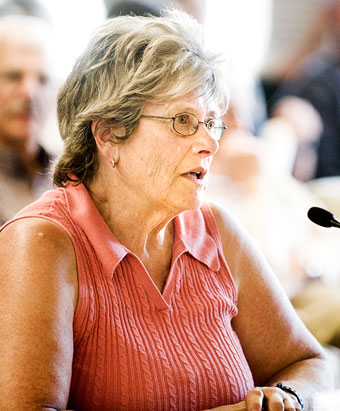
Photo by Whitehorse Star
Dorothy Bradley
Photo by Whitehorse Star
Dorothy Bradley
Two environmental groups have concluded there are "serious weaknesses” in the study design of the McIntyre Creek wildlife corridor commissioned by the City of Whitehorse.
Two environmental groups have concluded there are "serious weaknesses” in the study design of the McIntyre Creek wildlife corridor commissioned by the City of Whitehorse.
The Friends of McIntyre Creek (FOMC) and the Yukon Conservation Society (YCS) said Monday these weaknesses, in particular the limited scope of the assessment, have led to misleading conclusions.
"People need to know about the serious flaws in the Environmental Dynamics Inc. (EDI) study design so that they can develop an informed opinion,” said YCS wildlife co-ordinator Christina Macdonald.
"This cannot in any way be considered a definitive study of wildlife use of Middle McIntyre Creek. Since they didn't ask the right questions, the value of this study is limited.”
According to the FOMC and the YCS, one of the biggest problems with the study is its focus on the area as a travel corridor for medium and large terrestrial wildlife rather than as year-round habitat for smaller animals and birds.
"The study's focus on regional wildlife populations of large mammals is misleading because it only captures a fraction of the wildlife value this area holds,” said Macdonald.
"What about local populations of small animals like pine marten and fox, whose home ranges may fall almost entirely within the McIntyre Creek area, not to mention all the bird species who use the area for feeding, breeding and raising their young?” she asked.
"Destruction of forest habitat has reduced pine marten numbers across North America, but people see marten on their walks through Middle McIntyre Creek. Now that's special.”
The report says that because semi-aquatic animals use habitat in relatively close proximity to McIntyre Creek, they are unlikely to interact with the planned Porter Creek D residential development.
"How could a statement like that be included in this report?” asked FOMC president Dorothy Bradley.
"Of course, there will be interaction – buildings don't move but the people and their pets who live in them do.
"There will be more people in a smaller area of forest, noise and light pollution, not to mention the runoff from lawns and roads.”
The two groups said the study's characterization of the area as already considerably disturbed by development and human activity is also misleading. So is the implication that because of high levels of human disturbance, the proposed Porter Creek D subdivision and roads would not impact wildlife, the groups said.
"The report itself classifies only 10 per cent of the area as disturbed while 83 per cent is classified as forest,” said Bradley.
"The main disturbances are infrastructure like power rights-of-way, the pumphouse and dirt roads, not people walking.
"While the area could certainly benefit from some management of human recreational activities, especially ORV (off-road vehicle) use and activity around the wetlands, the level of disturbance in the Middle McIntyre Creek area has been seriously overstated.”
The organizations support the wildlife corridor assessment's recommendations that sensitive riparian and wetland areas in the Middle McIntyre Creek area be protected through the closures of certain trails.
But trail management and mitigation of the impacts of Porter Creek D are two separate issues, the groups argue.
"Trail management and habitat restoration should not be dependent on approval of the Porter Creek D subdivision. Implying that habitat and wildlife would benefit from the construction of Porter Creek D is ludicrous,” said Bradley.
Other weaknesses include the lack of year-round data (the study was conducted from April 21 to Sept. 19) and no consideration of how factors such as construction activity on Range Road or weather (2011 was a wet year) may have affected animal behaviour and movement between the Yukon River and upland areas, the groups said.
"This report is a very limited assessment of the wildlife in Middle McIntyre Creek,” said Macdonald.
"One of the reasons this area is so popular for recreation is because people enjoy the wildlife that they see here on a daily basis. It doesn't take a rocket scientist to understand that if you destroy the wildlife habitat and water quality by cutting down trees and building houses and roads, wildlife populations will be impacted.
"I hope that city council won't be misled by this report,”
The city is taking comments on Porter Creek D and roads through Middle McIntyre Creek until Thursday.
The FOMC and theYCS are encouraging Whitehorse residents to visit the city website and submit comments in favour of protecting Middle McIntyre Creek.
See commentary by the two groups
In order to encourage thoughtful and responsible discussion, website comments will not be visible until a moderator approves them. Please add comments judiciously and refrain from maligning any individual or institution. Read about our user comment and privacy policies.
Your name and email address are required before your comment is posted. Otherwise, your comment will not be posted.
Comments (1)
Up 0 Down 0
north of 60 on Nov 22, 2011 at 3:02 pm
It would seem that the contracted consultants gave the CoW the answer they paid for.
Smart consultants, with the very best answers that money can buy.
Sounds a lot like that re-branding logo study the CoW paid for a while back.
This CoW's Administration will leave a legacy of poor planning and inept management.