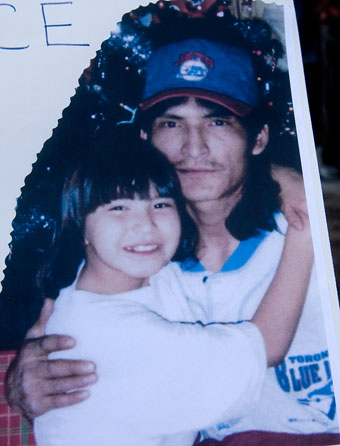
Photo by Whitehorse Star
INQUEST FINDING OVERTURNED – Raymond Silverfox died in Whitehorse RCMP custody in December 2008.
Photo by Whitehorse Star
INQUEST FINDING OVERTURNED – Raymond Silverfox died in Whitehorse RCMP custody in December 2008.
The verdict by a coroner's jury that found Raymond Silverfox died in an RCMP jail cell of natural causes has been thrown out by Yukon Supreme Court Justice Ron Veale.
The verdict by a coroner's jury that found Raymond Silverfox died in an RCMP jail cell of natural causes has been thrown out by Yukon Supreme Court Justice Ron Veale.
Veale said in a 51-page decision released Thursday the fault was not with the six members of the jury who heard seven days of unsettling testimony during the April 2010 inquest into the 43-year-old's death in December 2008.
Rather, writes Veale, instructions to the jury by then-coroner Sharon Hanley were inadequate. They didn't leave the jury much room to conclude anything but death by natural causes, despite opposing views held by the members of the Silverfox family, he writes.
It was also a mistake for the coroner to limit the jury's access to video tape that recorded the 13 1/2 hours Silverfox was held in a cell at the Whitehorse detachment, says Veale's decision.
The Silverfox family filed a request with the Yukon Supreme Court for a judicial review of the inquest and the jury's decision.
Testimony and evidence presented during the seven days revealed Silverfox vomited 26 times during the 13 1/2 hours, defecated and urinated, but did not receive assistance from RCMP officers nor civilian jail guards.
The jury heard how the officers mocked Silverfox with distasteful and crude remarks rather than respond to his requests for help.
When he was finally found to be unconscious, Silverfox was transported to the Whitehorse General Hospital, where he died.
Evidence from the inquest sparked harsh criticism of the RCMP from the general public.
The Silverfox family has filed a lawsuit against the RCMP.
In his decision to quash the jury's verdict, Veale found there was no need to hold another inquest, as the Silverfox family doesn't want one, and "it would be perverse to put them through this painful process again.”
The judge says the coroner made a mistake by limiting the jury's access to the video to 30 minutes on fast-forward, instead of letting them view the full 13 1/2 hours at normal speed.
Without seeing the whole tape, it was not possible for the jury to fully grasp exactly what happened, what was said, and the tone of what was said, says the decision.
Veale noted the RCMP and the coroner both indicated repeatedly at the inquest they were concerned that playing the full audio tape for the jury would inflame the situation.
"The situation is inflammatory,” the judge writes.
"Raymond Silverfox died following 13 1/2 hours in RCMP cells. Disclosing the truth of what happened does not inflame the situation. Revealing the truth was the legitimate expectation of the Silverfox family and in the public interest.”
Veale goes on to recall his own viewing of the video tape.
"It is not a pleasant experience to watch his suffering, but that is not the issue.
"At the heart of this inquest was the inhumane treatment of an RCMP prisoner and the lack of medical treatment given to him over the period of time he was in custody. I do not suggest that there was a deliberate attempt to sanitize the proceeding, but that was the effect of fast-forwarding through the crucial piece of evidence, creating merely a blur of movement that appears much more benign than it obviously was.”
Veale emphasizes in his decision the courts have found there is a high duty of fairness required of inquests.
"I conclude that the fast-forwarding of the video of Cell 3 and the dying hours of Raymond Silverfox breached the duty of fairness.”
The judge also found the coroner's instructions to the jury were not adequate, particularly given the length of the inquest, testimony from 28 witnesses and the general complexity of the case.
The charge to the jury, Veale indicates, was brief, when it should have been substantial.
It did not adequately explain the full scope of what the jurors could decide. Rather, it likely left them feeling they were limited to finding whether the death was by natural causes, without assigning any blame, the decision indicates.
Veale said in addition to the substandard charge, the coroner also refused to let the family's lawyer make a closing submission to the jury, eliminating any opportunity the jury might have to hear opposing views.
The family, the judge pointed out, believes that had Silverfox received medical attention, he would not have died.
Evidence presented during the inquest indicated the member of the Little Salmon-Carmacks First Nation had been drinking the night before.
But when emergency medical technicians responded to a call from the Salvation Army shelter, where Silverfox was passed out on chair, he was found to be coherent, and able to walk on his own.
On a scale of intoxication from one to 10, he was about a five, the ambulance staff figured.
They did not think he required medical attention. They called the police so he could be taken to the police cells until he could sleep it off, according to the evidence cited in Veale's decision.
Veale notes the pathologist who performed the autopsy testified Silverfox died of pneumonia – lung infection – and blood poisoning, likely a result of the pneumonia.
The pathologist told the jury that pneumonia could have been caused when Silverfox began inhaling the excess vomit remaining in his mouth, as he continued to throw up in the jail cell.
It's possible, the pathologist acknowledged, that Silverfox would have survived had he received medical attention, Veale points out.
Veale says the coroner, however, made no mention in her charge to the jury of the evidence Silverfox may have survived with medical attention.
And again, there was no chance for the family's lawyer to emphasize the point, because there were no closing submissions to the jury when there should have been, says the decision.
"It is not at all obvious to me that the jury verdict of death from natural causes was the only outcome available on the evidence. Raymond Silverfox went into the RCMP cell an apparently healthy man and became unresponsive after 13 1/2 hours of vomiting and dry-heaving in indescribable conditions that had him lying in his own vomit, urine and feces.
"The pneumonia and sepsis (blood poisoning) that he succumbed to could be characterized as a death by natural causes, but the jury charge
should have contained some reference to the evidence that supported a view that the lack of medical treatment may have contributed to his death.
"The mere fact that there is a medical cause or explanation for a death does not make it ‘natural' in the sense that an individual would have died regardless of treatment.
"In his circumstances, Mr. Silverfox could not have sought medical attention on his own. The conduct of the RCMP in failing to secure it for him is not irrelevant to an inquest verdict.
"At the end of the day, it was for the jury to determine how Mr. Silverfox died in RCMP cells and not for the chief coroner to tell it, ‘We are here simply to hear the facts of the case and come to a conclusion as to the cause of death of Raymond Silverfox' followed by reference to evidence solely relating to ‘the medical cause of death.'
"I conclude that the jury charge failed to meet the requirements of procedural fairness. The jury was not able to fully appreciate the evidence or the views of the parties to the proceedings, and in particular, they were deprived of an opportunity to meaningfully consider the views of the Silverfox family.”
In order to encourage thoughtful and responsible discussion, website comments will not be visible until a moderator approves them. Please add comments judiciously and refrain from maligning any individual or institution. Read about our user comment and privacy policies.
Your name and email address are required before your comment is posted. Otherwise, your comment will not be posted.
Comments (4)
Up 0 Down 0
flyingfur on Oct 23, 2012 at 1:07 am
Ken: First, we need a police act in the Yukon.
Up 0 Down 0
Former Yukoner on Oct 22, 2012 at 5:55 am
How very very sad for the Silverfox family. They have waited this long for answers. Isn't RCMP's supose to serve and protect! Disgusting!!! There should be some major housekeeping done, all of them should be accountable. Totally disgusted with RCMP and City Police these days and what they get away with.
My heart goes out to the Silverfox family, they deserve justice!!
Up 0 Down 0
Ken House on Oct 21, 2012 at 10:22 am
Now is the time for the Yukon Govt to explain to the citizens of the Yukon as to why the RCMP Contract was renewed for 20 years in light of this verdict when so many have called to replace the RCMP with a Territorial Police Force. If it is good for Ontario & Quebec to have their own Provincial Police Force why wouldn't it be good for the Yukon to have it's own. A Territorial Force could be made up of more First Nations Officers that would have more compassion towards their First Nations Brothers and Sisters in situations such as the Silverfox incident. Silverfox, possibly would have had medical personnel available to him sooner if that were the case.
And do not mistake the above as that I am a cop hater. I'm not.
I just figure with the foreshortened training the RCMP are getting now in BC and not Depot in Regina, SK and the full training taught there.
Ken House
Whitehorse, Yukon
Up 0 Down 0
not impressed on Oct 19, 2012 at 2:54 pm
A long battle for the Silverfox family who knew that justice was not served for their loved one and the Yukon Supreme Court delivered a just verdict. Building relations with all Nations is what all Yukoners deserve - as taxpayers, this is what our children deserve.