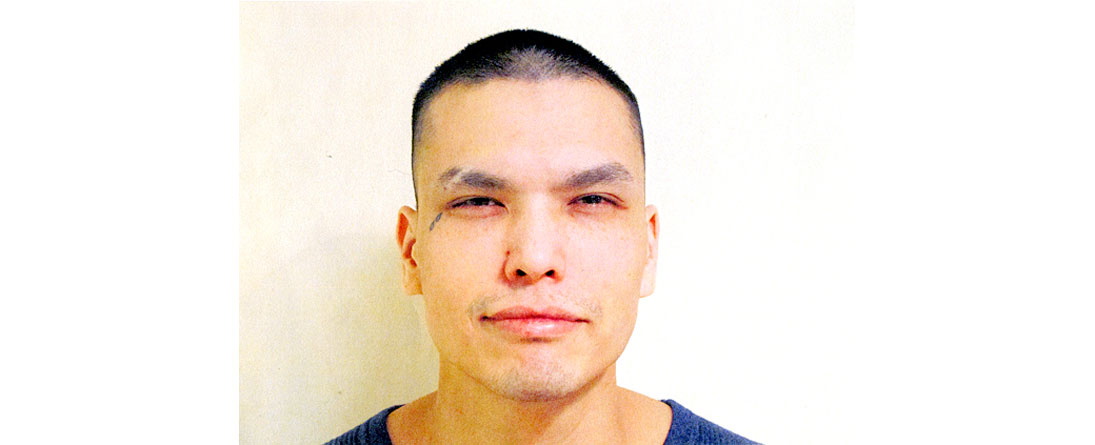
Photo by Whitehorse Star
Michael Nehass
Photo by Whitehorse Star
Michael Nehass
A correctional officer at the Whitehorse jail says that in the nearly two years he’s worked there,
A correctional officer at the Whitehorse jail says that in the nearly two years he’s worked there, he’s seen inmate Michael Nehass in the institution’s general-population area for just one hour.
Clayton Poberezny testified Monday in territorial court that since April 2013, he’s only ever seen Nehass in one of the jail’s two solitary confinement units, that one hour aside.
A two-day sentencing hearing began yesterday for five charges laid while Nehass has been in custody at the Whitehorse Correctional Centre (WCC).
The 31-year-old pleaded guilty in November 2014 to attempting to break out of the jail, causing thousands of dollars’ damage to the segregation unit, and spitting on and threatening correctional officers.
Typically, when an accused intends to plead guilty, he or she works with the Crown prosecutor to come up with an agreed statement of facts – the circumstances of an offence that both sides agree on – before entering a guilty plea in court.
But while Nehass conceded his guilt back in November, he disagreed with the Crown’s details of what happened.
So this week’s hearing was scheduled for both him and prosecutor Eric Marcoux to present their respective versions of events.
Marcoux called three witnesses on Monday – Poberezny, a second correctional officer, Christopher St-George, and an employee in the government’s property management branch who twice arranged for glass in the segregation unit to be replaced after Nehass damaged windows.
Each testified to some of the charges he’s pleaded guilty to. They date back to three incidents during the summer of 2013.
Poberezny said in June of that year, Nehass used a plastic chair to bust the telephone system off the wall in the segregation unit. Then he smashed glass panes with the phone, Poberezny said.
The correctional officer called a code yellow, seeking assistance from other staff. For about 45 minutes, management and correctional officers discussed what to do. In the meantime, Nehass broke into a utility room.
Jail staff decided to throw a flash-bang grenade into the room to stun him, and when they did so, Nehass climbed into a hole in the ceiling, Poberezny testified.
About a half-hour later, as guards and RCMP officers searched for Nehass, Poberezny heard his voice through the ceiling. Nehass said he was scared and wanted to come down.
He was later charged with attempting to break out of the jail.
The following month, correctional officer St-George said Nehass spat in his face after he refused to let the inmate have access to some photos stored in his bin of personal belongings.
St-George said inmates are generally permitted to have personal items in their cells, and he didn’t know why jail management prohibited this in Nehass’ case.
In August 2013, Nehass again pried the phone off the wall and began swinging it around by its cord, causing damage to several panes of glass.
Poberezny said the incident seemed to be prompted by his telling Nehass he had to put a shirt on.
Nehass and other male inmates would often walk around the segregation unit shirtless, the correctional officer said, so he wasn’t sure why the manager insisted that day that Nehass had to put a shirt on.
When Poberezny called a code yellow, Nehass retreated to his cell. Then a team of correctional officers dressed him in security clothing – a blue one-piece outfit made of material that can’t be ripped.
Poberezny said this may be used for inmates demonstrating suicidal tendencies. Nehass was not, he said.
In a similar format to a trial, Nehass, who is now self-represented, may cross-examine each Crown witness and present his own evidence about the charges during this week’s hearing.
Arrested in late 2011 for alleged offences in Watson Lake, Nehass has been in custody ever since.
A trial is scheduled for those charges, which include assault with a weapon and intimidation, for May. But Nehass racked up other charges during his time in custody.
The question of whether his human rights have been violated at WCC was first raised a year ago, when he was brought naked before a judge via videolink from the jail, accompanied by three guards in riot gear.
That judge, Justice Leigh Gower, apologized to Nehass in November.
“If (guards) did that on camera for court, imagine what is taking place behind closed doors with no one watching,” Nehass said Monday.
He has said in court that he’s been held in segregation for a very long time.
Nehass’ father has filed a complaint with the Yukon Human Rights Commission over his son’s alleged inhumane treatment at WCC.
Despite Poberezny’s brief testimony on the matter, it’s not yet known how long Nehass has spent in what the jail calls “separate confinement.”
Poberezny wasn’t questioned about how many shifts he’s worked since he started at WCC, back in April 2013. But he did say that he’d interacted with Nehass often, when he was stationed at the segregation and secure living units.
The former is used for discipline. Inmates remain locked in their cell for about 23 hours each day, with one hour out in the segregation unit’s common area.
The latter has a less rigid structure. Inmates may be permitted in the unit’s common area with others if they get along. The secure living unit isn’t punitive – it’s used for voluntary confinement or inmates with medical issues.
Nehass said Monday he will be filing an application under the Canadian Charter of Rights and Freedoms that his rights have been violated.
Bibhas Vaze, Nehass’ lawyer until the inmate fired him, is now serving as amicus curiae, literally, a “friend of the court” who represents neither side but assists in the proceedings.
Vaze says he’ll help Nehass file this application.
“He has not been properly confined during his time at WCC,” Vaze said during a hearing last week. “His mental health and well-being as a whole have been significantly impacted by his conditions of confinement.”
He suggested that these conditions may have led to Nehass committing the offences.
Studies have shown that solitary confinement can cause distorted perceptions, paranoia, hallucinations, insomnia and feelings of hopelessness and despair. The sentencing hearing continued this morning with testimony from William Riches, a correctional officer in charge of training staff.
Judge Donald Luther is overseeing this week’s proceedings, which will culminate with him handing down a sentence that’s expected to amount to time served, given the time Nehass has spent in custody awaiting trial for his original 2011 charges.
Luther said a second hearing will be held, prior to Nehass’ May trial, at which he can argue his Charter application and present evidence that his rights have been violated.
In order to encourage thoughtful and responsible discussion, website comments will not be visible until a moderator approves them. Please add comments judiciously and refrain from maligning any individual or institution. Read about our user comment and privacy policies.
Your name and email address are required before your comment is posted. Otherwise, your comment will not be posted.
Comments (7)
Up 1 Down 45
Sandy Helland on Feb 19, 2015 at 7:12 am
Quote: " Then a team of correctional officers dressed him in security clothing ..."
They dressed him. The guards could have dressed him for his video court appearance.
Shameful.
I believe that's contempt of court.
Up 49 Down 4
moose101 on Feb 18, 2015 at 4:03 pm
Do you want him as your neighbour? I think not .
Do we put him in a institution and pump him full of drugs? Not likely (human rights again).
Do we let him go and put him on parole and wait for him to kill someone? Probably.
Why don't we give him what he wants and put him with the general inmate population. I think that might solve our problem.
Up 51 Down 2
Rorex1983 on Feb 18, 2015 at 8:36 am
It's quite obvious that Nehass' violent tendencies and mental problems existed prior to his confinement at WCC. It's not his first offence and has been verified by his father. It's very likely that being put in segregation aggravated this but also likely that Nehass has a hard time in general population. He is generally un-liked by his fellow inmates and the guards so that can't help his pre-existing paranoia and conspiracy theories.
Someone can go to the segregation unit for bad behavior or their own protection (at their request). Nehass has been in segregation by his own request, for threatening inmates/guards and for damaging property. So it does beg the question, is it a breach of your human rights to send you to segregation if you ask to go? And furthermore, in situations where you're damaging property, threatening and harming others and attempting to break out, what other choice does a correctional center have? Remember its not WCC who put him in jail, they just have to deal with an inmate that has mental disorders and thinks they are out to get him.
The larger issue seems to be how does the WCC psychologist treat an inmate that believes the government is out to get him? I am no psychologist but it seems to me that you can't create trust if he believes you're out to get him. Does make you think that the Yukon needs a mental health facility though I am not sure it would help Nehass as again it would be a government facility and as far as he is concerned they are out to get him.
Up 9 Down 63
Gloria Rae Jack on Feb 18, 2015 at 3:05 am
Just sad. He does not deserve to be treated like that. The Justice system is messed up!
Up 53 Down 2
what are they to do? on Feb 18, 2015 at 12:02 am
So I've been following this story for the last few months….this individual has very violent tendencies and broke a guard's nose from what I recollect. He can't be trusted around other inmates is my guess…so what are they to do? I have a mentally ill person I work with and she is very challenging, although not violent. He clearly should have been sent somewhere where there is training and an environment for the mentally ill. That being said, what are we the public to do when he is out and flips out on somebody, maybe killing them? Segregation sounds over used by the system towards this individual, but if he is violent, how do they work with him?
Up 46 Down 2
Just Say'in on Feb 17, 2015 at 10:46 pm
"He suggested that these conditions may have led to Nehass committing the offences"…..Ok so that is his excuse for his behaviour in Jail. How about the total disregard for the people he injured prior to this time in Jail. I think we should just let him out on his own recognizance, he should be fine shouldn't he? Watson doesn't want him back. I mean look at him, feel the love?
Up 40 Down 9
June Jackson on Feb 17, 2015 at 5:40 pm
So..Yukon justice will prevail.. Nehass will be back on the streets very shortly, Human Rights will say..oh..poor poor criminal.. give him compensation, the government will pay him..what? $10,000 a day for every day he spent in solitary? The bright side to this, is with a couple of million, Mr. Nehass will hopefully take himself out of the Yukon...