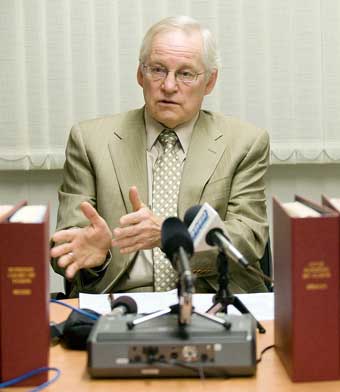
Photo by Whitehorse Star
Justice Ron Veale
Photo by Whitehorse Star
Justice Ron Veale
A case that could have increased the power First Nations have to influence – and possibly halt – mining and development projects in the Yukon
A case that could have increased the power First Nations have to influence – and possibly halt – mining and development projects in the Yukon has been decided in support of the existing assessment and regulatory regimes.
Last year, the Liard First Nation (LFN) asked a Yukon Supreme Court judge to suspend the director of mineral resources' decision to allow Selwyn Chihong Mining Ltd. to proceed with an underground exploration project at its zinc-lead property in the Howard's Pass area, part of Liard's traditional territory.
Although Selwyn Chihong is not actively mining in the area, it wants to expand its exploration and development activities there.
The company currently has two 50-person camps on its property. It wants to expand those for a larger workforce, as well as develop 2,340 metres of underground drifting, 500 m of crosscuts, and extract and store up to 200,000 tonnes of ore and development rock.
The development would affect the Don Creek, a tributary of the Pelly River, as well as the surrounding wilderness.
Selwyn's proposed project was first evaluated in early 2010 by the Yukon Environment and Socio-economic Assessment Board's (YESAB's) Watson Lake office.
After extending the comment period a number of times, it recommended the project be allowed if certain steps were taken to mitigate its impact on the surrounding flora and fauna.
During that assessment period, the LFN commissioned its own environmental assessment, which focused primarily on concerns about water and the effect on fish living in the Don Creek.
A draft decision was written by the YESAB office, and then amended by the director to take some of the First Nations' concerns into account, leaving Selwyn Chihong free to apply for a water licence, the last step before beginning the project.
Liard objected to the director's decision and filed their Supreme Court application a short time later.
As Justice Ron Veale noted in his decision, one of Liard's main criticisms was that Selwyn Chihong gave insufficient information and background data, and therefore the YESAB office could not make any evidentiary findings.
But Veale said that doesn't matter because "the environmental assessment process is not a permitting or regulatory process but rather a planning one to ensure environmental recommendations are taken into consideration before projects are undertaken.”
The judge said he was satisfied most of the concerns raised by Liard were considered by the YESAB office, and later by the director.
"I have no doubt that more research could be done and indeed may be ordered by the water board, but that does not render the evaluation report insufficient,” he wrote.
In fact, the Yukon Water Board granted Selwyn Chihong a water licence in April, permitting the company to use water from the Don Creek for its underground exploration project. The exploration was scheduled to begin this spring.
According to the water board licence, Selwyn Chihong is authorized to draw 160 cubic metres of water a day from Don Creek for its underground explorations, as well as 95 cubic metres from various sources in the Don Creek watershed for surface drilling.
The company can also draw 50 cubic metres a day total from a spring and a groundwater well for its two camps.
Selwyn Chihong must file a monthly report on how much water is used and a description of any visual impacts on the creek. A more detailed annual water and waste report is also required.
Selwyn Chihong Mining said earlier this year it is working toward completing a feasibility study to determine if the lead-zinc ore body is economically viable.
A draft of the study is expected to be ready late this summer, according to a press release issued in April by Selwyn Chihong.
The Star was unable to reach a company spokesperson before press time this afternoon, but at the time the water licence was issued, company president Harlan Meade said he was pleased the board did its job "in a timely manner.”
"You might have expected them to wait until the court decision was made,” he said. "But you know they had a job to do, and they did their job, and good on them.”
The Star was unable to reach anyone at the Liard First Nation before press time today.
In order to encourage thoughtful and responsible discussion, website comments will not be visible until a moderator approves them. Please add comments judiciously and refrain from maligning any individual or institution. Read about our user comment and privacy policies.
Your name and email address are required before your comment is posted. Otherwise, your comment will not be posted.
Be the first to comment