Photo by Whitehorse Star
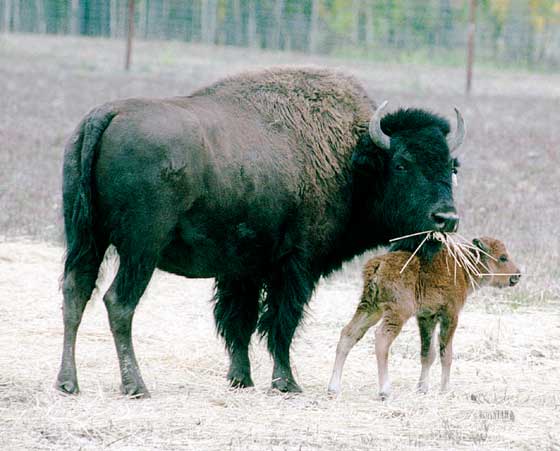
DOWN ON THE FARM – Bison young and old are seen at Clifford and Virginia LaPrairie's ranch west of Whitehorse. The ranchers say they have been promised ownership of the animals for years.
Photo by Whitehorse Star
DOWN ON THE FARM – Bison young and old are seen at Clifford and Virginia LaPrairie's ranch west of Whitehorse. The ranchers say they have been promised ownership of the animals for years.
The Yukon's only bison ranchers are suing the territorial government, because after 17 years of caring for their herd, they don't own a single animal.
The Yukon's only bison ranchers are suing the territorial government, because after 17 years of caring for their herd, they don't own a single animal.
Clifford and Virginia LaPrairie have been raising wood bison near Whitehorse since 1993, when they signed on to the Captive Herd Program, administered by the Department of Renewable Resources (now the Department of Environment).
The program was started as a way to control the flourishing population of wood bison, an endangered species brought into the Yukon in the mid-1980s.
"The introduction of the wood bison into the Yukon proved to be such a success that the bison spread beyond the boundaries established for the herd and some animals posed a hazard and nuisance to travellers on highways,” the LaPrairies explain in their Yukon Supreme Court petition, filed at the end of last month.
On the understanding they would own the animals once they had returned 35 members of the herd to the wild, the LaPrairies entered the bison business.
According to their petition, the LaPrairies were promised ownership of the animals on several occasions, by the then-minister as well as by a department director.
Bison are defined as wildlife under the Wildlife Act, and that means they are the property of the Crown. Period.
However, according to the LaPrairies, that didn't stop Environment officials from continuing to assure them they owned the animals.
In 2001, the ranchers renewed their agreement with the government and were told a draft ownership agreement was being prepared, the petition states.
But when Clifford was charged with breaching the Wildlife Act as well as the Wild Animal and Plant Protection Act for buying and selling bison across provincial borders, he began to suspect he would never own his animals.
Clifford contacted the then-minister of Environment, Peter Jenkins, who told the rancher: "We know you own your bison. We are trying to find a way to satisfy the first nations,” the petition states.
The LaPrairies waited, and still nothing happened.
The legislation was not amended and they still could not exercise their full rights of ownership such as buying and selling bison for breeding stock, or selling the meat directly to stores. (In 2009, the regulations were amended and game farmers can now sell their meat to stores.)
Finally, in April 2009, the LaPrairies went to Environment and asked for a straight answer on the ownership question.
The first response they got from deputy minister Kevin Leary stated the ranchers had "exclusive property” of the bison, but a second letter was somewhat more clear.
"All rights, title and interest in and to wildlife are vested in the Crown,” Leary wrote, meaning the LaPrairies' possession and use of the animals is entirely at the government's pleasure.
The LaPrairies are suing the government for damages, claiming the government made "negligent misstatements” and "negligent misrepresentation” of the facts when they entered into the captive herd program.
The LaPrairies have a herd of approximately 130 animals, while there are an estimated 1,151 wood bison roaming wild in the Yukon.
In order to encourage thoughtful and responsible discussion, website comments will not be visible until a moderator approves them. Please add comments judiciously and refrain from maligning any individual or institution. Read about our user comment and privacy policies.
Your name and email address are required before your comment is posted. Otherwise, your comment will not be posted.
Comments (3)
Up 0 Down 0
Arn Anderson on Apr 15, 2010 at 2:59 am
Al Gore owns the flatulence that comes out of the bison, simple, he who owns the flatulence owns the rest.
Up 0 Down 0
mosi on Apr 14, 2010 at 9:58 pm
Any legal case based on 'negligent misrepresentation' is almost impossible to win. You could spend the next 17x years in Court alone on this one. But more $ in the pockets for the lawyers.
Up 0 Down 0
bobby bitman on Apr 14, 2010 at 8:04 am
As an introduced species being farmed on privately owned land, what interest could the First Nations have with respect to the LaPrarie's ranch?
Are the FN being used as pawns here? Or do they actually take issue with the LaPraries owning their animals? I think that one needs to be cleared up first things first because it is quite an accusation to say the First Nations are getting in the way of what seems to be a reasonable and just request: that they own the animals in their care and possession.
There may well be other issues at stake, like fear of importing disease or more ticks, if people are allowed to arrange 'buying, selling and breeding' on their own, but let's at least identify the issue.