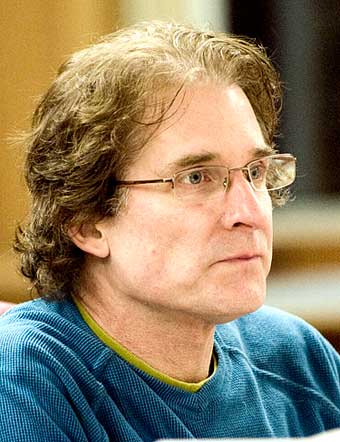
Photo by Whitehorse Star
Club president John Quinsey
Photo by Whitehorse Star
Club president John Quinsey
Local paddlers will have to wait another week to learn whether city council is on-board for a study that could see the city's first white water park developed in the Yukon River.
Local paddlers will have to wait another week to learn whether city council is on-board for a study that could see the city's first white water park developed in the Yukon River.
At Monday evening's city council meeting, members were asked to endorse the $490,000 funding application the city and Yukon Canoe and Kayak Club made to the federal government for a study on the park's potential design.
Members won't vote on it until next week. They weren't shy last night, however, in stating their fears the project could put the city on the hook to fund yet another facility down the road.
Those fears came despite the club's assurances that the study would be entirely funded by the federal government (provided funding is approved), with the city's role being simply administrative in managing the funds and the project.
"The city provides funds one way or another,” Coun. Betty Irwin said, pointing to the staff time that will be put into the project.
As Doug Hnatiuk, the city's projects and community development co-ordinator, told council in a report, the project has been a number of years in the making. It goes back to 2007, when the canoe and kayak club had a $15,000 feasibility study done with funding from the territory's Community
Development Fund.
The club also added another $5,000 to that project, which identified a whitewater slalom course that could be constructed along the Yukon River.
A terms of reference, funded by the federal government, for a project proposal was developed to look at a further, more detailed study, awarded to Inukshuk Planning and Development Ltd., pending the $490,000 in funding approval.
It's expected the study would take two years from the time the funding is approved.
As Hnatiuk's report states: "If the application is approved, the partners would end up with a comprehensive feasibility study that would include the following items:
• a viable business model which covers project financing, including capital and operating costs as well as facility management and the study will examine the options;
• public participation opportunities; and
• the information required for a YESSA (Yukon Environmental Socio-economic Assessment Act) and all regulatory assessments and permit submissions.
"The study will provide choice, identify potential partners, and spell out the nature and amount of private and public sector support needed for project implementation.”
As Coun. Ranj Pillai argued though, a major concern is in the operations.
There are cases, he said, where infrastructure is put in place by non-profit groups like the canoe and kayak club, which operate the facility at first.
As time goes on though, members of those volunteer organizations move on to other things, leaving the city with infrastructure that needs to be run.
As an example, Pillai pointed to Mount Sima. He noted his fear of potential liability issues from Saturday's evacuation of the broken-down chairlift, and noted that if the Great Northern Ski Society ever folded, the city would be left on the hook for the hill.
Along with the operational concerns she shared with other council members, Irwin reiterated the issues she expressed at a council and senior management meeting last month over the changes a whitewater park could mean for the river current at the intake where the park would be located.
"I'm still very, very hesitant,” she said.
Coun. Florence Roberts said she's since changed her mind on the matter and will likely vote in favour of the study, though she wants to see it address erosion issues that already exist in the area. Regular updates on the study should also be provided to council, she said.
Club president John Quinsey responded to both Roberts' and Irwin's concerns. He said the study is set to address erosion that is already going on, with hydrologists looking at creating a park that will be sustainable without a major impact on the river.
With the exception of the slalom course near Robert Service Campground, the river is planned to look very similar to what people see now.
It will be a more natural park using rocks and other natural features, Quinsey said.
Eddies may be created in some areas as spots, which would not only be there for paddlers, but could also be used by swimmers trying to get to a spot that isn't flowing so quickly.
"In that sense, it will be safer,” Quinsey said, reiterating later that the club wants a park that will have longevity.
Mayor Bev Buckway also cited reservations and questions about the project, but added: "there's only one way to find out,” and that would be through the study.
Coun. Dave Stockdale, meanwhile, voiced his support for the plan. He argued that while he agrees there are some issues to be looked at as other council members had pointed out, he would like to see the study move forward.
If council agrees to endorse it and the funding comes through, council would then vote on whether to receive the cash.
In order to encourage thoughtful and responsible discussion, website comments will not be visible until a moderator approves them. Please add comments judiciously and refrain from maligning any individual or institution. Read about our user comment and privacy policies.
Your name and email address are required before your comment is posted. Otherwise, your comment will not be posted.
Be the first to comment