Photo by Whitehorse Star
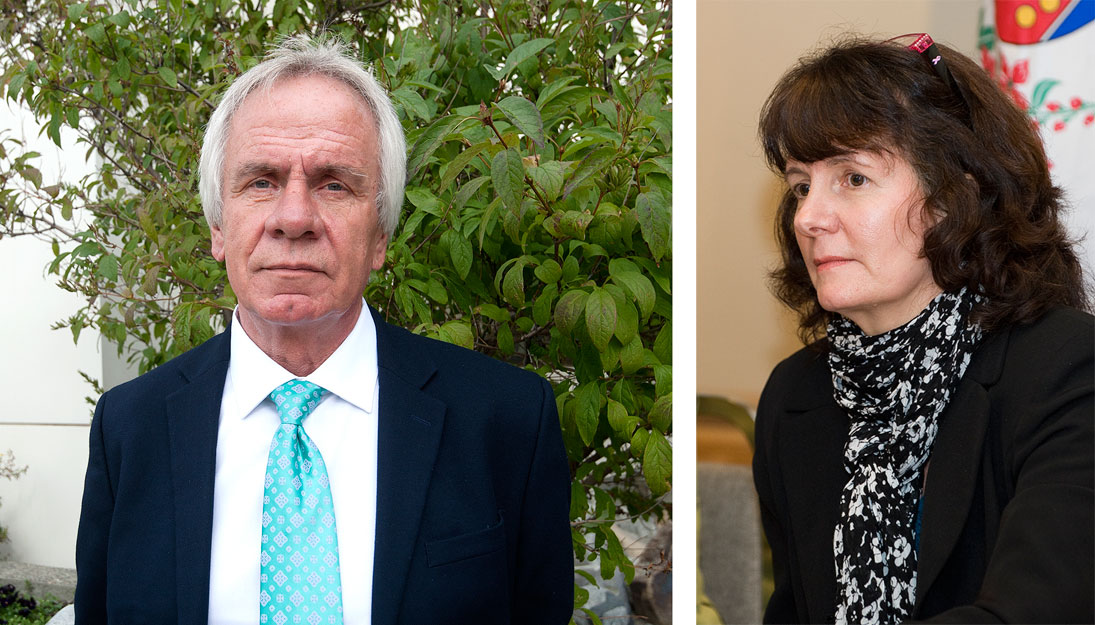
Stephen Walsh and Shari Borgford
Photo by Whitehorse Star
Stephen Walsh and Shari Borgford
The Ross River Dena Council wants to call a senior federal employee as part of its case against the federal government regarding the Kaskas’ unsurrendered aboriginal rights and title.
The Ross River Dena Council wants to call a senior federal employee as part of its case against the federal government regarding the Kaskas’ unsurrendered aboriginal rights and title.
Federal lawyer Suzanne Duncan told Justice Leigh Gower of the Yukon Supreme Court during a hearing last week there’s absolutely no need for Ross River to call Shari Borgford to testify.
Senior courts have ruled there must be compelling reasons for the court to allow a party to call an “adverse witness,” or a witness from the other side, she said.
Duncan said Stephen Walsh, the Whitehorse lawyer representing the Dena council, has no such compelling reasons and must not be allowed to call Borgford.
While Borgford is a senior official with Indian and Northern Affairs Canada, she was not directly involved in negotiations around the settlement of aboriginal land claims in the territory, Duncan told Gower.
She said Borgford’s work with the federal department was mostly in financing, not aboriginal land claims, she said.
“She does not have independent and direct knowledge on the issues that are to be determined in this court,” Duncan said.
Walsh countered he does have reasons to call Borgford, but he shouldn’t have to go into specific details, he shouldn’t have to reveal his client’s strategy before the start of the five-day trial scheduled to begin Sept. 26.
Clearly, the burden of convincing the court there is no need to call Borgford as a witness lies with Duncan, not him, he told Gower.
Gower reserved his decision on whether he’ll allow Walsh to call the senior official.
At the centre of the lawsuit is Ross River’s belief that the Umbrella Final Agreement (UFA), the template for negotiating final land claim agreements in the Yukon, was never properly ratified.
Ross River is one of three Yukon First Nations without an aboriginal land claim settlement.
It’s proceeding with this and another similar lawsuit claiming Ottawa never fulfilled its duty to deal fairly with Ross River.
It never fulfilled its constitutional obligation to settle the interests of the Ross River Kaska before giving away its traditional territory to third parties such as a mining company, the First Nation contends.
The first trial focused on the 1870 Order which was made to provide for the transfer of Rupert’s Land and the North-Western Territory, including the Yukon, to the Dominion.
Ross River contends the obligation to settle the interests of the First Nation before giving away their land is set out in the 1870 Order, which is part of the Constitution of Canada.
The trial has been held. Gower agreed to suspend his decision on the case at the request of the federal government.
The government argued it would be beneficial to first decide if Canada has acted honourably and has fulfilled its legal obligation to Ross River in the post-1973 era.
It was in 1973 following a precendent-setting decision by the Supreme Court of Canada involving aboriginal rights that then-prime minister Trudeau and his federal cabinet agreed to begin negotiating aboriginal land claims. Yukon First Nations were among the first in line.
Ross River maintains there is a trail of documents suggesting Yukon First Nations, the territorial government and Ottawa agreed there would be an official process set out and agreed upon to ratify the UFA. That never happened, the First Nation maintains.
At an earlier court appearance, Walsh sought and received permission to examine Borgford on sworn statements she’s provided to the court in response to information requests.
While she indicated there was a meeting to discuss the ratification process on Oct. 25, 1991, the information was incorrect.
The federal lawyer told Gower last Wednesday incorrect information was no fault of Borgord’s, as she was supplying the affidavits as a senior federal official based on information provided to her by the research team.
As soon as Ottawa realized its mistake a couple of years later, it informed Walsh and corrected the error, Duncan said.
She informed the judge that while there was no meeting on Oct. 25, 1991, there was a letter sent on that date by then-Indian Affairs minister Tom Siddon to Judy Gingell, chair of the Council for Yukon Indians, as it was known at the time.
The federal government has answered all of Ross River’s information requests, Duncan insisted.
She emphasized Walsh got to examine Borgford on the record this past spring, after having received permission to do so.
What more, Duncan put it to the judge, could possibly be gained by putting her on the witness stand?
“We say that is difficult to see what Ms. Borgford may add that may be helpful to the court.”
Even Gower said he was having trouble seeing what more could be gained by putting her on the stand.
Walsh told the judge he has no issue whatsoever with Borgford’s credibility. This is not an attempt to “bushwhack” her on the stand, he insisted.
“I expect my examination of her will be within the four corners of the evidence she has given.”
When Walsh sought and received permission to examine Borgford on her sworn statements, he also sought the production of a memorandum to the federal cabinet from a federal lawyer regarding the ratification of the UFA. Gower denied the request, though the judge indicated he has seen the document.
The memorandum to cabinet was sent April 14, 1993, a month and a half before the UFA was officially signed by Gingell, Siddon and the late government leader John Ostashek.
In order to encourage thoughtful and responsible discussion, website comments will not be visible until a moderator approves them. Please add comments judiciously and refrain from maligning any individual or institution. Read about our user comment and privacy policies.
Your name and email address are required before your comment is posted. Otherwise, your comment will not be posted.
Be the first to comment