Photo by Whitehorse Star
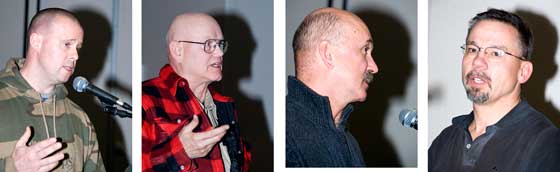
Guy Corderre, Ken Gabb, John Carney and Rob Florkiewicz
Photo by Whitehorse Star
Guy Corderre, Ken Gabb, John Carney and Rob Florkiewicz
Environment Yukon's proposal for a no-hunting corridor along the Atlin Road was hit with staunch and almost unanimous opposition at a public hearing Monday night.
Environment Yukon's proposal for a no-hunting corridor along the Atlin Road was hit with staunch and almost unanimous opposition at a public hearing Monday night.
John Carney of the Yukon Fish and Game Association went so far as to suggest it appeared to be a backdoor political initiative disguised as a safety issue to prohibit bear hunting along the right-of-way.
If it's an issue of protecting bears while they forage along the Atlin Road, then it should be identified as such, Carney said tersely. He spoke during the annual meeting the Yukon Fish and Wildlife Management Board held to review proposed regulation changes.
If it's a safety issue, he told senior government biologist Rob Florkiewicz, the government had better start looking at the issue of roadside hunting throughout the entire Yukon.
He pointed out in the last couple of years, Environment Yukon has itself created more hunting opportunities to control elk and bison along the Alaska Highway west of Whitehorse, through an area much more populated than the Atlin Road.
That road, he suggested, has but a handful of residents along the 50-kilometre stretch from the turnoff at the Tagish Road to the B.C. border.
Carney also noted the existing law prohibiting hunting within one kilometre of dwellings.
"The fish and game association looks at this as a knee-jerk reaction to some concerns raised by a couple of residents,” he said.
Florkiewicz told the 40 or 50 people in attendance the proposal arose out of safety issues raised by Atlin Road residents.
Surely, said Carney, there must be another way to address safety concerns, such as posting signage to notify hunters of nearby dwellings, just as it's done along other roadways in the Yukon.
The association's president also pointed out the government's proposed corridor would infringe on large blocks of aboriginal settlement land running along the highway.
"Does this proposal have the support of the Carcross-Tagish First Nation?” Carney asked.
Representatives of the First Nation, whose traditional territory includes the Atlin Road, voiced their clear rejection of the proposal during the meeting.
The management board is floating eight suggested changes to regulations under the Wildlife Act.
In its standard procedure, once it gathers public input, it forwards a recommendation in late December to the Environment minister, who can either accept, reject or alter the recommendation.
The no-hunting corridor would prohibit hunting for 500 metres on both sides of the Atlin Road.
A couple of years ago, a concern was raised by Atlin Road resident Ken Gabb and others about the safety of permitting hunting along the road when his and other homes are not visible from the road. There is, it's been suggested, a chance that a wayward bullet could cause serious injury.
It was also suggested that bears grazing along the roadway are much more valuable as a wildlife viewing resource than a trophy in someone's house.
Gabb reiterated his safety concerns during last night's meeting. He was the only one to defend the proposal from the six who spoke on the matter.
A .30-calibre bullet, said the former RCMP officer, can travel 3,700 metres.
If a hunter isn't aware of a nearby home and he misses his target, it can make for a deadly combination, Gabb suggested.
"They have no idea if they miss where that bullet is going to go.
"All in all, it is a dangerous practice, and I would ask the board to consider putting in a no-hunting zone along that stretch of road,” he said.
Gabb also used the floor to suggest anybody who shoots grizzly bears while they forage harmlessly in the ditch is not a hunter, but rather a slaughterer of wildlife.
Hunters who want to shoot the majestic animals, Gabb has emphasized in the past, should have the jam to at least leave the safety of their vehicles and the highway right-of-way, and face the animals on their own turf in the outback.
But it was also noted last night that road hunting is a common practice in the Yukon, either for grouse or for big game. For some, it was pointed out, it is their only means of harvesting wild meat.
Patrick James, chair of the land use team for the Carcross-Tagish First Nation, said there is no safety issue along the Atlin Road.
With a tinge of anger in his voice, the former chief suggested if the government wanted to implement land use management measures, it should embrace, not resist, the planning tools established in the land claim settlement.
Deputy Chief Dan Creswell said members of the First Nation know the area, they know where people live, and even know where they camp in the summer.
He reminded board members of the potential conflict with the Taku River Tlingits of Atlin and their overlapping transboundary land claim.
"For the record, the Carcross-Tagish First Nation is opposed to this,” Creswell said matter-of-factly.
Carcross Road resident Guy Corderre was also adamant in his opposition to the proposal.
Corderre said he does not hunt in the area, but establishing the corridor would take away his right to do so.
"I am concerned this is coming forward as a safety issue, but I see no evidence there is a safety issue,” he said.
Currently, Corderre pointed out, the Yukon's prohibition against hunting within one kilometre of a dwelling is the largest buffer in the country.
He told the meeting the buffer in B.C. is 100 metres.
"I am kind of curious why the people on the B.C. side of the road have 100 metres and they are safe and the people in the Yukon have 1,000 metres and they are not safe?”
See more coverage on the meeting in tomorrow's edition.
In order to encourage thoughtful and responsible discussion, website comments will not be visible until a moderator approves them. Please add comments judiciously and refrain from maligning any individual or institution. Read about our user comment and privacy policies.
Your name and email address are required before your comment is posted. Otherwise, your comment will not be posted.
Comments (2)
Up 0 Down 1
Mike Kohler on Nov 16, 2010 at 5:10 pm
Well, puff it went and so it should!
Ken, I agree with what you are saying about irresponsible shooting, stray bullets and shooting at wildlife or signs for that matter. Yet, your approach adds just more regulation and laws for those who are responsible hunters. I'm sure you would agree that the Criminal Code of Canada already has all the laws necessary to nab those who handle firearms in a public-endangering way. More laws won't make a difference for those who are set to brake them. Education, posting signs, citizen patrols and surveillance will make a difference. I am much more concerned about the hundreds of alcoholic beverage containers I collect twice a year on an eight kilometer stretch where we live. I believe it's directly related to the wild-west shooting along our highways. It may not be obvious that this is a hobby of some, since the Highway Department has removed most of the road signs, even real necessary ones, for whatever stupid reason. And who knows, taking away the prime targets of these hooligans, may get them to shoot at what is left in the corridor.
Up 0 Down 1
David Griffiths on Nov 16, 2010 at 3:37 pm
Well said Ken Gabb!
There's a reason people from all over the world travel here to kill our wildlife; they've killed all of theirs.
And years ago they probably thought shooting animals from a road was acceptable.
The more and the larger no hunt corridors we have in the Yukon the better.