Photo by Whitehorse Star
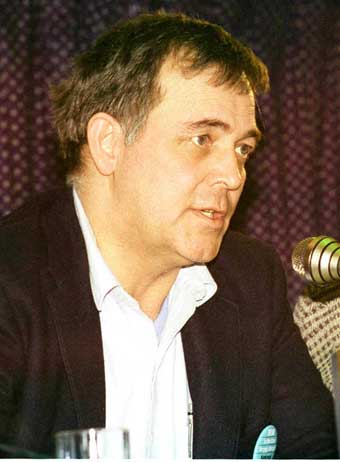
Robert Olson
Photo by Whitehorse Star
Robert Olson
Convicted murderer Dean Boucher will have to wait another six months before he can make his case to the Yukon Court of Appeal,
Convicted murderer Dean Boucher will have to wait another six months before he can make his case to the Yukon Court of Appeal, after a brief appearance before the territory's highest court Tuesday.
Boucher was in front of Justices Mary Saunders, Elizabeth Bennett and Nicole Garson. He was prepared to represent himself, but the three judges weren't so sure.
Knowing that Boucher intended to appeal his May 2006 conviction for the second-degree murder of Robert Olson without the help of a lawyer, the judges took a particularly careful look at the transcripts and documents from the trial, Saunders explained.
She said they had found some points of concern which Boucher did not mention in his appeal factum.
First was the fact the judge who oversaw the jury trial of Boucher and his co-accused, Mark Lange, did not address the issue of post-offence conduct in his instructions to the jury members.
During the trial, the court learned Boucher went to the police detachment three days after he and Lange dumped Olson's lifeless body in Wolf Creek.
The two men had beaten the Carcross hotel owner senseless, then loaded his body in the back of his truck and driven toward Whitehorse.
At Wolf Creek, they realized the man was dead. They left him in the creek where he was found on Dec. 27, 2004, the same day Boucher told an RCMP officer Olson had died by accident.
At trial, Boucher first pleaded guilty to manslaughter, but when he took the stand, said it was Lange who beat Olson to death
Boucher said he had tried to help Olson and was attempting to get him to the hospital when he put him in the truck.
The second area of concern for the court of appeal panel came from what may have been a slip of the tongue on the trial judge's part.
When Yukon Supreme Court Justice Leigh Gower was instructing the jury on what evidence they could use to convict Boucher, he said: "In deciding if accused number one is guilty, you can only use evidence admissible against accused number two.”
"It strikes one as unusual,” Saunders said of the statement, and indicated it may have been a mistake which no one noticed at the time.
"... It occurred to us that in these two areas there may be an issue,” Saunders said, "but of course we haven't come to a conclusion on that.”
As for the appeal issues raised by Boucher, the judges found he was ill-prepared to argue them. He hadn't entered any of the required evidence or affidavits to support his case.
One of Boucher's issues was the quality of work done by his lawyer, Keith Parkkari, whom Boucher says had a conflict of interest which he never mentioned.
But, as Saunders pointed out, Boucher did not give Parkkari a chance to defend himself.
"We aren't quick to say a lawyer did a bad job without giving them an opportunity to respond,” Saunders said.
Other issues Boucher raised in his original appeal filing included possible bias on the jury and the judge's failure to address the issue of intoxication as a defence, but it was not clear Tuesday which factors he planned on pursuing.
Saunders did note, however, that Boucher had not filed any supporting evidence or affidavits.
Nor did Boucher bring the materials from the trial which a lawyer would normally come prepared with.
When Justice Bennett was referring to the transcripts of the first trial, Boucher had to borrow a copy from the judges.
Boucher told the judges yesterday he had some help preparing for the appeal, but came on his own because the lawyers who want to help him are all in B.C.
When Saunders asked if he wanted a lawyer, Boucher said: "Would it be a Yukon legal aid-appointed lawyer? That's my first question.”
Saunders explained that a B.C. lawyer could represent him as long as they were called to the Yukon bar and approved to work under Yukon legal aid.
The judges and Crown prosecutor David McWhinnie also discussed the possibility of Boucher's appeal being heard at the same time as Lange's.
"I don't want that in life, or legally,” Boucher said. He was heard telling his family and friends who came to court Tuesday that Lange had threatened to kill him.
Although Lange and Boucher were tried together, the two men had different lawyers and each blamed the other for Olson's death.
Boucher said he heard a fight in the bar of the Caribou Hotel and came down to find Lange beating Olson.
At the end of the trial, Boucher recanted his story and said he was responsible for Olson's death.
Lange said it was Boucher who started the fight over a piece of art he wanted off the wall of Olson's bar.
Lange said he tried to defend Olson, then started beating him when the hotel owner scratched Lange's face.
Both men were found guilty of second-degree murder, which comes with an automatic life sentence. Boucher was sentenced to 15 years without parole, while Lange was sentenced to 10 years without parole.
Boucher was scheduled to appear in court again this afternoon, but his arguments will have to wait until the fall sitting of the Court of Appeal.
In order to encourage thoughtful and responsible discussion, website comments will not be visible until a moderator approves them. Please add comments judiciously and refrain from maligning any individual or institution. Read about our user comment and privacy policies.
Your name and email address are required before your comment is posted. Otherwise, your comment will not be posted.
Comments (2)
Up 0 Down 0
Don McKenzie on May 24, 2010 at 2:00 am
I remember this case, and the descriptions of the brutality of Mr. Olson's death. These scum should have been hung, and now they want out of prison early.
Up 0 Down 0
JC on May 20, 2010 at 1:24 am
Back in my day, those two crack heads would have been hung by now. Case closed! But now, thanks to lord Human Rights, there is no victim rights today, only perp rights. And to make things worse, the government wants to take away all our protection so the perps won't get hurt.