Conservator pinpoints music from the deep
After an international scavenger hunt, three recordings found aboard the A.J. Goddard have been identified, giving new insight into life onboard the doomed steamboat.
By Sarah Niman on March 1, 2011
After an international scavenger hunt, three recordings found aboard the A.J. Goddard have been identified, giving new insight into life onboard the doomed steamboat.
Local conservator Valery Monahan was the first to hear recorded versions of the songs found on the vessel.
"We did not pull the audio from the discs,” she said today, because they were ruined; one was broken in two pieces.
Conservator Tara Grant, with the Canadian Conservation Institute in Ottawa, received the discs for cleaning. She was able to identify the recordings with information on the discs.
The ship still sits at the bottom of Lake Laberge, where it sank in 1901 during a violent storm. Three of its five crew members perished.
The vessel was made famous for being the first to reach Dawson City after the first winter of the Gold Rush.
Finding other recorded versions of the songs was up to Monahan, a conservator for the territorial Department of Tourism and Culture.
The Harp that Once thro' Tara's Halls by Thomas Moore, Ma Onliest One by Fay Templeton and Rendez Vous Waltz performed by the Metropolitan Orchestra are not exactly on the 1890s top 10 list.
After much digging, scouring online records and a bit of coincidence, Monahan found the titles listed in the American Library of Congress.
In fact, as soon as she realized what she had found, Monahan was the first to listen to an on-line recording of the Rendez Vous Waltz, knowing it had played on the Goddard.
To hear the music the crew had listened to aboard the work vessel has given a "human side” to the research being done on the ship, said Lindsey Thomas, a student at Texas A & M's Nautical Archaeology Program. She is finalizing her thesis paper on the wreck.
The other two songs are not available to be heard publicly, because they are under copyright by Sony Music. Monahan said her office is awaiting written permission from Sony to share the songs.
The gramophone player and discs will be returned to the Yukon from Ottawa, where they are being treated free of charge, because they have been deemed as important clues into Canada's heritage.
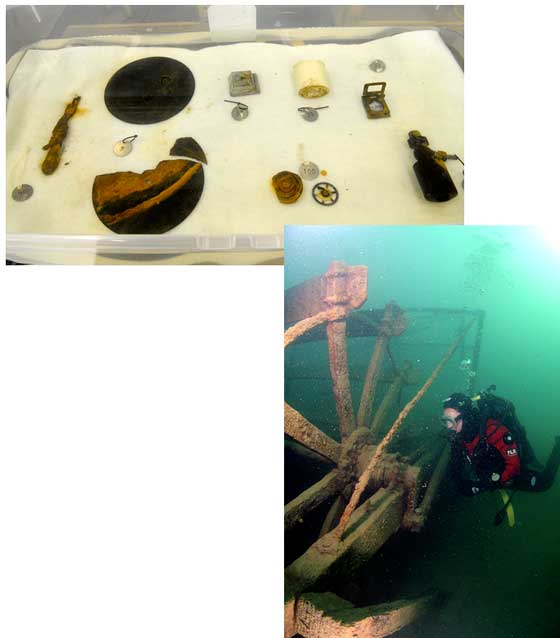
An additional 26 artifacts found onboard remain under Monahan's care, as she treats them herself.
The other items found aboard were "what you would expect onboard a working ship,” Thomas said today in a telephone interview from Texas.
Cooking items, writing instruments and work equipment help paint a picture of life onboard the Klondike Gold Rush-era vessel. Finding a gramophone onboard such a utilitarian ship was surprising to researchers.
"The Goddard was a working vessel, like a long-haul truck today,” said Monahan. "This is an exotic, luxury item.”
The gramophone would have been expensive, large, and unyielding, said Thomas. And yet, the crew had it out and were likely playing it, as one of the discs was found in the player.
"It shows how important music was,” she said.
The gramophone, discs and other artifacts will be featured in an exhibit on sternwheeler life at the Yukon Transportation Museum.
Those wishing to visit the A.J. Goddard, named a Yukon Historic Site in June 2010, will have to get wet.
Diving into Lake Laberge's icy waters may not appeal to all, but the site has warranted international attention.
National Geographic named it as one of the Top 10 archaeological finds of 2009, calling it a "Gold Rush-era Ghost Ship”. Online readers of the magazine ranked it the number one most popular find.
The shipwreck was discovered in June 2008 by a group of divers from the Institute of Nautical Archaeology and the transportation museum.
Thomas has been researching it since she learned of the discovery two years ago, and said she will continue well after her thesis paper is written.
"I'll be doing more research and then publish it as a book,” she said.
Comments (1)
Up 0 Down 0
Yukon Eddie on Mar 1, 2011 at 11:33 am
I think the ship should be brought up and rebuilt and put on display. Its not doing anyone any good down there.