Photo by Whitehorse Star
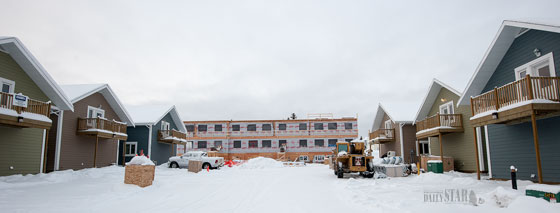
NEVER TO BE FINISHED – The semi-built apartment complex seen at the rear will never see the light of day as a completed development. It will be replaced by another type of housing proposed to the Yukon Supreme Court.
Photo by Whitehorse Star
NEVER TO BE FINISHED – The semi-built apartment complex seen at the rear will never see the light of day as a completed development. It will be replaced by another type of housing proposed to the Yukon Supreme Court.
A disputed, "half-decrepit” apartment complex in a Copper Ridge-area subdivision will, at long last, be torn down.
A disputed, "half-decrepit” apartment complex in a Copper Ridge-area subdivision will, at long last, be torn down.
That's revealed in a court-ordered proposal for new units put forward by the neighbourhood's developer.
What will replace the building hangs in the balance of the judge's scales.
The development plans bring a lengthy legal dispute between Falcon Ridge homeowners — worried about property values and neighbourhood character — and subdivision developer Brian Little one step closer to resolution.
Lawyers for both parties met in a case management conference this week following Little's submission of two options for replacing the contentious three-storey complex — originally blueprinted as four storeys and 24 units.
The cube-like structure has sat vacant for more than a year since the condominium corporation — made up of Falcon Ridge homeowners — took legal action and a Yukon Supreme Court judge ordered a halt to all construction on the building, its framing and particle boards now exposed to the elements.
One of the two options lays out plans for dual sets of three connected four-plexes — 24 units total — plus another standalone four-plex, bringing the unit sum to 28.
The second possibility suggests three connected four-plexes, three standalone four-plexes and one house, adding up to 25 units.
None of the units would reach the four-storey height initially slated for the apartment complex they may soon replace.
The proposal states that Little is willing to run with either blueprint, depending on the condo board's preference.
Helen Booth, the condo board's president, is taking issue with the plan's labelling of apparent 12-plexes as three connected four-plexes.
"It's an apartment building,” she told the Star. "A four-plex would be outside entrances to each of the units. You can't call that a bare land unit if it's connected internally.”
Booth said she has sent out the plan to Falcon Ridge homeowners and continues to receive feedback on it. The board will meet next week to discuss its options.
"Our position is formed from what the owners say,” she added. "But it looks like a 12-plex to me.”
Little, also the developer behind the Mountain Air Estates complex off Mountainview Drive, declined comment as the matter is before the courts.
The legal battle between him and the condo owners entered its end game in January with a Yukon Supreme Court decision that saw Justice Ron Veale side largely with the owners.
He ruled "it would be unjust and inequitable to the majority of unit owners that oppose the condo developer's proposal to allow it to proceed with the construction” of the apartment building.
In July 2012, Little began construction of the partially completed complex — and has since sunk more than $1 million into the project — despite not having consent from nearby condo owners concerned about property values and "community cohesion.”
The squat, four-storey structure would have the effect of "destroying the character of the development that unit owners found to be so attractive in the first place,” Veale said.
Booth agreed.
"The crux of it was that in the plan up until 2012, there was basically no mention of this ... the crucial point there being that consent from owners was not obtained,” she said in an interview two months ago.
In the court ruling, Booth noted "concerns were voiced with respect to the notion of living in a high-density environment.”
One unit owner, Fabian Barajas, said: "I believe that an apartment building in Falcon Ridge will significantly decrease the value of our home because of the increased traffic, lack of adequate parking, loss of aesthetic qualities in the complex, loss of community feel of the complex and most especially the fact that the apartment building is located directly beside our home.”
The structure places Barajas' building in shadow during the evening, according to the ruling.
He said he would not have purchased his unit had he known an apartment building would obstruct his view.
The subdivision's declaration and plan from 2005 include only detached houses, duplexes and rowhouses.
Any exceptions — like an apartment block — require amendments to both documents, and must be agreed to in writing by each homeowner.
The structure is "half-decrepit” and an "eyesore,” one homeowner told the court last year.
Veale ruled that a combination of four-plex and single-family units could take the place of the apartment.
The condo owners found restitution last month when the judge ordered Little to fork over nearly $400,000 in unpaid fees.
In a ruling that resolved the bulk of the acrimonious housing dispute and offered lessons for homeowners and developers alike, Veale said the Falcon Ridge condo corporation was entitled to $394,000 — plus some legal costs — because Little failed to pay his share for units his company owned.
"I find from the evidence that there was no agreement between the condo corp. and the condo developer that the condo developer was not required to pay condominium fees,” states the decision.
"There was clearly a practice by the condo developer not to charge itself condominium fees when it was in de facto control of the condo corp. (from 2005 to 2011).”
That practice was in "direct conflict” with a board declaration from 2005 — when the subdivision and its board were created — which states the developer "shall pay to the corporation his proportionate share of the common expenses ....”
Booth supported the court decision, handed down Feb. 10.
"I think Judge Veale was fair,” she said in an interview last month.
"He was careful to avoid a windfall payment, and that's not what we were looking for,” she said, despite the owners having asked for $2.6 million in outstanding fees, penalties and accrued interest.
"Judge Veale made it very clear that condo developers, because they are owners, have to pay condo fees,” said Booth.
"I think this is a pretty clear message to condo developers across the territory that they need to start paying condo fees, and I think that condo boards need to look at this decision very carefully.”
Booth told the Star today the condo corporation will submit a response to Little's recent proposal to the court by April 3.
In order to encourage thoughtful and responsible discussion, website comments will not be visible until a moderator approves them. Please add comments judiciously and refrain from maligning any individual or institution. Read about our user comment and privacy policies.
Your name and email address are required before your comment is posted. Otherwise, your comment will not be posted.
Be the first to comment