Company may eventually make case for pipeline
If Northern Cross finds enough natural gas in Eagle Plain, a pipeline to the west coast is not out of the question, says a company vice-president.
By Chuck Tobin on November 22, 2012
If Northern Cross finds enough natural gas in Eagle Plain, a pipeline to the west coast is not out of the question, says a company vice-president.
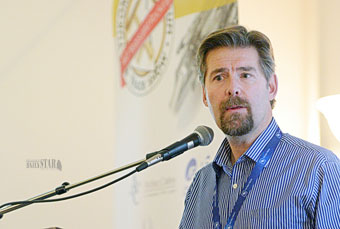
"We are still in the exploration stage of the project here,” Don Stachiw emphasized during his presentation to this week's annual Yukon Geoscience Forum in Whitehorse.
"The time to commercial development is contingent upon our success, but it is measured in years, and not months.”
Stachiw acknowledged, however, that while the primary commercial target is supplying liquified natural gas (LNG) to a local market, if quantities warranted, a pipeline to the coast is possible.
The overseas market for natural gas is favourable, he pointed out.
Stachiw said results from the six exploration holes to be drilled before the thaw next spring and historical data from 34 wells drilled on Eagle Plain from the 1960s through to the 1980s will provide the company with an initial analysis.
Current estimates by the Geological Survey of Canada suggest 6,000 billion cubic feet of natural gas, and 450 million barrels of oil, he indicated.
The Eagle Plain basin, said the vice-president of exploration, is the largest of the Yukon's eight onshore basins, and Northern Cross has 1.3 million acres of the basin under lease.
Stachiw said 27 of the 34 wells already drilled showed signs of hydrocarbons.
Of the six exploration wells Northern Cross has to complete to fulfill work commitments made to secure the land leases, one has been completed, one is being drilled currently, three more are scheduled for this winter and one next spring, he told the audience.
Completing the six holes, he said, will satisty the remaining work commitments of $18 million in expenditures.
Stachiw acknowledged the attention that fracking – hydraulic fracturing – has been receiving in the Yukon of late. (See separate story, p. 4.)
But Northern Cross, he added, is primarily focused on conventional methods of oil and gas exploration and development.
The company is, however, gathering all types of data as it drills its way down the bottom of holes, he pointed out.
"We still have a lot of work to do to undersand if there is any potential in the shales and the best way to do it.”
Stachiw said examining the shales and the potential for commercial production with unconventional reservoirs of natural gas is on a much longer timeline than the company's approach to a conventional project.
The benefits to the Yukon of a successful oil and gas sector are self-evident, he told the audience.
They include economic diversity, a local supply of energy and another base to generate revenues from resource royalties, he said.
Stachiw said natural gas is a cleaner-burning fuel, and has the ability to displace other local fuels that don't burn as cleanly.
"We will hopefully establish a resource base that will allow for the development of local and export markets,” he said in his 20-minute presentation.
Both Yukon Energy and Yukon Electrical Co. Ltd. have indicated an interest in switching their diesel generators to natural gas.
Delegates at this week's geoscience forum heard how Yukon Energy is exploring supply options for LNG from down south, and the logistics of transporting and storing it at or near the generating plant at the Whitehorse Rapids Dam.
They also heard how the rising demand for electricity has eaten up the availability of surplus hydro in the winter months, requiring regular diesel generation to keep the lights on in the last couple of years.
Western Copper and Gold Corp. is advancing its Casino property 100 kilometres northwest of Carmacks, on the south side of the Yukon River.
The company has indicated if the mammoth project proceeds, it would be looking at LNG as a fuel source to power its own generating plant.
Liquified natural gas is said to be not only much cleaner than diesel fuel, but cheaper.
Don Strickland, the general manager of Yukon Zinc's Wolverine Mine, mentioned this week it will be keeping an eye on development proposals to switch diesel generators to generators powered by natural gas.
The Wolverine Mine, he explained, has eight diesel units on site, six of them running full-time, one on standby to handle load fluctuations and one in scheduled maintenance.
Be the first to comment