Commission member to lecture this evening
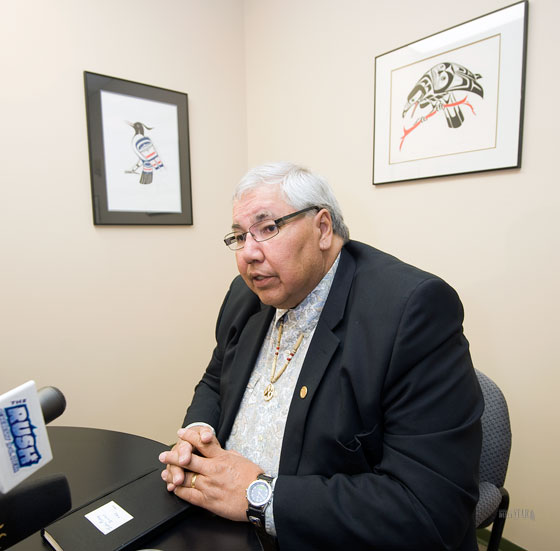
Justice Murray Sinclair, a commissioner on Canada's Truth and Reconciliation Commission, is in Whitehorse to present a lecture this evening entitled Will Truth Bring Reconciliation? as part of the 30th anniversary of the Canadian Charter of Rights and Freedoms, being celebrated across Canada today.
By Max Leighton on April 17, 2012
Justice Murray Sinclair, a commissioner on Canada's Truth and Reconciliation Commission, is in Whitehorse to present a lecture this evening entitled Will Truth Bring Reconciliation? as part of the 30th anniversary of the Canadian Charter of Rights and Freedoms, being celebrated across Canada today.
The lecture will discuss the relationship between truth and reconciliation, the work of the commission and what still must be done to come to terms with the legacy of residential schools.
That legacy resides deeply within the history and the psyche of the Canadian public, Sinclair told reporters this morning.
In 1920, Dr. Donald Campbell Scott, then head of the Department of Indian Affairs, said: "I want to get rid of the Indian problem.... Our objective is to continue until there is not a single Indian in Canada that has not been absorbed into the body politic and there is no Indian question, and no Indian Department, that is the whole object of this bill.”
The commission was established in 2006 to help the continuing work of bringing justice to survivors and their families.
"With any kind of relationship where there has been a breach of trust, where trust has been damaged, if parties want to repair the relationship, there has to be an establishment of trust,” Sinclair said. "That's what reconciliation is all about.”
A fundamental aspect of truth and reconciliation has been addressing the issue of government responsibility for the system.
"Discussion needs to be built around the breach,” said Sinclair. "If a couple wants to get back together, for instance, there are questions they need to asked: ‘Do you know what you did?' ‘Does Canada know what it did?' And if it does, ‘Can we discuss how to move forward?'”
Understanding the lasting effects of residential schools and residential school abuses are another vital component of the commission's work.
The legacy of residential school is something that affects all Canadians, he said.
"All Canadians have been impacted and many don't seem to realize it,” he said. "It's not just an aboriginal problem, it's a Canadian problem.”
The extent of the damage done by residential school to Canada's aboriginal peoples, their cultures, family structures, knowledge of their own history and identity is still coming to light.
"Aboriginal children were systematically taken from their families and removed from their culture, their language and sense of who they were... they were taught that their language and history was primitive and the only way was to become ‘Christian' and ‘civilized.'”
The extent to which residential schools have affected even non-First Nations society is less understood, said Sinclair.
He believes the same system has failed aboriginal and non-aboriginal Canadians alike, revising Canadian history and our collective self-image, in favour of former government's colonial agenda.
"That same message was given to both aboriginal and non-aboriginal students in the public school system as well,” he said.
"There was no discussion during my generation or many subsequent ones about the cultures that existed before contact, what they were like, the validity and importance of the cultures to their people. Because what was lost had value. It had value to those who lost it.”
The truth and reconciliation process in Canada is still in its infancy, said Sinclair.
Gains made by the process have come slowly, including substantial federal funding commitments to aboriginal healing, the prime minster's June 2008 apology for assimilation policies and statements made by the RCMP for their own role in the residential school system.
Sinclair believes further institutional change is likely some time away, but the commitment to continuing the process remains vital to repairing one of the greatest rifts in Canadian society.
"We need to see truth and reconciliation as a long-term commitment, as residential schools themselves were,” said Sinclair.
"We need to have a statement as powerful as Duncan Campbell Scott's in 1920.... We need to make an equal and opposite commitment that aboriginal rights be respected, because aboriginal people are not going to go away, aboriginal issues are not going to disappear.”
Sinclair will speak at 7:00 this evening at The Old Fire Hall on First Avenue.
Members of the public are welcome to attend.
Be the first to comment