College joins affordable housing project
The construction of a new affordable housing unit where the notorious 810 Wheeler St. drug house used to be will go ahead with the participation of Yukon College, it was announced today.
By Jason Unrau on January 20, 2009
The construction of a new affordable housing unit where the notorious 810 Wheeler St. drug house used to be will go ahead with the participation of Yukon College, it was announced today.
"We're going to have a needy family, or needy families, who are going to have a home, the students are going to be engaged in an exciting project and learning skills ... (and very) importantly, we're going to be expanding green technology that will benefit all of Yukon and all of the North," said college president Terry Weninger.
"So what kind of a better project can you have? Three winners all there."
Weninger was joined this morning at the college by Whitehorse Centre MLA Todd Hardy (who is also the president of the Habitat for Humanity Yukon chapter) and Jim Kenyon, the minister responsible for the Yukon Housing Corp.
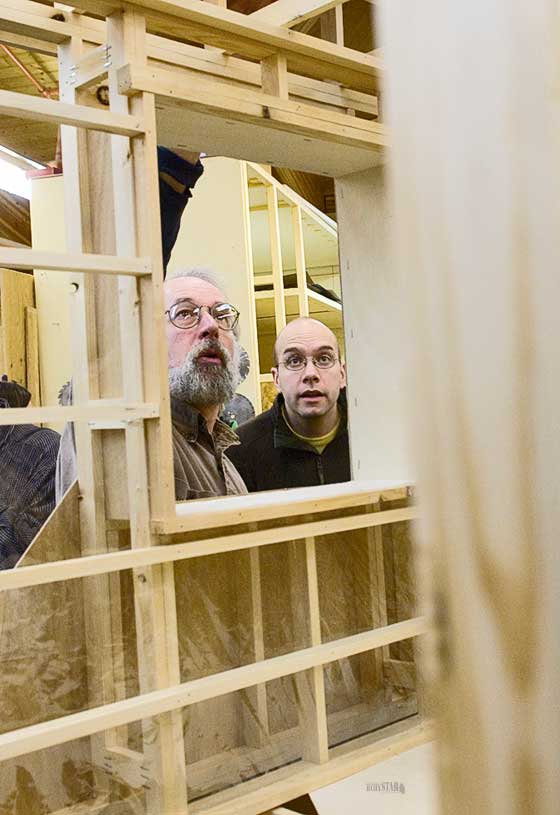
On top of providing much-needed low-cost housing for Whitehorse, the government-college-NGO partnership will train future tradespeople in building what's being touted as "super green" construction.
Al Lyon, the housing corporation developer who came up with the design, said the prototype will cost approximately $30,000 more to build but would require cheaper heating infrastructure and reduce the owner's heat expenses by 80 per cent.
"The difference is, a house that would cost you $4,000 to heat with high fuel prices, would cost you 20 per cent of that (with this design)," said Lyon.
"The issue here is people can afford to make the mortgage payment but they get into the house and … they can't afford to make the heat payment."
In addition to purchasing the property, funding the design work and assisting with the mortgage, the housing corporation will place an onsite teaching facility to train college students, and Habitat for Humanity volunteers, on how to build the house.
Lyon, who described the innovative design as a house within a house, told the Star that installing windows and ensuring decent indoor air quality with such a high level of insulation were the key challenges.
"The heating load is so low here, if you've got a house full of kids running around and a fridge running with heat coming off the back, you could probably heat this house," added Lyon, basing this efficiency claim on a 1,000-square-foot home.
"Sure, the next ones might be $15,000 to $20,000 more, but the heating system reduction (in costs) is going to be $12,000 to $15,000."
While Lyon provided the technical explanations, Kenyon offered a more humourous take on the super green home.
"We joke about the fact you can heat it with a cat ... in a really big one, I guess you could heat it with two cats," said Kenyon.
The overall goal of bringing the college on side, Kenyon said, was to prepare current and future tradespeople to construct this new design, which is anticipated to become the norm in Yukon home building.
Construction is expected to begin in May. It will be the third such Habitat for Humanity project in the territory. The group has already built two homes in Watson Lake.
"I'm extremely pleased," said Hardy. "This will be a huge benefit for what Habitat for Humanity tries to do in the community ... building simple and affordable housing, and the efficiency will allow these people to afford this house."
Applicants for the Habitat for Humanity program must go through an interview program and, if selected, must contribute 500 hours to the construction of their house.
While Habitat for Humanity relies on donated building materials and manpower, the new owners must pay an interest-free mortgage relative to their incomes. That money is then used to finance other builds.
Be the first to comment