Photo by AinslIe Cruickshank
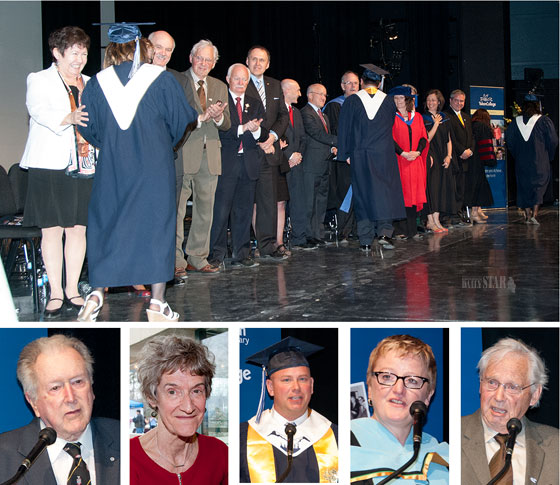
WELL DONE – Geraldine Van Bibber (far left), Yukon College's chancellor, led the receiving line during Saturday's graduation ceremonies. James Smith, Julie Cruikshank, Cody Doerksen, Karen Barnes, Thomas Berger
Photo by AinslIe Cruickshank
WELL DONE – Geraldine Van Bibber (far left), Yukon College's chancellor, led the receiving line during Saturday's graduation ceremonies. James Smith, Julie Cruikshank, Cody Doerksen, Karen Barnes, Thomas Berger
Yukon College celebrated its first batch of graduates from four new programs Saturday.
Yukon College celebrated its first batch of graduates from four new programs Saturday.
Natasha Sandra Ayoub was the first student to complete a bachelor of science degree, from the University of Alberta, entirely North of 60.
The college also celebrated first-time graduates from the mineral resource technology program, the First Nations governance and public administration program, and the medical office assistant program.
In all, 160 students walked across the Yukon Arts Centre stage this year, the college's 50th anniversary, to receive their hard-earned certificates, diplomas or degrees.
College president Karen Barnes urged the graduates to enjoy the moment, but encouraged them to keep pushing themselves.
"Push continuously, and grow continuously as a human being; don't ever stop learning. This is just the beginning, and it should be,” she said.
Premier Darrell Pasloski, one of several community leaders on hand, highlighted how far the college has come from an institution that offered only a handful of course options to one that now provides more than 50 opportunities to complete full degree programs.
"The previous graduates helped build the territory into what we enjoy today, and you as our new graduates will help build the Yukon of tomorrow,” the premier told the 2013 grads, expressing confidence that the future is in good hands.
Thomas Berger, a renowned aboriginal law attorney, gave the keynote address at both the morning and afternoon ceremonies.
In 1971, Berger became the youngest judge appointed to the B.C. Supreme Court in the 20th century.
But 12 years later, he would resign that seat in protest of a decision not to include aboriginal rights in former prime minister Pierre Trudeau's repatriated Constitution.
Berger has been honoured with both the Order of Canada and the Order of B.C. He is the author of several books, including one about his experience leading the 1970s inquiry in the Mackenzie Valley Pipeline.
The government of the day accepted the inquiry's recommendations and did not approve the pipeline.
Instead, parks were created to protect the porcupine caribou herd and a moratorium was placed on resource development in the area, a landmark decision even today.
Berger was introduced Saturday morning as "a man with principle, a man of conviction, a man who is a role model for all of us.”
Berger shared how he came to be so intimately involved with aboriginal rights and environmental issues through a mentor.
Neither topic was taught when he was in law school in the '50s, he explained; they emerged as important concerns over the years.
"You are the folks that will continue to develop new ideas and new frontiers in relation to those questions of social and science policies,” he said.
"You have challenges that are going to keep you busy. I know you're grateful to your families and your friends, and you have duties to your family and your friends but you also have duties to your community and your country,” he told the grads. He urged them to devote themselves to the betterment of society.
Cody Doerksen, a graduate of the northern justice and criminology program, gave the student address.
Congratulating his fellow graduates, he urged them to be proud of their accomplishments.
Doerksen explained he was a chronic under-achiever in high school, more interested in having adventures with his friends.
He was intimidated returning to school, but smaller class sizes and dedicated instructors eased his fears.
"My high school teachers always told me that if you did your reading on time, participated in class and tackled your homework with enthusiasm, you'd be able to live up to your potential,” Doerksen said.
"My parents always told me that if you work hard and show dedication, it will pay off. I was shocked when I realized that my teachers were right.
"And it was humbling when I realized that my parents were right all along. I should have listened to them,” he said.
His time at the college helped him to realize his potential and gave him the drive to continue his education, he said.
The college gave three honourary diplomas this year, one to anthropologist Julie Cruikshank, one to former Yukon commissioner Jim Smith and one to former Tr'ondek Hwech'in chief Percy Henry.
The 93-year-old Smith, who led the charge for the devolution of federal powers to the territory in the early 1970s, was awarded his diploma during the morning ceremony.
While in 1973 the federal government did not move forward with devolution, it gained a better understanding of the Yukon's situation after receiving Together Today For Our Children Tomorrow, the First Nations-produced document which began land claims negotiations in earnest.
Smith would later produce a paper, Meaningful Government For All Yukoners, which would be a foundation for devolution and First Nations relations.
Smith expressed gratitude to the college for the honour, before thanking his long-time supporter, his wife. She made his public life possible, he said.
Cruikshank, professor emerita at the University of British Columbia, received her honourary diploma during the afternoon ceremony.
Cruikshank lived for close to a decade in the territory, where she was active with the Yukon Language Centre working with First Nations elders to record their oral histories.
She has written several books and received the Order of Canada last January.
"It's a tremendous honour,” Cruikshank said of the diploma following the morning ceremony.
It's brought back warm memories of the college and how important it was to her life in the Yukon, she said, noting particularly the late Angela Sidney, who was an instrumental teacher for her.
Henry was awarded his honourary diploma in Dawson City in April.
He was a key force behind the land claims movement while he served as chief between 1968 and 1984 and was part of the contingent of chiefs who travelled to Ottawa to present Together Today to Trudeau.
Henry currently works as the language master in TH's Heritage Department.
In order to encourage thoughtful and responsible discussion, website comments will not be visible until a moderator approves them. Please add comments judiciously and refrain from maligning any individual or institution. Read about our user comment and privacy policies.
Your name and email address are required before your comment is posted. Otherwise, your comment will not be posted.
Be the first to comment