Coalition updates local housing picture
A lack of transitional and supportive housing options still presents a significant hurdle in Whitehorse.
By Ainslie Cruickshank on June 6, 2013
A lack of transitional and supportive housing options still presents a significant hurdle in Whitehorse.
That's the reality the Yukon Anti-Poverty Coalition has found in its latest housing action plan progress report.
This is the group's second progress report since it released A Home for Everyone: A Housing Action Plan for Whitehorse, two years ago.
Gaping holes are still evident in supportive housing for people exiting correctional centres, leaving drug and alcohol treatment, mental health facilities, or youth care facilities, as well as for people with mental health issues or active addictions, the report finds.
Whitehorse is also lacking emergency shelter for women who are not fleeing abuse and emergency and transitional shelter for families.
The report goes on to note that plans for more emergency shelter space won't address the need for long-term housing options.
Similarly, it notes there hasn't been any significant movement to increase the availability of affordable rental units.
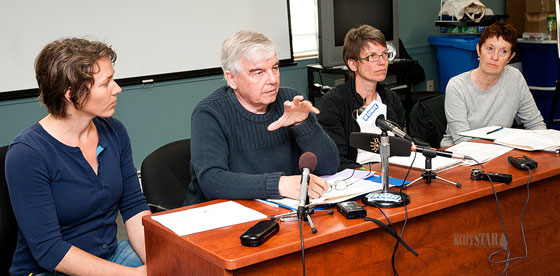
"Low-income and vulnerable Whitehorse residents continue to suffer the impact of inadequate, inaccessible, unaffordable, and insecure housing,” Heather Ashthorn told reporters this morning at the report's release.
"Women in particular continue to face a very bleak picture concerning their housing.”
Ashthorn is the housing advocate for the Blood Ties Four Directions Centre.
But she noted that "we have all of the expertise in Whitehorse to fill these gaps, we're slowly starting to see progress and we're encouraged by that.”
Bill Thomas, who chairs the coalition's housing task force, agrees there are things to be optimistic about.
"We're heading in the right direction,” he said.
The coalition highlighted a number of areas where it has seen progress over the last year.
The City of Whitehorse has listed attainable housing as one of its top five priorities for its strategic plan.
Meanwhile, the Yukon government has announced plans to develop a Yukon housing strategy.
And interest in developing a 10-year plan to end homelessness has been building.
The report highlights the success of Blood Ties' supportive housing project and the Steve Cardiff tiny house.
It also points to a new agreement between the Yukon government and the Salvation Army for an expanded emergency shelter.
The report also notes that six new youth shelter beds opened last January, while Betty's Haven, a second-stage transitional housing program for women, is set to open this fall.
Still, there is work to be done.
Kristina Craig, the coalition's co-ordinator, said she'd like to see targets developed alongside the government's housing strategy.
The coalition is easily able to identify gaps along the housing continuum, but it's more difficult to analyze how far we are from closing those gaps, she explained.
Affordable rental housing is another area that needs attention, Craig argued.
"Without the housing stock, particularly rental housing to have people in, it's very difficult to provide the appropriate supports when you don't have somewhere for people to live.
"We need to be working on both ends,” she said.
As a predominantly advocacy organization, the anti-poverty coalition may face funding cuts if Health and Social Services Minister Doug Graham follows through on comments he made toward last month's end of the spring legislative sitting.
The federal government is tightening its health transfer purse strings in the near future, which means the government will have to do the same.
One area in which the minister imagines he can save money is by cutting spending to advocacy-only NGOs.
But the coalition isn't worried. Craig noted at this point, its funding hasn't been cut.
She also highlighted a number of services the organization provides to the community.
Those include holding three "Connects” days a year, where vulnerable Whitehorse residents can access free services such as haircuts.
Every October, it also holds a Poverty and Homelessness Action Week and works with partners in the city on a number of different initiatives.
Be the first to comment