Coalition releases its latest survival guide
A guide designed to help Yukoners find free or low-cost services around the territory was unveiled Thursday afternoon.
By Ashley Joannou on March 1, 2013
A guide designed to help Yukoners find free or low-cost services around the territory was unveiled Thursday afternoon.
Surviving in Yukon: Where to Get Free or Low-Cost Goods & Services has been published by the Yukon Anti-Poverty Coalition since the 1980s.
Now in its third or fourth incarnation, this latest version of the guide is the first to go beyond Whitehorse, and covers the entire territory. It is also now available in French for the first time.
A Yellow Pages-like guide offers summaries, addresses and contact numbers for services including drop-in centres, food banks, shelters, health care and counselling.
It's a big step up from the original design in 1982 — a standard sheet of paper, folded into six panels.
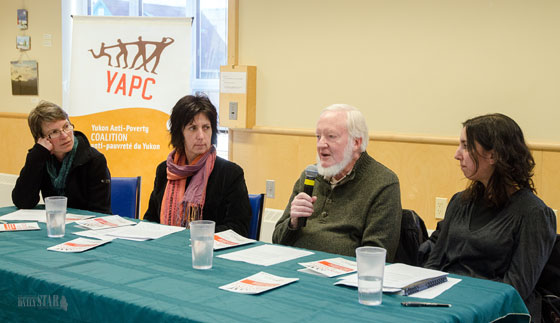
The original guide was put together by volunteers without any government funding, coalition member Ross Findlater remembered Thursday at a press event.
"People were saying they had no idea what existed in the Yukon, or where to get their services.”
The latest, now 18-page guide was funded through a $6,000 grant from Aboriginal Affairs and Northern Development Canada.
About 1,000 English guides and 100 French versions are being printed and distributed through groups around the territory.
"It's really important for our community to have that option,” said Isabelle Salesse, executive director of the Association franco-yukonnaise.
"We're really pleased it was translated into French.”
For service providers, guides like this eliminate some of the barriers facing people who may not have access to information online or through other resources.
"Blood Ties (Four Directions) believes strongly in guides like these,” said Patricia Bacon, executive director of the support centre for HIV/AIDS and Hepatitis C. "Guides like this really work for people.”
"Not everyone can access the phone book or a computer, so something like this is just really fabulous,” Caron Statham, executive director of the Help and Hope for Families Society in Watson Lake, said in a statement.
"It lets people know what is available to them — especially if they are coming into the communities, like Watson Lake, and may not know many people or have much money.”
Since the guide was first created, the number of services available in the territory has grown, said coalition co-chair Reanna Mohamed, but there still aren't enough services to meet the needs.
"The pressure on housing right now is such that people are using more and more of their income to pay rent and have less for food,” Mohamed said.
Hard copies of the guide are available around the territory, as well as online at www.yapc.ca
Be the first to comment