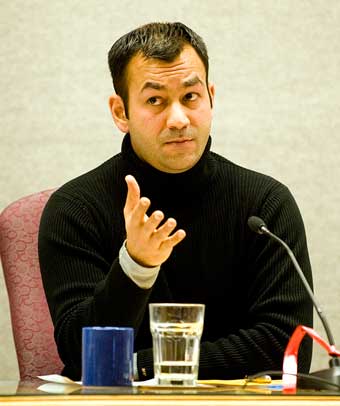
Photo by Whitehorse Star
RANJ PILLAI
Photo by Whitehorse Star
RANJ PILLAI
Whitehorse city councillor Ranj Pillai believes the city needs to take a look at getting into the business of generating electricity.
Whitehorse city councillor Ranj Pillai believes the city needs to take a look at getting into the business of generating electricity.
The city, Pillai insisted in an interview this week, is on an unsustainable financial path.
He believes it should explore any opportunity to establish new streams of revenue besides digging deeper and deeper into the pockets of taxpayers.
The first-term councillor said it might be wise to take a look soon, particularly with Yukon Energy investigating alternatives to hydro generation, including the possibility of burning garbage at the Whitehorse landfill to help drive a power plant.
It would not be in the city's best interest to sit by and watch the publicly owned utility do all the feasibility work and potentially reap all the benefits, he said, with the city receiving only limited opportunities or revenue.
Pillai said entering into a joint-venture with Yukon Energy would not be his first choice. He would rather see the city go it alone or partner with the development corporations of the two local First Nations to purse the initiative.
There's nothing new about using heat from burning municipal waste to generate electricity, he said. (See separate story, this page, on Metro Vancouver.)
Pillai said whether Whitehorse is capable of supporting such a facility is another question.
As Yukon Energy has already indicated, the councillor pointed out, the volume of available garbage may have to be augmented with beetle-killed wood from the Kluane region to make the proposal fly.
But it's indeed worth the city's time to and energy to get in there and investigate the potential so it's not left sitting on the sidelines, he said.
For the councillor, two issues are at the forefront: securing financing for the feasibility work; and, if bettle-killed wood is required, determining whether the environmental impact of trucking logs from Haines Junction outweighs the benefits.
Pillai knows feasibility studies cost money. Whitehorse doesn't have a lot to spare these days, having just announced yet another property tax increase and higher fees for water and sewer services.
There is, however, mounting global interest in finding greener energy to supply growing demand, and there's likely funding available somewhere for the feasibility work – perhaps federal dollars through CanNor, he said.
Pillai said this isn't about arm wrestling with Yukon Energy; it's about looking out for the best interests of city taxpayers.
"I feel, with the current service model we have, to continue on with the service we provide in the city, especially with the anticipated growth and the infrastructure needed to support that growth, I think we need to find some other sources of revenue.”
He's already spoken with an associate at the New York office of Macquarrie Financial who's assured him financing municipal initiatives to generate power is common in North America and Europe.
"Macquarrie will go wherever there's a good deal in place, and they are open to working with municipalities.”
A lawyer with the Bay Street firm who put together the contract which Ontario Hydro uses to establish power purchase agreements with municipalities and other independent producers says the concept is sound, Pillai said.
The city councillor said if some form of energy production is financially feasible using city garbage and perhaps beetle-killed wood, in simplified terms, the rest is standard business: form a city business corporation, secure the capital financing and begin generating revenue through the sale of power.
Pillai pointed out the regional municipalities of Durham and York outside of Toronto have hired a company specializing in municipal electrical generation to get its operation up and running.
Whitehorse could do the same until it had the capacity and expertise to take over, he said.
Pillai said the population of the two regional municipalities obviously put them in a different category.
But there might be a facility out there that suits Whitehorse's profile, he said.
Pillai said while pursuing alternative sources of revenue, the city does not want to compete with the private sector.
"But in the area of waste-to-energy, there's nobody else in it, so it's an area we can get into without anybody getting upset.”
In order to encourage thoughtful and responsible discussion, website comments will not be visible until a moderator approves them. Please add comments judiciously and refrain from maligning any individual or institution. Read about our user comment and privacy policies.
Your name and email address are required before your comment is posted. Otherwise, your comment will not be posted.
Comments (2)
Up 0 Down 0
Icycle on Mar 4, 2011 at 6:08 pm
Sorry to bother again but I just had an idea that I have to share. I did a quick feasibility study and I If my calculations are correct a 'feasibility study burner' should produce enough hot air to heat most of downtown for most of the winter, I think. I'll have to check again but I'm sure the numbers are accurate.
Up 0 Down 0
Icycle on Mar 4, 2011 at 5:19 pm
There happens to be a fluid bed gassifier - complete with feasibility studeeessss up at the college if you might happen to need one.