City mulls 21st-century snowmobile rules
Snowmobilers in the region may soon be operating under some new regulations.
By Gemma Karstens-Smith on July 20, 2011
Snowmobilers in the region may soon be operating under some new regulations.
City council is considering a set of recommended changes to Whitehorse's Snowmobile Bylaw, which was originally drafted and passed in 1972. The current legislation still refers to snowmobiles as "motor toboggans”.
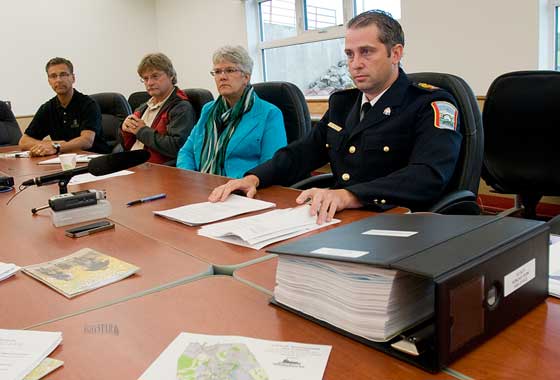
"So that'll tell you how long it's been since we've taken a look at the legislation,” Mayor Bev Buckway said at a press conference this morning.
Misuse of snowmobiles has become an increasingly large issue for the city, Buckway said.
The recommendations currently before council come from city bylaw officials, based on a report prepared by the Snowmobile Task Force. That body was made up of a number of community organizations, government officials and other interested parties.
The public was also consulted in the creation of the recommendations through a DataPath Systems survey: 73 per cent of survey respondents said they wanted to limit snowmobile use in residential neighbourhoods; 72 per cent said snowmobiles should have designated trails within the city; 68 per cent felt snowmobiles should be restricted in where they travel; 59 per cent felt snowmobile use should be limited within the city limits.
Some of the recommendations include creating "out and away” trails whereby city residents can access the hinterland, having clear signage for trails and imposing stiff penalties for people found to be operating their snowmobiles off trails.
The snowmobile bylaw should also say where snowmobiles can drive on trails, the recommendations say.
Any new trail development should include the active participation of the Department of Environment, and should be developed by trail committees in the affected community, according to the recommendations.
Currently, the region's approximately 8,000-km-long trail network includes about 400 km of trails for motorized vehicles.
Other recommendations look to protect environmentally sensitive areas in the region, prohibiting snowmobiles in areas designated as "sensitive” in the Official Community Plan.
It's also recommended that public service announcements be created to let users know when they can snowmobile in non-restricted areas.
"There are certain other areas that may not be environmentally sensitive, but we do live in the North and vegetation does have a tough time growing in certain areas so we do want to make sure that other areas don't become damaged due to snowmobile use,” Dave Pruden, the city's manager of bylaw services, told the news conference.
Another recommendation says snowmobiles should be classified as motor vehicles under the Protected Areas Bylaw, restricting their operation in areas listed under the bylaw. They are not currently classified as motor vehicles under the bylaw.
The public survey showed people are concerned about the effect of snowmobiles on the environment, Buckway said.
"It's very clear that citizens would like to see a balance struck between environmental protection and lifestyle, recreation and public safety in our community,” she said. "We also recognize that that's a very difficult balance to achieve because they are diametrically opposed positions on the subject.”
Several of the recommendations suggest limiting the use of snowmobiles in residential areas. One recommendation suggests snowmobiles not be allowed to drive within residential areas, except on designated trails.
This would mean the vehicles could no longer drive on roadways. Driving a snowmobile from a residence to a trail, which is currently allowed, would be prohibited.
New speed limits are also included in the recommendations.
Currently snowmobiles are allowed to go 15 miles per hour (24 km/hr) in residential zones. It is recommended they be allowed to go 30 km per hour on residential trails (such as the Hamilton Boulevard trail) and 50 km/hr on trails not within residential areas.
Other recommendations clarify current legislation, such as the need for anyone riding a snowmobile to wear a helmet.
"There seems to be some confusion as to whether it's law or not,” Pruden said. "It is the law in the Yukon for snowmobilers to wear helmets under the Motor Vehicle Act.”
Snowmobiles must also be registered with the motor vehicles branch and have licence plates, as per the Yukon government's regulations.
Operators must also have a valid licence and be at least 16 years old. One new recommendation is to have operators take a snowmobile safety course.
"When we talk about licensing and registration and those kinds of things, they are already required in legislation from the territorial government,” said city manager Dennis Shewfelt.
"These are not new things that the City of Whitehorse is trying to impose on anyone. What we're doing, really, is asking the territorial government to be more vigilant and enforce their own legislation.”
It's nearly impossible to enforce bylaws when there's no way to identify the people breaking the rules, Pruden and Shewfelt said.
"Without those licence plates on those snowmobiles, it's very difficult to identify that small percentage of users that operate their vehicles in an unsafe or inconsiderate manner,” Pruden said.
Bylaw enforcement will continue to be on a complaints basis.
"We do not have the resources or the staff levels or the ability to put staff levels in there to do regular patrols on the trail network,” Shewfelt said.
However, Pruden emphasized that updating the rules will help in education. A lot of complaints have been around young people using snowmobiles, he said.
"So we need to start hitting the youth with information,” Pruden said, adding that it's necessary to have a bylaw in place to show how important things like the environment and public safey are.
"The key here is not bylaw enforcement .... The key is education.”
Now that council has the recomendations, it will take a look and tell administration which ones they do and don't want to pursue.
If, from there, a new bylaw needs to come forward, city staff would do so under the city's bylaw process, which includes a public consultation.
"Recommendations are not set in stone at this point,” Pruden said.
Initially, the goal was to have new rules in place by the time the snow flies and operators are itching to jump back on to their machines.
"It could still happen,” said Pruden. "It's really pretty fluid on where the process takes us.”
No matter where the recommendations go, Pruden said, they're not meant to penalize all operators.
"Most snowmobile users are respectful when they're out there. However, there are a percentage of the users out there who are not respectful, and they are the ones who might be causing disturbances in neighbourhoods or out in the green spaces or along the trails.”
Comments (1)
Up 0 Down 0
Yukon Dsl on Jul 21, 2011 at 1:49 am
Sounds like an exercise in futility to me.
In a news story from the July 15th edition of the Yukon News titled, "Bike helmet law scarcely enforced", Mr Pruden commented on enforcing another of Whitehorse's bylaws.
"Less than 20 tickets have been issued since it became mandatory for all cyclists in Whitehorse to wear helmets in July of 2003, estimates Whitehorse Bylaw Services manager David Pruden.
"I know from being in the department for 17 years, off the top of my head, since the bylaw has been in place, we probably haven't written more than 20 tickets,” said Pruden.
"At the onset we were looking to do it through voluntary compliance and education. So for the first three years we just had officers warning people and whatnot, to make sure they wear their helmet.