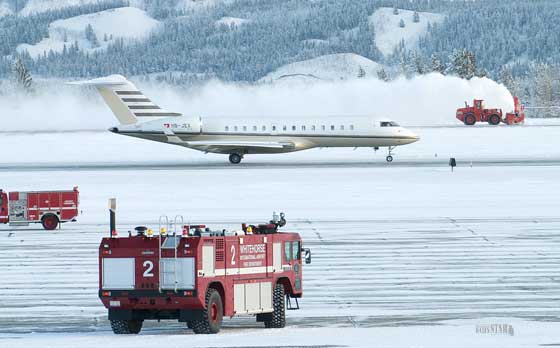
Photo by Vince Fedoroff
WORLD RECORD PACE - Whitehorse was the first stop for this high-flying Bombardier Global Express during its recent record-setting endeavour to fly around both magnetic poles in the fastest time.
Photo by Vince Fedoroff
WORLD RECORD PACE - Whitehorse was the first stop for this high-flying Bombardier Global Express during its recent record-setting endeavour to fly around both magnetic poles in the fastest time.
As though it was a NASCAR pitstop, the long-distance jet was in and out of Whitehorse in a relatively snappy 40 minutes while on its way to setting a world speed record.
As though it was a NASCAR pitstop, the long-distance jet was in and out of Whitehorse in a relatively snappy 40 minutes while on its way to setting a world speed record.
Shortly after the aircraft touched down here at noon on Nov. 21, two local fuel trucks hooked up to the high flyer. The second they finished fueling, the Bombardier Global Express taxied down the tarmac and was airborne in what seemed like seconds.
The crew, led by aeronautics notable Aziz Ajjeh, landed Nov. 23 in Farnborough, England, setting a new record for flying around both the North and South Poles, with a time of 52 hours and 31 minutes.
The previous record of 54 hours and seven minutes was established back in 1977 by a Pan-Am Boeing 747.
The Global Express made five stops on its polar mission after departing from Farnborough en route to the North Pole, before turning south. Whitehorse was the first stop, nine hours and 33 minutes into the endeavour.
"It was the first, and I think it was the longest stop," Bombardier spokeswoman Danielle Boudreau said on behalf of the record-setting effort sponsored by the international TAG Group. "Afterwards, I think they were a lot quicker."
Though uncertain of the average speed, Boudreau pointed out the goal was to travel an average of 792 kilometres an hour (492 mph). The Pan-am fight travelled at an average speed of 782 kilometres per hour (487 mph).
After leaving Whitehorse, Ajjeh and crew spent another six hours and 27 minutes in the air before landing in Majuro, Marshall Islands, in the South Pacific. Next was a flight of six hours and 31 minutes to hit Christchurch on New Zealand's South Island.
Flying from Christchurch south to the South Pole, and then North to Punta Arenas at the southern tip of Argentina, was the longest leg at 10:46.
The second longest leg, just 15 minutes longer than the Farnborough-Whitehorse stretch, took the crew to Sal in the Cape Verde Islands off the east coast of Africa.
After a pitstop of just 16 minutes, the Bombardier Global Express left for what was the shortest leg, arriving back in Farnborough west of London in 4:52, with a new world speed record.
"It was an endurance test for them, but also for the aircraft, because it was a long time flying with very little stopping time," said Boudreau.
She said the Global Express is purpose-built aircraft to serve private clients, corporations and governments, and is not for commercial use, other than the occasional charter flight.
It has a maximum altitude of approximately 51,000 feet, and normally cruises at between 45,000 and 48,000 feet, substantially above normal commercial traffic.
Boudreau said the Global Express hit the market 12 years ago, and sells for $50 million.
"It can fly up to 14 hours, depending on the configuration and number of passengers," she said. "In its category of jet, which is ultra-long range, it can fly further and faster than any other jet, and it has a bigger cabin than any of our competitors.
"So it really is what we call our flagship aircraft. It really is an impressive jet."
She said Ajjeh has been looking at the polar record for 25 years, and was only waiting for the right aircraft to come along.
Ajjeh, vice-president of the TAG Group's aviation arm based in Geneva which distributes Bombardier aircraft to the Middle East, also holds the record for the fastest time flying around in globe in a eastward direction.
Four other pilots accompanied Ajjeh, along with an in-flight co-ordinator, and engineer and an onboard observer.
Also to assist the effort, a Bombardier flight technician was stationed at each of the checkpoints to assist with anything that might arise, Boudreau said.
She did not know what the record flight cost, but did point out the TAG TransPolar08 project will be buying carbon credits to offset that footprint of its flight.
In order to encourage thoughtful and responsible discussion, website comments will not be visible until a moderator approves them. Please add comments judiciously and refrain from maligning any individual or institution. Read about our user comment and privacy policies.
Your name and email address are required before your comment is posted. Otherwise, your comment will not be posted.
Be the first to comment