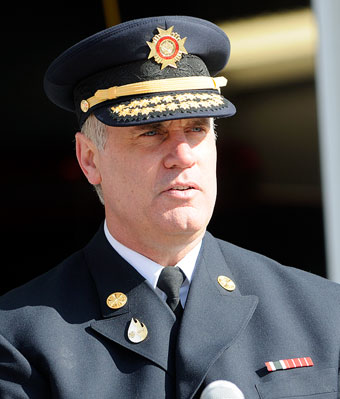
Photo by Whitehorse Star
Jim Regimbal
Photo by Whitehorse Star
Jim Regimbal
Dawson City's fire chief thinks it's time for 911 services to be available across the territory.
Dawson City's fire chief thinks it's time for 911 services to be available across the territory.
Jim Regimbal is in Whitehorse to speak at Saturday's Association of Yukon Communities' board meeting.
He hopes to get the board to support his call to reactivate a territorial 911 committee, and eventually start offering the emergency phone throughout the Yukon.
"If someone in Whitehorse can phone 911 for an emergency, someone in Dawson should having that same ability,” he said in an interview.
"Whoever phones 911 wants to know that there's somebody answering the line.”
Regimbal has been studying the possibility of have 911 services in Dawson for some time.
He has already received letters of support from several organizations. Those include the Association of Yukon Fire Chiefs, the Canadian Association of Fire Chiefs and the Dawson City Firefighters Association.
But Regimbal believes there is no reason 911 can't be available across the territory from a central answering hub connected to all the communities.
Northwestel Inc. already has the capabilities to offer 911 in the communities. The company is just waiting for a costumer to pay for the service, company spokesperson Emily Younker confirmed.
In a February 2009 911 feasibility study for the Yukon government, it was estimated that offering 911 throughout the territory would cost customers about $1 a month per phone line or cell phone.
The report goes on to recommend the expansion of 911 services to four of the territory's largest communities (Dawson, Watson Lake, Carcross and Tagish).
This would cost the government $630,000 initially and about $104,000 a year after that.
The same report estimates the additional costs to expand the service territory-wide would be around $1 million annually.
The report makes a number of suggestions for how the costs could be covered, including by the territorial government shouldering the costs alone or through some form of a cost-sharing agreement.
Regimbal points out that this report was done nearly four years ago, and the cost may have dropped since then.
That's why it's important for the intergovernmental 911 committee, which was formed in the mid-'90s, after Whitehorse 911 was created, be reactivated, Regimbal said.
"Let's reconvene the 911 committee, have qualified people on the committee that can make decisions,” he said.
Matt King, a Department of Community Services spokesperson, said the committee has not been active since 2009.
A subcommittee, which deals specifically with technical issues surrounding Whitehorse service, is still active, he said.
At the time of the feasibility study, the department's focus was on making other technical improvements to emergency responses, such as consolidating services and the construction of the new Public Safety Building atop Two Mile Hill.
King said today his department is willing to be part of any future group looking at 911 expansion, and will also look at the possibility of re-establishing the old committee.
Currently, 911 is available only within Whitehorse, but ends about 70 kilometres along the Klondike Highway.
Its been that way for 17 years.
All calls within the city are filtered through the RCMP. But that practice is changing around the country.
"Police departments want to get out of dispatching,” Regimbal said. "They want to dispatch for their own. They're slowly moving away from dispatching for EMS and fire.”
In communities outside the city, residents are forced to call a seven-digit number in an emergency.
Each emergency numbers begin with the community prefix and ends in 2222 for fire, 4444 for ambulance or 5555 for police.
In communities like Dawson, calls to the fire department ring on the radios carried by firefighters.
For the ambulance and the nursing station, a clerk answers the phone on a regular work day.
After hours, a person follows steps to be transferred to an emergency cellphone.
"So there's about three steps you have to go through; there's a lot of human factor there and a lot of time that could be lost,” the chief said.
Meanwhile, most people, including tourists and Dawson residents, naturally assume 911 is the right number to call in an emergency.
Regimbal said he spends a lot of time talking to Dawson kids in school about the emergency numbers.
"A third of the class, when I ask for the emergency number, they say ‘911.' Another third of the class, they don't know the numbers, and these are people that live here all the time.”
In reality, anyone who tries to call 911 receives only a message that "Your call cannot be completed as dialed.”
At the very least, that should change, the chief said.
"What I'd like to see is, if someone phones 911 out of here, they can say, ‘911 is not available in this community; here are the emergency numbers.'”
That was a recommendation in the 2009 study as well, but was never acted on.
Regimbal is imagining a scenario where there would be one 24-hour central answering system where people are trained to answer, ask the pertinent questions and then fire it back to the appropriate first responder.
The central location could be situated anywhere in the territory, he said.
The skilled personnel would not only streamline the process but also help protect the safety of the first responders.
"If the call is being put forward to a place where they have qualified people asking the right questions, then when the call goes through to the right services —whether it's ambulance or fire — they're getting the right, pertinent information,” he said.
It's also important for the territory's 911 service to be an enhanced version that can recognize a caller's address or provide first responders with an approximate location if
the call is coming from a cell phone, he said.
Liberal MLA Sandy Silver has given Regimbal's plan his support.
In October, the Klondike representative issued a motion urging the government to work to establish 911 service in that community.
Silver said today he would also support expanding the service across the territory.
"It happens that Dawson is the community where the ball got rolling, but there is a need for this service to move forward,” he said today.
Regimbal said he recognizes that expanding 911 is not something that can happen right-away, but says it's important to start forward on a plan.
"It's simple to do; the political will has to be there, and the education. I think the time's come; we've got to move forward on it.”
In order to encourage thoughtful and responsible discussion, website comments will not be visible until a moderator approves them. Please add comments judiciously and refrain from maligning any individual or institution. Read about our user comment and privacy policies.
Your name and email address are required before your comment is posted. Otherwise, your comment will not be posted.
Comments (1)
Up 0 Down 0
Nick on Dec 7, 2012 at 12:28 pm
Jim,
Could not agree more. To establish this service, it is vital to ensure that that the Whitehorse EMS station 911 system is staffed properly, that is with enough staffing coverage to ensure that staff are not overwhelmed. As well, there is a lack of carrying capacity of call volume, so that its entirely possible to get a busy signal if, memory serves me correctly, if all 4 lines are busy. Mr. King in Community Services Communications is well versed in the proper "messaging", however, the public should know that if not for the extra mile our Paramedics go every day for our community, we would be having serious service gaps due to the years of chronic underfunding to EMS and the 911 system. As we have an increase in population, and with more seniors staying up here, Jim is right, we need a 911 system that works all day, everyday without compromising staff and risking lives.