Chief has never encountered lightning-caused building fire
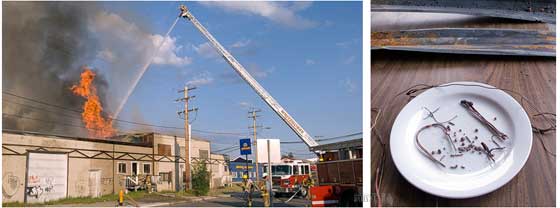
Faced with a puzzling investigation, RCMP and the Whitehorse Fire Department have determined lightning caused a June 11 fire in an abandoned building downtown.
By Elizabeth Hames on July 8, 2009
Faced with a puzzling investigation, RCMP and the Whitehorse Fire Department have determined lightning caused a June 11 fire in an abandoned building downtown.
The building at 3181 Third Ave., beside NAPA Auto Parts, was uninhabited at the time of the evening fire, which drew hundreds of onlookers.
However, one door was unsecured, which made it suspicious, and RCMP were called to assist with the investigation.
Making their way through the desbris and electrical systems, investigators became increasingly perplexed by their discoveries.
After finding the initial site of the fire, investigators dug through the rubble only to find their first clue: a melted piece of copper wire.
"Generally, a structure fire won't melt copper wire, so that's one of the things we look for when we're doing an investigation," Warren Zakus, the fire department's chief training officer, told a media briefing this morning.
Copper wire doesn't melt until the 1,000 degree C point, and temperatures in a regular structure fire usually don't exceed 800 C, he said.
'Because the building was not supposed to have any electrical power in it, it was a little unusual to find that melted copper wire," said Zakus.
So they contacted Yukon Electrical Co. Ltd. and the territorial government electrical inspector who investigated the site. Officials then determined that the electrical system had been properly disconnected and sealed and there was no electrical power in the building.
Left with a mystery, the RCMP and the fire department took a closer look at the electrical system.
"As we pulled it apart, we saw more and more extensive damage to the electrical system," said Zakus.
"Really, the extent of the damage was far what would exceed any electrical malfunction that might occur."
That was when investigators started raising the possibility of a lightning strike.
"Our investigation of the building really didn't yield and clues or any indication that would suggest it was an intentionally-set fire, but we did find a number of clues that would indicate the possibility of a lightning-caused fire."
Indicating a blackened metal panel of a fluorescent light fixture and a set of small melted wires, Zakus said, "It would be literally impossible to melt those wires through a regular electrical short .... In a number of lights, they would be completely evaportated."
A smaller fire in another location in the building was also an indication that the cause was lightning.
For a second opinion, investigators sent photos of the scene to experts in B.C. and Manitoba who have experience with lightning-caused blazes.
"They verified our thoughts that the most likely cause for this fire was a lightning strike," said Zakus.
There had been lightning earlier that day, but the fire was not reported until 8:42 that evening.
Fire chief Clife Sparks said it would not have been unusual for it to take a few hours for a passerby to notice the fire.
"It would smoulder away for quite some time before it would be burst into flame," he said.
Zakus said there is an antenna on the top of the building, but there was no indication the lightning had hit it.
"Lightning doesn't always strike the tallest metal object nearby and quite often is just completely random in terms of what it hits," said Zakus.
Sparks said in his 40 years in the Yukon, he has never encountered a lightning-caused building fire.
"It's quite unusual to have lightning strikes in a building here," he said.
"It doesn't mean that it hasn't happened; we may not have seen it properly or it may have been put to another cause."
"(Lightning) does very strange things you just can't explain with normal methods," said Sparks.
Be the first to comment