Photo by Whitehorse Star
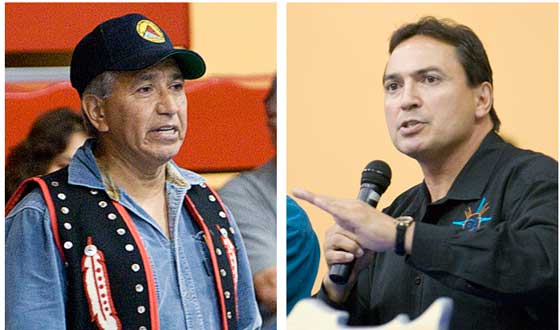
Kwanlin Dun First Nations Chief Mike Smith and Perry Bellegarde
Photo by Whitehorse Star
Kwanlin Dun First Nations Chief Mike Smith and Perry Bellegarde
The Yukon government's recent seizure of a newborn right after birth was nothing short of horrible,
The Yukon government's recent seizure of a newborn right after birth was nothing short of horrible, Kwanlin Dun First Nations Chief Mike Smith told fellow aboriginal leaders Wednesday.
There wasn't even the opportunity for the mother and child to bond, he told delegates and guests attending the 29th annual general assembly of the Council of Yukon First Nations.
Smith made his pointed remarks on the heels of a campaign speech by Perry Bellegarde, an aboriginal leader from Saskatchewan and one of five candidates running for grand chief of the Assembly of First Nations.
Bellegarde and two other candidates who addressed delegates said there is a pressing need for Canada's first nations to stand united against the federal, provincial and territorial governments who don't want to recognize aboriginal rights or honour treaties.
Kwanlin Dun was in court Tuesday to fight the seizure of one of its citizens, and to determine what obligation the Yukon government has to consult before doing such a thing, Smith told delegates.
He said in this case, there was no consultation whatsoever.
In an interview afterward, the chief described the Yukon government as somewhat dysfunctional.
In the government's eyes, Smith said, it's their bat, their ball and their rules.
"The big problem with government is its all or nothing for them," he said. "You're either 100 per cent behind them, or you're 100 per cent on the outside.
"Getting both governments to work together, that is just not in the cards for them," Smith said.
The Carcross-Tagish First Nation tried and tried to work with the Yukon to bring together their two pieces of child protection legislation, but just couldn't get through, he said.
He said another slap in the face was the government's insistence that Kwanlin Dun had no standing in the case of the infant, did not have the right to enter evidence in court and did not the right to make arguments.
"We said bull----on that," said the Kwanlin Dun chief, who is a lawyer by profession. "So we are challenging their authority in court."
The child remains in the custody of the Yukon government, as the judge adjourned matters to determine whether he has jurisdiction.
Again and again this week, aboriginal leaders attending the assembly have emphasized unity as an essential tool if first nations are going to be successful in their struggle to achieve the recognition and support they are due as self-governing nations.
Governments, it was said, love to see division among first nations.
Smith pointed out to the assembly that as first nations fight for financial support necessary to implement their land claim and self-government agreements, the Yukon government wallows in financial transfer payments from Ottawa.
When first nations seek arrangements under their settlements to build their own capacity in different areas like education and child care, the federal government sends them back to talk with the Yukon government, he said.
As first nations have continued to claw their way through the red tape, Smith told delegates, the annual territorial budget - supported almost entirely by federal dollars - has ballooned in recent years from $600 million to $1 billion.
Money that should be flowing directly to Yukon first nations to build self-governing capacity, is flowing instead to the territorial government, he suggested.
"We are being used to build capacity for the Yukon government."
Grand Chief Andy Carvill said in an interview this week the prevailing assumption in Ottawa is that all aboriginal matters are handled by Indian Affairs Minister Chuck Strahl.
Yukon first nations, the grand chief emphasized, did not enter into their modern-day treaties with the Department of Indian Affairs.
They entered into their constitutionally protected agreements with the Government of Canada, and other federal ministers have to come to understand that when aboriginal leaders go to Ottawa with their concerns, he said.
In order to encourage thoughtful and responsible discussion, website comments will not be visible until a moderator approves them. Please add comments judiciously and refrain from maligning any individual or institution. Read about our user comment and privacy policies.
Your name and email address are required before your comment is posted. Otherwise, your comment will not be posted.
Comments (4)
Up 0 Down 0
Don McKenzie on Jul 18, 2009 at 10:41 am
Was the seizure in the best interests of the baby? If so, then the first nation is blowing political smoke.
Up 0 Down 0
Sarah Niman on Jul 17, 2009 at 9:33 am
First Nation or not, if a baby is removed from its mother's care immediately upon birth, one has to wonder why. Child protection laws prevent the reasons from becoming public, but let's say the mother had a cocaine-addicted baby after using drugs through pregnancy. Would the Kwanlin Dun have their own self-governing social system in place to evaluate the child's well-being throughout the pregnancy and come to the conclusion that the baby's best chance was not under the mother's care? What then? The argument for self-government needs to be backed up with concrete examples of how it CAN work, not looking for fights with hospital staff and social services in a case were there may be no such argument.
Up 0 Down 0
Joseph Campbell on Jul 16, 2009 at 1:00 pm
Chief Mike Smith: How about telling the readers why the Yukon Government seized the new born infant! Its one thing to make accusations, its another to provide proof to the public. Does your silence on the issue make you better than the government? I mean, if you want the public's cooperation and support, then let us in on the details.
Up 0 Down 0
mosi on Jul 16, 2009 at 9:38 am
I those (people) would learn to parent their children properly there would be no need for ANY child protection legislation or apprehensions in the first place? Grow up.