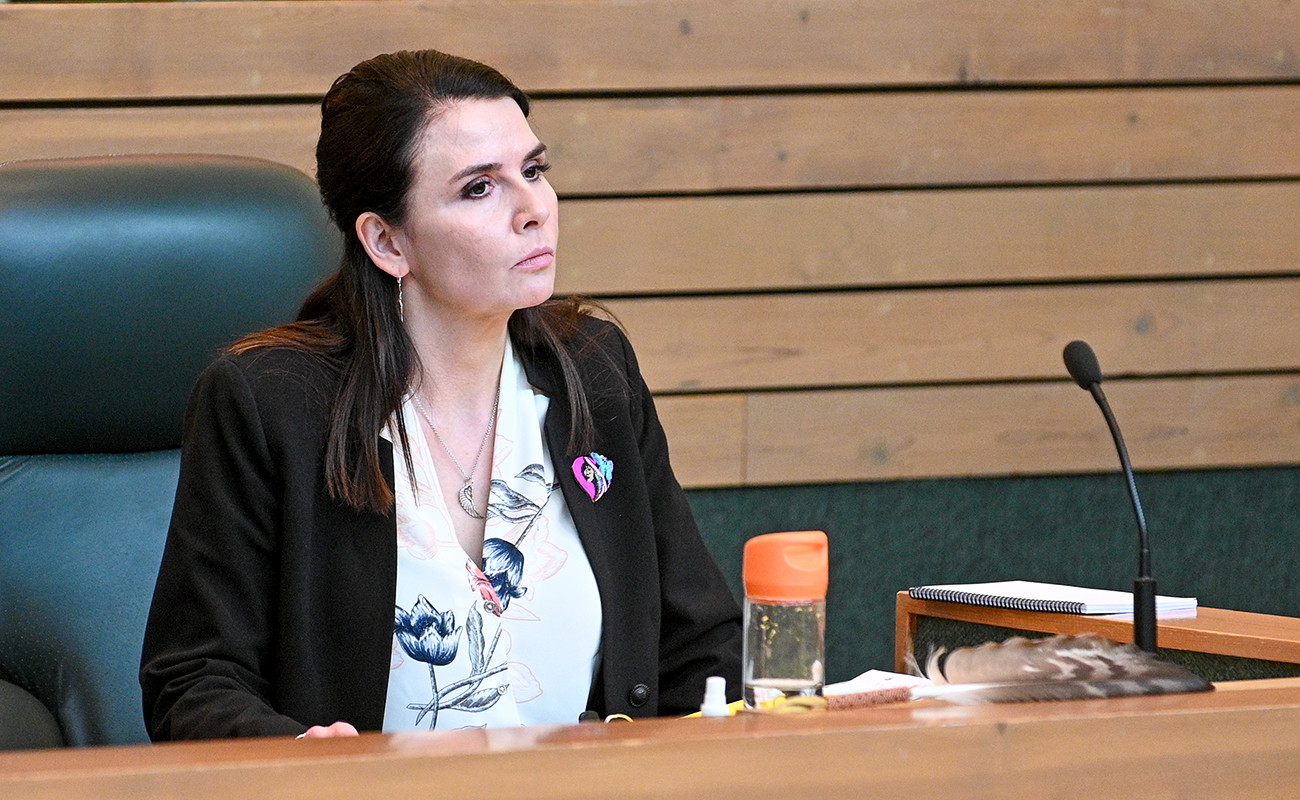
Photo by Whitehorse Star
Education Minister Jeanie McLean
Photo by Whitehorse Star
Education Minister Jeanie McLean
An independent final report on inclusive and special education is calling for changes to the way the Yukon operates in those sectors.
An independent final report on inclusive and special education is calling for changes to the way the Yukon operates in those sectors.
The report was released in a ceremony Tuesday at the Haa Shagóon Hídi (Learning Centre) in Carcross.
According to a news release, the independent report, completed by Dr. Nikki Yee, outlines the history of inclusive and special education in the Yukon, as experienced by people in the education system.
It also highlights how the current approach for delivering inclusive and special education programming needs to be improved to meet the needs of students.
In the report, Yee said, “Overall, respondents suggested that inclusive and special education programs and services in Yukon are not currently supporting vastly diverse and dynamic student needs.
“Throughout their school careers, students are sometimes denied services or their needs are ignored, as more immediate and intense needs are ineffectively addressed.
“Generally, students experience low-quality education based on chaotic and disjointed structures in schools and across the educational system, and based on under-developed capacity among educators,” Yee said.
“Rather than support educators and students, DOE (Department of Education) systems are a patchwork of policy that lack direction and purpose, and that are shaped by colonial assumptions.
“This system is rooted in a social context that continues to enable colonial relationships, especially discrimination against students with disabilities and racism towards First Nations students and Peoples.”
Yee said it wasn’t all bad, however.
“I also found that there are tremendous strengths that currently exist within the educational system, and that there are many more ideas and suggestions for what is possible within inclusive and special education
“In particular, change within inclusive and special education might be built upon pockets of highly effective programs that are currently operated within and beyond the system.
“Furthermore, major transformation could occur from a strong desire to collaborate and co-ordinate services in support of students.”
Yee concluded with six recommendations:
1. Evaluate whether the DOE’s approach to inclusive education is working.
Conclusion: “No, the vast majority of respondents, including students, families, educators, and First Nations struggled to identify the DOE’s vision of inclusive education, and did not believe diverse students were being adequately supported in schools.”
2. Determine whether services and supports are having the desired effect.
Conclusion: No. Assuming the ‘desired effect’ to be equitable access to learning opportunities, this review found that services and supports are largely reinforcing inequity within the system.
3. Determine whether sufficient resources are in place to support inclusive education.
Conclusion: Perhaps. Several respondents thought it was possible that there were sufficient financial resources; however, systems and structures may be limiting students’ access to adequate supports.
Resource allocation needs to be more closely examined by a Community of Inquiry.
4. Prioritize students for specialized assessments.
Conclusion: Needed. The Community of Inquiry may need to come up with localized criteria around prioritizing assessments.
However, respondents stressed that it may be more important to help educators address students’ learning needs as they surface in day- to-day classroom activities, as assessed by curriculum-based measures or other assessment measures.
5. Assess and track specialist recommendations.
Conclusion: Needed. Increased communication and collaboration are required by families, teachers, EAs, LATs and other members of a student’s support team. This could be achieved through software and/or locally determined procedures that necessitate ongoing communication.
6. Assess and track teachers’ use of recommended strategies.
Conclusion: Needed. All parties involved in supporting students need to be able to communicate and collaborate about what supports are provided.
“I honour and acknowledge the many stories and perspectives shared as part of the review of inclusive and special education,” said Education Minister Jeanie McLean.
“There is much work ahead of us to address the report findings and longstanding failings of the education system.
“I’m calling for change for the benefit of all our children and society,” the minister added. “I share Dr. Yee’s vision of building a world-class system where the strengths of every learner are built up to help them meet their personal goals.”
Yee is an educator with a doctorate in special education from the University of British Columbia. In 2020, she began a full review of the services and supports for inclusive and special education in the Yukon.
“It has been a privilege for me to connect with so many people who have an interest in inclusive and special education in Yukon,” Yee said. “They shared not only significant individual and systems level challenges, but also talked about some truly amazing ideas, programs, and people already in Yukon that could help create an equitable education system for diverse students with many kinds of needs.
“Going forward, there is a real opportunity for diverse peoples to come together, in community with one another, to create a visionary system of inclusive and special education.”
To compile the final report, Yee estimates she connected with 300 to 400 people and reviewed notes from 31 focus groups and 26 individual interviews.
She also read more than 73 written submissions and 500 stories and comments shared through the online tool developed for the review.
In order to encourage thoughtful and responsible discussion, website comments will not be visible until a moderator approves them. Please add comments judiciously and refrain from maligning any individual or institution. Read about our user comment and privacy policies.
Your name and email address are required before your comment is posted. Otherwise, your comment will not be posted.
Comments (11)
Up 2 Down 1
Bring Back Hope to the World on Jun 8, 2021 at 12:45 pm
With TheHammer - An absolutely precise analysis of the problem. Intuitively perceptive. When we speak we tend to speak from the environmental frame that surrounds us. Thinking and speaking are one and the same and the words that we speak are encoded with our experiences and each piece of language down to the fragments of sound, the phonemes, carry images in the minds eye such that our perception is a reflection of our speech. We see words and sounds and these convey the message that “we” intend.
But these images are based in our own understanding of our own experiences and cannot be meaningfully shared through conversation or words. Thus, if one uses the word ‘culture’ in conversation different meanings are spoken and understood. Clarification of intent and meaning is an ongoing and fluid process requiring a mutual dialogue of give and take between speaker and experiencer in a bidirectional process. Where one is closed off to the other by virtue of some pedagogy, epistemology, intent professional or otherwise true understanding requires mutual openness and the willingness to inquire. This is rarely the case because speech/conversation is a motivated process and while language may be shared it is not common because we communicate perceptions rather than reality because that is all we have to work with... This is problematic in systems of authority and can be dangerous in an adversarial world.
Thanks for your submission... Absolutely brilliant!
Up 3 Down 2
TheHammer on Jun 7, 2021 at 11:42 am
There's a book called "Class Codes and Control". Some of the highest IQs in England were Bell Boys, and Messenger boys, why? Because the teachers in the schools are middle class and they speak a middle class English. The high IQs are working class and the language at home is working class English. The teacher is speaking a different kind of English.
Up 20 Down 3
Anie on Jun 4, 2021 at 3:31 pm
"the vast majority of respondents, including students, families, educators, and First Nations struggled to identify the DOE’s vision of inclusive education, and did not believe diverse students were being adequately supported in schools.”
This sentence made me wonder, do the recipients of a government program EVER answer "yeah, everything is good?" Not likely. So just by asking the report was bound to conclude that it's not working and needs to be fixed.
Up 24 Down 4
Arthur on Jun 4, 2021 at 8:10 am
Healthy communities and Healthy babies. Government needs to attend to the problems of drugs and alcohol abuse pro-actively. Fix the the problem, not the symptoms.
Up 35 Down 1
BnR on Jun 3, 2021 at 2:19 pm
How many years and successive governments have been kicking this issue down the street? And yet, Francophones demand a school all for themselves, and BAM, it gets done.
Up 37 Down 8
jason on Jun 3, 2021 at 9:49 am
To say that the education system is "rooted in colonialism" is unhelpful. What does that mean? Does a colonial education structure speak to the hierarchy of school administration, the courses which are taught (I'm pretty certain Yukon has some of the most progressive education I've seen), the way in which those courses are taught? I don't doubt that there are kids who have difficulty achieving in school as not everyone is an academic. Does that mean we ought to retool our entire system? There is onus on parents and the children themselves to take their education seriously. The government pointing out in their report that 50% of FN students experience "chronic absenteeism" and framing that as a problem is colonial and paternalistic itself.
Up 25 Down 2
Streaming works on Jun 2, 2021 at 11:03 pm
Streaming works. When you have classes with more resources b/c the children in it need more help (so more EA for example) why is this wrong? Agreeing with 'Bring Back..' and 'Patronne.' You try being a teacher with 'everything thrown into one class' in terms of ability, cognition, and behaviour. Doesn't work. And once they're in high school, they just fail.
Up 9 Down 20
Wilf Carter on Jun 2, 2021 at 7:41 pm
About time - this has meat in it but do we have the will to do it?
Up 27 Down 4
Vern Shlimbesser on Jun 2, 2021 at 5:24 pm
When any learning experience is modified to reach the lowest performer the response is predictable; bored, frustrated, then departure if your lucky, acting out and rebellion when they are confined.
This is in all grades, levels and even in adult education. It is as natural as breathing.
We want the quick-learners to be patient, and tolerant, and most of the time they are, for a while. Then they realize they are being penalized and losing opportunities themselves. They look for ways out....alternative programs....self directed courses, whatever they can find. If they find nothing available is this not as big an issue as leaving no child behind, as viewed from behind.
Up 61 Down 5
Patronne on Jun 2, 2021 at 4:08 pm
Going to school in the 70s all students were divided by cognitive ability, thus some students excelled earlier in life and others it just took more time and a better ratio of teacher to students. This somehow became taboo and all walks of life were ranting about inclusiveness blah blah..well it’s reaped it’s ugly head. All students are thrown in a class and it’s left up to the lone teacher to somehow deliver an education. Separate those who struggle and get them the assistance they need.
Up 70 Down 12
Bring Back Hope to the World on Jun 2, 2021 at 4:06 pm
Get stuffed! You can be inclusive without making everyone stupid. Bring back standardization, examinations, and core curricula necessary for advancement in the modern world not the mediocrity of a dumbed-down, diversified, and inclusive world where others are dragged below their potential under the weight of rainbow intersectionalisms...