Photo by Justine Davidson
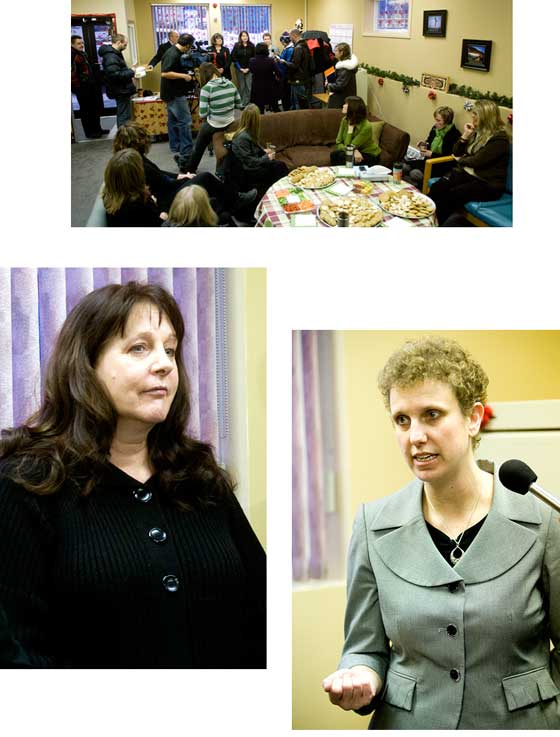
WELLNESS COURT BOLSTERED – Officials involved with the new one-stop centre for the Community Wellness Court chat with reporters during a media availability session held Tuesday morning. Tricia Ratel, left, Karen Ruddy
Photo by Justine Davidson
WELLNESS COURT BOLSTERED – Officials involved with the new one-stop centre for the Community Wellness Court chat with reporters during a media availability session held Tuesday morning. Tricia Ratel, left, Karen Ruddy
The Yukon's chief judge is lauding the opening of a "one-stop” centre for people going through the Community Wellness Court.
The Yukon's chief judge is lauding the opening of a "one-stop” centre for people going through the Community Wellness Court.
"I think it's going to make a real difference,” Judge Karen Ruddy said Tuesday of the Fourth Avenue office.
It will be home to a probation officer, drug and alcohol counsellors, corrections staff, a coffee machine and an air hockey table, among other services.
It will serve the average of 12 to 15 people who are going through the wellness court process, as well as those who have completed their court-ordered programming, but are still in need of support, or even just a place to go in the evenings.
"They need a lot of support and a lot of programming,” Ruddy said of those going through the wellness court.
Much of that support and programming will now be based out of the new office, which director of corrections Tricia Ratel was clearly proud to say "was created with no new money.
"Everything you see here is scrounged and borrowed from other places in the department,” Ratel told reporters.
"First and foremost, they will have a place to go,” Ruddy said of what the centre can offer.
Open from early morning to late night, seven days a week, the centre aims to overcome the "silo” scenario where people are pin-balled from office to office, and often punished if they miss a meeting.
With this office now set up just around the corner from the courthouse, "they don't need to remember to go to 10 different places to meet 10 different people,” Ruddy said.
Her words echoed those of many in the justice system who work with offenders with fetal alcohol spectrum disorders (FASD).
As defence lawyer Fia Jampolsky told the Star in a previous interview, many of her FASD clients have trouble following their court orders because they are easily distracted due to their impaired brain development.
Even when someone under a court order may well be on his or her way to a probation meeting or addictions counselling, a chance meeting with friends could result in a night of partying instead – and several steps back in the rehabilitation process.
With back-up from Judge Michael Cozens, Ruddy presides over the Community Wellness Court.
The court is "near and dear to my heart,” Ruddy said at Tuesday's public opening of the Wellness Centre.
Its creation was suggested during one of the first conversations she had with fellow judge Heino Lilles shortly after being called to the bench in 2004, she recalled.
Its purpose is to direct offenders out of the traditional court-jail system into programming which focuses on the root causes of their criminal behaviour.
The hope is that by helping people overcome addictions, or getting them treatment and assistance in coping with mental illness or cognitive disabilities, the court can reduce their chances of reoffending.
Most of the crimes Ruddy is dealing with in the specialized court are associated with those barriers, she said, so bringing them down is vital to preventing recidivism.
"This is not a court where we are dealing with manslaughter or murder or aggravated assault,” Ratel noted. Nor is it for sex offenders, she said.
People must choose to go into the wellness court system; they have to enter a guilty plea and agree to participate in whatever treatment plan is created for them.
Offenders are invited into the system if they have drug or alcohol addictions, mental health issues or cognitive disabilities such as FASD.
Along with lawyers and social service workers, Ruddy creates a personalized "wellness plan” for each offender, and once they have completed that plan, they are sentenced as any other offender would be.
"I am still required to apply the same principles of sentencing” once the programming is completed, Ruddy said, but at that point, she can take into account the positive efforts the offender has made.
There are no statistics available on how many people in the regular court system reoffend versus those who go through the wellness court.
"Not everyone is successful,” Ruddy said "... but we do have success stories, and even one person is huge.”
In order to encourage thoughtful and responsible discussion, website comments will not be visible until a moderator approves them. Please add comments judiciously and refrain from maligning any individual or institution. Read about our user comment and privacy policies.
Your name and email address are required before your comment is posted. Otherwise, your comment will not be posted.
Comments (1)
Up 0 Down 0
Barb on Dec 8, 2010 at 1:36 pm
I have said it all along, yukoners are going to have to put sentencing into there own hands, Yukon courts are a joke, especially for me, when i get robbed blind, assaulted (in my own home) and the perp gets away because of a technicality.
enough is enough...