CBC stalwarts sign off for the last time
In 1991, the news media were a very different beast.
By Stephanie Waddell on May 3, 2013
In 1991, the news media were a very different beast.
People tuned in to the radio or TV for regularly scheduled news. Or, leafed through actual printed pages in a newspaper to learn what was happening in the world around them.
The Internet was yet unheard of by many people, and it would be 15 years before the first tweet was posted to Twitter.
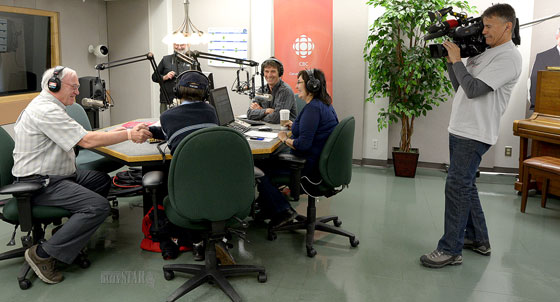
It was that same year that Doris Bill and Russ Knutson started working together at the CBC in Whitehorse – Knutson having been there since he was a high school student working a summer job in the late 1970s and Bill starting her career there.
On Tuesday, they both retired, each having decided it was the right time to move on to something new.
In interviews Thursday afternoon, they recalled their time working for the national broadcaster and the history
they were part of broadcasting for the north.
As Knutson remembered his first job – in the archives doing cataloguing work for microfiche – it was pretty boring, but he "hung around” long enough to get on-air work, covering sports in 1981.
"That was my first on-air job,” he said. "Ever since, I've been in the service of her majesty the Queen.”
Meanwhile, Bill went to the CBC full-time after having done some contract work for the network and working at First Nations radio stations elsewhere and short stint with CHON-FM.
Before that, in the 1980s, Knutson and Bill had been introduced when they were attending school at Grant MacEwan University in Edmonton.
Then they ended up at the CBC together, essentially working "back to back” in the same cubicle, Knutson said.
"Yeah, he's really noisy,” Bill added with a smile.
Bill's career was primarily focused on her chosen career of TV reporting, with some radio reporting as well when the CBC moved to a more integrated newsroom model.
Knutson's time with the CBC has seen him in a variety of roles, from sports reporter to anchor to his most recent role as the host of the Midday Café.
As Bill noted, there have been many changes in the way news is covered both at the CBC – requiring reporters to do both radio and TV reporting – and in broader media with the onset of the Internet and social media.
"It hasn't slowed down at all; it's gotten really, really busy,” she said, adding that people want their news "yesterday.”
Bill said she personally needs to slow down, and decided now is the right time to leave the CBC.
"It's everything now – it's online, they want you to tweet, everything,” she said.
Knutson added the reality at the CBC as well as throughout the industry is there's been a big turn in how people consume the news and in how it's presented to them, with online services, "shorter, snappier” stories.
There has also been what he says is a "huge unfortunate influence from American viewing habits” that focuses more on an "if it bleeds it leads” mentality.
The powers that be at the CBC are driven more by spread sheets and the bottom line now than in the past – and that's taking a toll on its services.
Knutson, who's been head of the local union chapter for a number of years, said the total CBC workforce across the country since he's started has dropped from 10,000 to 5,000 – while services have expanded.
"It means we can't do the job we used to do,” he said. "The news is watered down to a great extent; the amount of time you can spend developing a story is decreasing because the goat is hungry. It's gone from a goat to a herd of goats.”
When Bill started working in TV for the CBC, it was for a weekly program. That allowed for more time to research, write and put together a good quality story.
"And nowadays, you're lucky if you have a day,” she said.
"We blow a lot of really good stories by turning them into mediocre stories,” Knutson added.
Now, as a consumer of the news, the frightening thing is he believes the CBC still does the best job in reporting the news.
It's the most reliable, "probably the authoritative news voice in the country still, and yet it could be better,” he said.
There's no question the CBC used to "be fat”, Knutson said.
He recalled a time when if something was happening in Burwash, for example, a reporter would be sent by plane.
Now it's more likely they will try to find someone by phone.
"It's different than what it used to be,” he said. "I think I've seen enough change over the years.
"I don't want to leave disappointed in any way, and I'm still really proud of the work that we do. I really enjoy it.”
If he were invited back to do a show here and there, Knutson said he'd happily return.
Along with the continuing changes to media, Knutson said layoffs and budget cuts over the last couple of years have also taken a personal toll on him, adding that was another factor in his decision to leave now.
"It was still the greatest job I could've asked for,” he said.
"And it was the best training ground and I think it still is for young journalists,” Bill added, noting there were many opportunities she wouldn't have otherwise had.
Both say there are many stories they have covered that have been coming to mind over the past week.
For Bill, being on the ground, in the community where the story is happening is what she loved about television reporting.
During the RCMP centennial climbs, she got to be at the base of Mt. Logan.
"It's one of those jobs you find yourself in the most remote, and some of the most interesting places too,” she said.
In her early days at the CBC, she flew to Detroit and covered Glenna Frost's caribou lobby that went through five states.
"Glenna was as green as I was; she didn't like speaking in public,” Bill recalled, noting she ended up having to comfort Frost.
The lobby continued with Bill interviewing Frost and covering the tour of the five states.
"Those are the stories I love doing; they're people stories, they're Yukon stories,” she said.
And then there are the stories that have a personal impact.
Bill went to residential school herself. So when she went to Inuvik to cover the residential school reunion there, and everyone in the room cried as they heard former N.W.T. government leader Stephen Kakfwi perform a song he wrote about residential school, she had to leave.
Kakfwi came out quickly after his song was over, and Bill asked him his thoughts on it.
He too said he had to leave, seeing a room full of elders in tears.
It's not the only story that had a personal effect on Bill. She was the first journalist John Graham would speak to.
Graham, a former Yukoner, was extradited to the United States and later convicted of murder in the 1975 death of Anna Mae Aquash.
Arlo Looking Cloud was also convicted of the murder. Graham, Looking Cloud and Aquash were all members of the American Indian Movement.
"It's one of those stories where you deal with the ethical side of it, you deal with your journalistic issues, you know the people involved, you know that there was this beautiful young mother who was murdered who never knew her children, FBI was involved – there were times I thought my head was going to explode with the amount of information,” she said.
"Anytime you lifted up a rock, there were 10 more things under there to question and stuff like that,” she said.
She would go to people like the late Frank Fry, who headed up the local CBC operations at the time, and cameraman Wayne Vallevand when she needed another perspective or to talk about it.
Knutson also recalls the many lessons he learned from those he interviewed.
A mother who is doing everything she can to help others prevent violent deaths after her child died violently taught him humility.
Going underground in mines gave him an appreciation for the metal that goes into the quarter he's tossed into water at the Elijah Smith Building.
Logging blockades in B.C. where elders told him what the area used to be like also made a significant impact, he said.
Like Bill, he is quick to praise his former bosses and co-workers – people like Fry and the many technicians he's worked with over the years, among numerous others.
The stories that come over more than 20 years are endless, as Bill and Knutson relayed them.
As they move into a new era of their lives, outside of the broadcaster, they both say they will be watching and standing with their former co-workers after Bill C-60 was introduced earlier this week.
The planned legislation would give cabinet "explicit power to give Crown corporations orders as to how they should negotiate with employees both unionized and non-unionized.”
Both Knutson and Bill say the bill raises significant concerns for them, and they will be keeping a close watch on the situation as it unfolds.
Comments (1)
Up 0 Down 0
DMZ on May 6, 2013 at 5:26 am
I'm sorry to see Russ go. He seemed pretty smart to me, smarter than he showed on the air, and his comment about the CBC turning good stories into mediocre stories shows it. Anyway, he had a nice manner on the air.