Cause of tragic poisoning found to be accidental
The Yukon's fire marshal's office has released its full report into the deaths of five people from carbon monoxide poisoning earlier this year.
By Ashley Joannou on April 2, 2012
The Yukon's fire marshal's office has released its full report into the deaths of five people from carbon monoxide poisoning earlier this year.
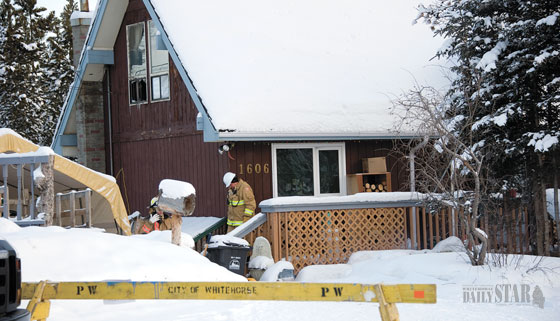
Brad and Valerie Rusk, their children Gabriel and Rebekah and family friend Donald McNamee, were found on Jan. 29, in their rented home in Porter Creek.
The 20-page report, including 18 photos, was made public Friday.
It will be part of the coroner's final findings when that investigation is complete.
Officials who examined the home located a single walled, galvanized vent approximately six inches in diameter which extends from the top of the masonry chimney approximately two feet.
Soot stains were found between the chimney and the siding on the building in the midway portion just above the cleanout.
Heavy frost mixed with soot was coming from the bathroom vent's exhaust.
"Behind the cleanout's access door revealed that ice mixed with soot and deteriorated masonry had formed the entire opening and access to the inside of the chimney was blocked,” the report, signed by deputy fire marshal Kevin Taylor, says.
"The writer attempted to break through the ice and soot and was not able to.”
The report lists the temperature that day as -24 degrees Celsius.
The report confirmed a problem suggested by multiple boiler experts in the weeks following the tragedy.
The home's Burnham V-73 boiler had a firing rate of 1.05 gallons per hour of fuel oil.
The burner, a Riello 40-F3, had a nozzle capable of delivering only .65 gallon per hour of fuel, nearly 50 per cent less than what the boiler requires.
"Flue gases produced will be at a lower temperature. When the flue gases are subjected to low outside winter temperatures they condense and allow the products of combustion to accumulate within the chimney lining,” the report says.
"During freeze thaw conditions, as the products freeze they expand, spalling the masonry and allowing the lining to break apart and fall within the chimney.”
The burner was manufactured in 2009 and the boiler was manufactured in 1993.
Aside from falling debris, the report indicates, the mismatched equipment led to an ice buildup.
"As the flue gases travelled up the exterior chimney, they cooled and condensed which caused the vent to freeze solid at the top portion of the chimney,” the report says under the heading Possible Causes.
"The flue gases were not able to escape through the venting and therefore, exhausted through the combustion chamber and into the building.”
There were two burner service stickers on the boiler dated October 27, 2010 and October 14, 2011. Service work was performed and signed by Certified Heating and Service.
The company's owner, Lance Couch, told the Star Friday his business is made up of certified journeyman who serviced the heating system.
They did not install the unit, he said.
A typical service would include breaking down the burner, checking the parts and then test firing the system to analyze the gas.
If that test showed indication of a blockage, employees would investigate further.
Staff would not necessarily check the chimney, unless the analysis suggested a problem, he said.
When his company serviced the unit in 2011, his records show there was no fuel in the tank, Couch said.
That meant the company was unable to do its standard test fire.
When staff left the house, the unit was turned off, he said.
Couch said he can't speculate how the unit got new fuel.
The report lists the cause as "accidental” and estimates the total monetary cost of the tragedy at $50,000.
The 1.5-storey single-family home is listed as having smoke detectors.
The house did not have a carbon monoxide detector.
Comments (2)
Up 1 Down 0
north_of_60 on Apr 3, 2012 at 5:29 am
If a landlord 'accidentally' decides not to follow the advice of a qualified service person and fails to follow common practice to upgrade the chimney when upgrading the furnace and burner, then who should be held responsible for any death or injury that happens?
The Yukon needs comprehensive 'whistle blower' legislation.
Up 1 Down 0
eesmith on Apr 2, 2012 at 7:46 am
how is negligence deemed to be 'accidental'? The Fire Marshal's report states that little was done to ensure the heating system was safe and that the chimney was not in a suitable and satisfactory condition, as required by a 1976 building code. It lists a litany of missed permit inspections, negligent inspections, and an empty fuel tank that prevented proper servicing which should have prevented refueling of the tank.