Photo by Jason Unrau
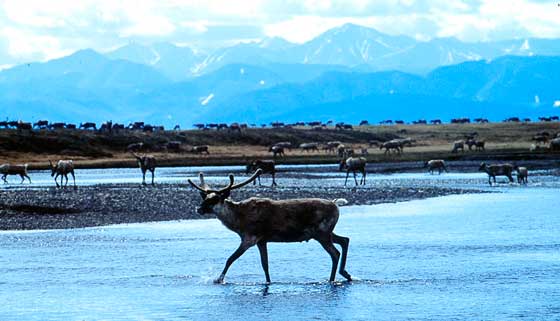
GOOD NEWS – Scientific information released Thursday by Alaska shows the Porcupine caribou herd had grown above the 123,000 estimated in 2001, and is not in dire straits as many feared. Photo by DON RUSSELL
Photo by Jason Unrau
GOOD NEWS – Scientific information released Thursday by Alaska shows the Porcupine caribou herd had grown above the 123,000 estimated in 2001, and is not in dire straits as many feared. Photo by DON RUSSELL
The Porcupine caribou herd is not in a nosedive.
The Porcupine caribou herd is not in a nosedive.
Preliminary results of an aerial population census last summer put the herd at 123,000-plus members, and not below 100,000 animals as feared by many wildlife managers and community leaders.
"This is very good news,” Joe Tetlichi, chair of the Porcupine Caribou Management Board, said this morning following Thursday's confirmation out of Alaska, where the count is being conducted.
"We are excited about that; we are very happy.”
Tetlichi cautioned, however, that this is not a time to abandon principles of conservation that have taken hold in recent years with growing concern over the future of the Porcupine herd. The animals range from Alaska, through the Yukon into the N.W.T.
Thursday's news release out of Alaska suggests the Porcupine herd "is significantly greater than 123,000” caribou.
The belief the Porcupine caribou was in trouble over the last few years was the driving force behind the development of a Harvest Management Plan for Porcupine caribou – a sometimes controversial and emotional process.
The feared state of the herd prompted the Yukon government to bring in emergency harvest restrictions in the last two years for all caribou hunters, aboriginal and non-aboriginal. The move prompted a lawsuit from the Gwich'in Tribal Council of Fort McPherson, which is still unresolved.
Until last summer, there had not been a count since 2001, when the herd was estimated at 123,000.
Attempts over the ensuing eight years to update the population estimate were foiled by weather, or the caribou's migration patterns.
With no hard count, and evidence of other Arctic and sub-Arctic barren land herds shrinking, some drastically, computer modelling and input from wildlife managers put the herd at a cautious 100,000, but perhaps well below.
Last July, all the stars lined up and conditions were most favourable for taking aerial photographs.
As well, the entire Porcupine herd all came together for calving on or near the Beaufort Sea coast, Alaskan biologist Cathie Harms explained in an interview Thursday.
The Alaskans began going over the aerial photos in late December, as summer census work typically doesn't get assessed until the winter months after the field season.
Harms said the count is still not finished, and then verification is required to make sure caribou aren't counted twice, or a piece of lichen-coloured rock hasn't been recorded as a caribou, as the resemblance can be remarkable.
"But we are at the point where we are convinced the herd has grown beyond 123,000,” she said. "We have already counted more than we counted last time, so we are convinced the herd has grown.”
Harms said the count and verification won't be complete until early March. Alaska, however, is well aware of next month's meeting of Yukon-N.W.T. community and government representatives to discuss harvest management guidelines for this year, she said.
"I do not think anybody expected to see this many caribou,” she said. "I think it is good for everybody.”
Vuntut Gwitchin MLA Darius Elias of Old Crow was elated this morning, but like the chair of the management board, expressed the need for continuing conservation.
The Porcupine herd, said the Liberal MLA, has proved to be resilient for now, though it's important to keep in mind many barren land herds are crashing.
"That is something we have to be aware of,” he said. "The Porcupine caribou herd is not immune from crashing itself, and we still have to be vigilant.”
Elias, who has been calling out loudly for conservation in recent years, credited hunters for recognizing the need for caution during an information void which prevented them from knowing just how many Porcupine caribou were out there.
Non-aboriginal hunters, he said, told him they stopped hunting Porcupine caribou because of the herd's uncertain status.
The aboriginal subsistence hunters in Old Crow and across the North heard the request to hunt bulls only in order to protect the cows, which together with their offspring can produce 23 calves in 10 years, he said.
Elias has said many times in recent years that with aboriginal hunting rights comes the responsibility to conserve.
This count shows subsistence hunters have accepted that responsibility, he said, adding he believes they'll continue to accept the wisdom of hunting bulls only.
Under the Harvest Management Plan agreed to last year by aboriginal communities across the North, along with the territorial governments of the Yukon and N.W.T., four harvest zones have been established.
Currently, the parties have agreed to manage the herd as if it were in the yellow zone, at a population of between 115,000 and 75,000.
In the Yellow zone, aboriginal hunters are asked to voluntarily hunt bulls only.
In the orange zone, when the population is estimated between 75,000 and 45,000, it becomes mandatory to hunt bulls only. When the herd is below 45,000, in the red zone, there is to be no hunting.
But in the green zone, when the herd is above 115,000, there are no harvest restrictions nor special requests for aboriginal hunters, though non-aboriginal hunters would still be restricted to two bulls only.
Under the current yellow status, they're limited to one and just a couple of years ago could take one cow and one bull in certain zones.
Tetlichi said as chair of the Porcupine management board, he does not think there will be a shift back to a substantial cow harvest by aboriginal hunters.
Developing the Harvest Management Plan, which included the bulls-only request, was a sensitive issue for communities that traditionally rely on their annual harvest as the primary food source, he pointed out.
Tetlichi said they've crossed over that hump now and moved closer to acceptance, and he doesn't think there will be a shift back.
"With the board, it is still business as usual,” he said.
"And we are still cautious, because as you know, back in 1989, we were up to 178,000 caribou and we are still not up to where we were, so we still have to be cautious.”
In order to encourage thoughtful and responsible discussion, website comments will not be visible until a moderator approves them. Please add comments judiciously and refrain from maligning any individual or institution. Read about our user comment and privacy policies.
Your name and email address are required before your comment is posted. Otherwise, your comment will not be posted.
Be the first to comment