Photo by Photo submitted
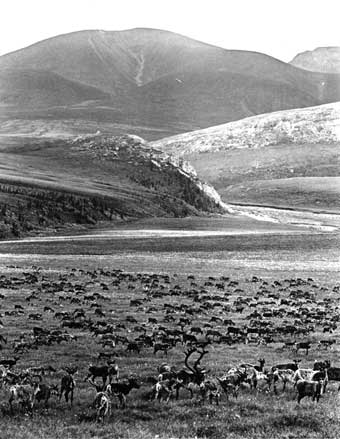
DWINDLING HERD – Since 1989, the Porcupine caribou herd's population has dropped from 178,000 to fewer than 100,000 animals. Photo courtesy GOVERNMENT OF YUKON
Photo by Photo submitted
DWINDLING HERD – Since 1989, the Porcupine caribou herd's population has dropped from 178,000 to fewer than 100,000 animals. Photo courtesy GOVERNMENT OF YUKON
Despite warnings from biologists, a new plan to manage harvesting of the Porcupine caribou herd will see few changes to the annual hunt that could continue to go largely unmonitored and on a scale that would have dire consequences for the herd.
Despite warnings from biologists, a new plan to manage harvesting of the Porcupine caribou herd will see few changes to the annual hunt that could continue to go largely unmonitored and on a scale that would have dire consequences for the herd.
Since 1989, the Porcupine caribou's population has dropped from 178,000 to fewer than 100,000.
Acting on advice from its Environment department, last fall the Yukon government imposed a bulls-only restriction on all hunting from the Porcupine caribou; an interim measure while a harvest management plan continued its sluggish pace to completion.
For the government's efforts, it was sued by the Inuvialuit and Gwich'in from the Northwest Territories, who contend the interim measure trampled their beneficiaries' treaty rights.
And the Porcupine Caribou Harvest Management Plan released in March, after six years of deliberation, dials back the Yukon government's "bulls only” edict to "voluntary bulls only” for aboriginal hunters based on the current estimated herd size.
But according to government biologists, a voluntary bulls only policy is not enough to reverse the Porcupine herd's decline.
"The importance of adult female survival on population growth cannot be over emphasized. This parameter is shown to have the greatest influence on population growth,” reads a Sept. 4, 2009 Environment Yukon report explaining the rationale for banning the hunting of female Porcupine.
"To illustrate the importance of cows, if a hunter took 10 bulls a year for the next 10 years instead of 10 cows, there would be 230 more caribou in 10 years.”
It posits that, "... if harvest of females ceased, there would be 50,000 more caribou in the herd by 2020,” based on the estimated 4,000 Porcupine caribou harvested each year, 60 per cent of which are females.
If the status quo continues, the above projection would be completely reversed, and the herd size would be reduced to just 50,000 by 2020, Environment Yukon's report forewarns.
Last week, the governments of Canada and the Northwest Territories signed on to Porcupine harvest plan, joining the Yukon government, First Nation of NaCho Nyäk Dun, Gwich'in Tribal Council, Inuvialuit Game Council, Tr'ondëk Hwëch'in and Vuntut Gwitchin government.
Since 2004, public and aboriginal governments have considered measures to preserve a declining caribou herd whose migratory route spans two countries, including one U.S. state, two territories and the traditional land of five settled land claim regions.
Adding to this negotiating challenge between competing user groups is determining historical harvest figures, gleaned from just three years' worth of "the most complete records”, and weighing these numbers against data on herd population, which has not undergone a census for nine years.
Back in 2001, biologists estimated the herd at 123,000 caribou .
Today, it is believed the number of Porcupine caribou has fallen to between 90,000 and 100,000 animals.
"Strictly from a biological perspective, there is no sustainable harvest for the Porcupine caribou given the population has been in steady decline since 1992,” the government report reads.
Only if the harvest is reduced to 2,000 Porcupine caribou, with less than five per cent of this take cows, will the herd have a chance to rebound, according to a sustainable harvest scenario outlined in the report.
In a nutshell, the harvest management plan for the Porcupine caribou is as follows: licensed hunters (non-aboriginal) are restricted to bulls only, whether the herd size is in the "Green zone” (115,000-plus animals), "Yellow zone” (80,000 to 115,000) or "Orange zone” (45,000 to 80,000).
Licensed hunters get two animals when the herd is in the Green, one when it's in the Yellow and by permit in the Orange.
Hunting is completely restricted to licensees when the herd's population is in the "Red zone” (fewer than 45,000 animals).
For aboriginal hunters, there is no harvest limit and bulls and cows can be taken when the Porcupine is in the Green.
When in the yellow, there is still no harvest limit and aboriginal hunters are urged to shoot bulls only.
If the herd reaches the Orange zone, a harvest limit would be imposed on aboriginal hunters and once in the critical Red zone, "extremely limited harvesting” for ceremonial purposes is permitted.
The Porcupine harvest management plan also includes, for the first time, mandatory reporting of hunting by all users, but the Porcupine Caribou Management Board must meet again to hash out "... a rigorous and verifiable system.”
Previously, aboriginal hunters were not required to report their harvests.
In order to encourage thoughtful and responsible discussion, website comments will not be visible until a moderator approves them. Please add comments judiciously and refrain from maligning any individual or institution. Read about our user comment and privacy policies.
Your name and email address are required before your comment is posted. Otherwise, your comment will not be posted.
Be the first to comment