Candidates make their pitches for support
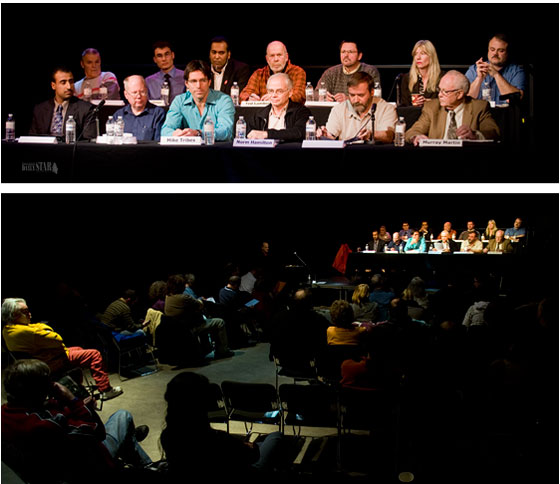
All 13 contenders for the Dec. 1 city council byelection met Wednesday evening for a debate, hosted by the Whitehorse Chamber of Commerce at The Old Fire Hall.
By Max Leighton on November 24, 2011
All 13 contenders for the Dec. 1 city council byelection met Wednesday evening for a debate, hosted by the Whitehorse Chamber of Commerce at The Old Fire Hall.
The council hopefuls were organized into groups of four, addressing the crowd of about 50, on a range of topics from housing to the future of McIntyre Creek, transit and city finances.
Chamber president Rick Karp chaired the event.
The first questions posed by the chamber concerned the city's lack of housing availability.
"The fact is even people with government jobs are having trouble affording housing,” said Mike Tribes, an IT consultant and NDP candidate for October's territorial election.
Tribes suggested discussions with the city's two First Nations as well as YTG to open up more land for housing.
For some, development means more than freeing up lots and building new homes.
"I would like to see more community gardens, I would like to see more affordable housing and I would like to see buildings built higher,” said local activist Linda Bonnefoy, the only female candidate.
"I would like to see the NDP proposal to have affordable housing in our downtown core for the elderly and people with disabilities or with young children who are unable to transfer their children from Porter Creek or Copper Ridge.”
"I believe we need to open up more areas for recreation as well as housing,” said Harry Hrebien, an employee at Murdoch's gem shop.
Market-based solutions were also presented as solutions to Whitehorse's worsening housing crisis.
"I think these increases in prices are cyclical and governed by supply and demand,” said Kirhn Dhillon, a local engineer and business owner.
"I think the solution is to get more lots on the market, and densification, and one thing we should look at is giving the private sector a crack at developing areas like the tank farm (the former oil tank field near Hillcrest).”
Candidates were also asked what their positions are on development lots in the infill areas around the city.
Norm Hamilton, a local writer, photographer and officer with the territorial government, said he "is not sold on the idea.” Further consultation with the citizens of the community is needed before a clear decision can be made, Hamilton said.
"Downtown infill lots may be different,” he added.
The issue quickly morphed into a discussion about the proposed Porter Creek D subdivision.
"This city seems to be missing the focus on ecology, starting with McIntyre Creek,” said Murray Martin, a retired Ontario conservation officer and Star outdoors columnist.
"The response from councillors must be to the people whose taxes pay the wages, and it must be open to them, which I do not think it is now.”
That sentiment was shared by the majority of speakers.
"The area of the city of Whitehorse is roughly that of the city of Winnipeg, which houses almost 800,000 people,” said Pat Berrel, a retired principal at Whitehorse Elementary School.
"We have enough area in and around Whitehorse that we can use to develop in an infill way without endangering areas that should be protected, like McIntyre Creek ... we need to concentrate on areas that aren't as ecologically sensitive.”
"That Porter Creek D means nothing to me at the present time,” said Duke Connelly, a retired military serviceman and former city councillor.
"You got all of downtown, and there is no reason they can't build buildings six storeys high, because the clay cliffs are behind them. You are not blocking scenery, and this is something council have got to open their minds to.”
Others had a more economically focused view of the proposed development.
"I don't believe there needs to be a winner or a loser when it comes to Porter Creek D,” said Martin Lehner, a local businessman and employee at the Yukon Council on Disability.
"I believe we can develop the area responsibly and accept that it's on an area of extreme environmental significance. Also, I do believe we can still have homes there. I believe it can be done responsibly and not cause serious issues.”
"If we don't develop there, where do we develop?” asked Patrick Singh, an entrepreneur and candidate for the Liberal party in the territorial election.
"I really think there are a lot more issues there: densification, the area that Porter Creek D is planned in is already rigged for all the infrastructure, so to develop elsewhere, the cost to the taxpayer goes up, but if everyone is OK with that, I am OK with that. This is a decision that must be made by the people.”
Fiscal responsibility on council was another key concern. Karp asked candidates what role they would play in supporting economic development in the community.
"The cost of services needs to be looked at,” said Ted Lambert, a construction and capital management consultant. "We need to look at what the need to do's are and what the nice to do's are.”
"There are several ways in which a city can be involved in economic development,” said Berrel. "Affordable housing is one example. We have an economy that is very strong, but we need to have the people who are working in all these industries be able to live in the city. We must invest in housing.”
The concept of actually increasing taxes to encourage investment was also brought up.
"We should increase the tax base from derelict houses,” said Cam Kos, chief operating officer of the territory's fleet vehicle agency.
"The city is losing taxes on properties that are sitting empty, sitting vacant, sitting derelict. The city are not getting money on improvements, they are not getting income from those properties ... the taxes should be increased until the properties are improved.”
The last phase of the debate saw questions drawn from a box of audience submissions.
The first question was whether Whitehorse is experiencing a boom from the mining industry and how to sustain growth.
"There is absolutely a boom, but we need to manage it,” said management consultant Kirk Cameron.
"We need aggressive leadership on all levels of government. We are looking at 20- to 30-year mine lifes in some operations. People can come here and build homes and raise families. We can have sustainability but we need aggressive leadership.”
Opinions on the issue were divided.
"People are here for a variety of reasons; work, play, retirement, kids coming back from school,” said Lambert.
"The difference is how we handle the economy and attract people. But right now, I do not think we are going through a boom.”
Other audience questions focused on public transit, where suggestions to expand services to include evening and Sunday operations were supported by most candidates.
Future adoption of a ward-based electoral system was unanimously rejected by all speakers, except for Kos, who said he would leave the decision to the people of the community.
One audience member asked candidates to identify the First Nations on whose territory they were seeking office.
Though all candidates were able to identify Kwanlin Dun as an original inhabitant of the city, it was Tribes who correctly identified the Ta'an Kwäch'än Council as the other First Nation with a traditional claim to the community.
The debate concluded with a final address from each of the candidates.
Citizens were encouraged to look up each candidate and inform themselves of the issues before voting.
Residents can participate in an advanced poll, which is being held today at city hall during regular business hours.
See Friday's Star for candidates profiles.
Be the first to comment