Cameron sees provincehood in his lifetime
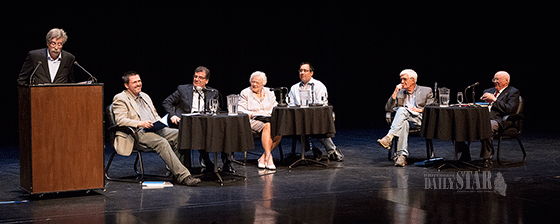
Close to 50 of Whitehorse's policy wonks and politicos gathered Tuesday evening at the Yukon Arts Centre to celebrate the 10th anniversary of the Yukon Act and muse about the territory's future.
By Ainslie Cruickshank on June 12, 2013
Close to 50 of Whitehorse's policy wonks and politicos gathered Tuesday evening at the Yukon Arts Centre to celebrate the 10th anniversary of the Yukon Act and muse about the territory's future.
The discussion was led by a panel of mostly Yukon experts. Robert Nault was the lone panelist from Outside. He served as the Liberal minister of Indian and Northern Affairs when the act was passed.
Along with celebrating the 10th anniversary of the act, which serves as the Yukon's constitution, the evening highlighted the repeal of the last surviving clause from the previous Yukon Act. That clause allowed the federal Northern Development minister to give a letter of instruction to the Yukon commissioner.
Patrick Michael, the emcee for the evening and a former longtime clerk with the legislative assembly, asked the three former commissioners who served under the new act whether they had been given written instructions. None had.
Current Commissioner Doug Phillips noted that he even asked for a letter of instruction to clarify what his job is.
He was told the last letter written was given to former commissioner Judy Gingell, who served from 1995 to 2000.
Similarly, Geraldine Van Bibber, who served as commissioner from 2005 to 2010, said she wasn't given a letter of instruction either.
She did have a face-to-face meeting with then-Conservative minister Chuck Strahl. When she mentioned a letter, he just laughed, she said.
Each of the panelists was given about 10 minutes to provide initial comments on the act and the state of the territory, where it's been and where it's going.
A brief question and answer period and ensuing debate about the Yukon's future followed immediately.
Kirk Cameron, a current city councillor with experience in the constitutional field, speculated that the Yukon will become a full-fledged province within his lifetime.
But the territory wouldn't simply be a carbon-copy of the 10 provinces Canada already has.
Instead, Cameron argued, it would form a new model, one based on a constitutionally protected intergovernmental relationship between First Nations and public government.
Others on the panel cautioned Cameron's eagerness for provincehood.
Panelist Daryn Leas suggested that both the territorial government and Yukon First Nations need time to mature and sort out their interconnected responsibilities.
A lawyer, Leas represented the Council of Yukon First Nations in the early 2000s during Yukon Act talks.
A comment was made earlier in the evening that as the Yukon was developing into its current form, there were discussions surrounding the issue of First Nation representation in the legislative assemble.
New Zealand's model of guaranteed representation for the Maori people was considered, but Leas argued perhaps that's not necessary.
Perhaps what is necessary is regular meetings between First Nations chiefs and MLAs, and commitments to working in collaboration.
Ken McKinnon, a former territorial councillor and commissioner, echoed Leas' assertion that the Yukon needs time to resolve outstanding issues.
He noted there are three outstanding court cases between the territorial government and Yukon First Nations.
Cameron retorted that a decade ago, the government was managing a budget half the size it is today, and "the wheels haven't fallen off.”
But former Yukon senator Ione Christensen noted the budget may have grown, but the vast majority of that budget it still provided through the federal government.
Let's stay a territory and keep the federal transfer, suggested the longtime Liberal, joking that Yukoners should encourage provinces to become territories, but that the feds may not like that.
Nault agreed there is a difference between being ready politically and being ready in terms of a tax base for provincehood.
But he couldn't foresee the federal government stalling the process if Yukoners decided that's what they wanted.
Former commissioner Jack Cable questioned how the territory could make up the difference of the federal transfer.
Cameron suggested the development of four to five new mines, an expanded population and higher royalties could help ease that burden.
But of course, there's the age-old question: do Yukoners want their territory to get bigger?
It's a question only Yukoners can answer, and one everyone should have a say in.
Comments (3)
Up 0 Down 0
just Say'in on Jun 16, 2013 at 6:08 am
Some of these guys just love to hear themselves talk. First of all we will never in the forceable future be able to support ourselves without transfer payments. Secondly I can't believe we are talking about First Nation representation in the Yukon Government. They already have that, not guaranteed however they run who they want and vote for who they want. The real problem I have with guaranteed representation is that we already have a situation that see's First Nations having their own self Government (Nationhood) and then when this Nation negotiates with my government they are also on that side of the negotiations and not with my best interests in mind. Elections should never be based on race. Look around the world.
Up 0 Down 0
northerntut on Jun 14, 2013 at 6:14 am
Until the Yukon can garner at least a half million souls to generate a measurable level of own source revenue, the likelyhood of provincial status will not be on the table.
Up 0 Down 0
jack on Jun 12, 2013 at 4:00 pm
so he wants the provinces AND Ottawa to:
a). agree to admit the territory as a province
b). agree to amend the constitution
He must planning a very long life indeed