Photo by Whitehorse Star
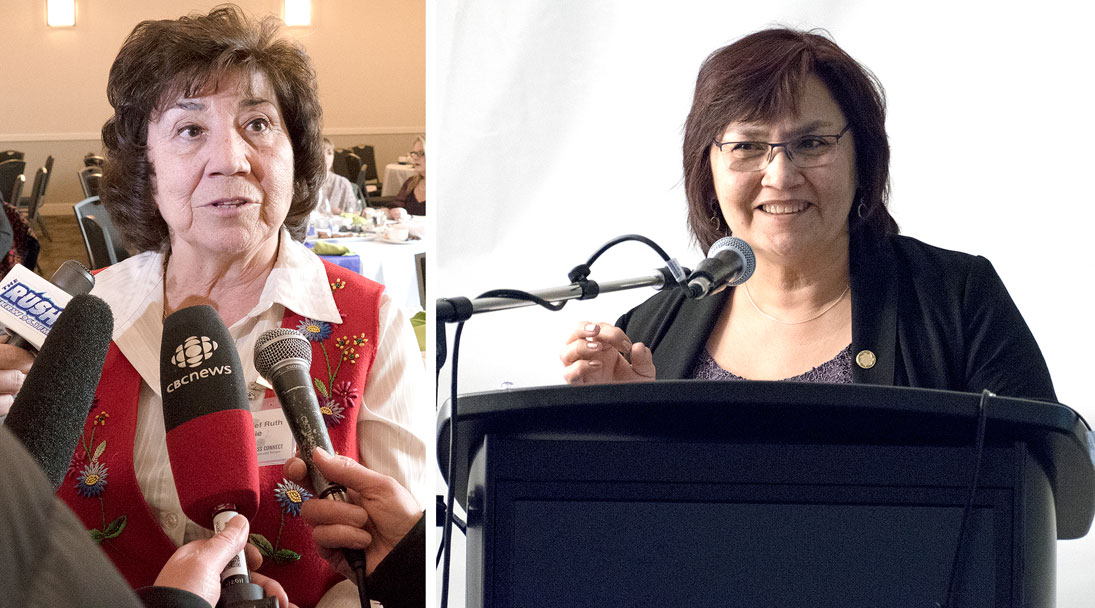
Ruth Massie and Doris Bill
Photo by Whitehorse Star
Ruth Massie and Doris Bill
“Don’t be shy about reaching out.”
“Don’t be shy about reaching out.”
That was the thrust of a presentation Ruth Massie, the Council of Yukon First Nations’ grand chief, made at a small business convention last Thursday in Whitehorse.
This message was also communicated the previous day by Doris Bill, chief of the Kwanlin Dün First Nation.
The two leaders spoke of new opportunities for partnerships between First Nations communities and Whitehorse businesses at the High Coast Country Inn Convention Centre, as part of Whitehorse Business Connect.
The two-day annual conference brings in speakers from around Yukon and provides local business people with the chance to network.
“I don’t know how many people in this room work or meet with the First Nation governments, but they’re more than welcome to, so don’t be shy,” Massie told a packed luncheon hall on the final day of the conference.
“If you have something to offer, go and start the dialogue with them .... They are looking for different opportunities that will be long-term here in the territory.”
Speaking to reporters after her presentation, Massie stressed the need for corporations to build relationships with First Nations communities.
“We all know what they want to do in resource extraction. What is the benefit to the community for that allowance?
“The First Nations have to have some benefit. Whether it’s participating in business or whether it’s something the companies leave behind in the community as they leave,” she said.
Massie said there is a wealth of construction and trade knowledge in First Nations communities.
“They’ve lived in the North long enough; they know what our whether conditions are like; they know their building materials and I really, really think that they have a lot of expertise to offer,” she said.
For Kwanlin Dun, the Land Registry Initiative is a big part of expanding economic opportunities for people in the Kwanlin Dün community and in Whitehorse, Bill said during her presentation.
The initiative enables Kwanlin Dün to register settlement land on the Yukon’s registry while holding onto aboriginal rights and title to that land.
Amendments to the Land Titles Act made by the Yukon government in 2015 enable Kwanlin Dün to use the land registry system, which is trusted by banks and other lending institutions.
This will make it easier for people and companies obtain mortgages and home improvement loans for properties on settlement lands.
Bill, who previously worked as a journalist with the CBC, played a short video to attendees, explaining some of Kwanlin Dun’s plans for the future.
“It has always been the intention of the visionaries of Kwanlin Dün self-government and land claim negotiations that Kwanlin Dün First Nation’s settlement land be available for its citizens forever,” Bill said in the video.
“The land registry will not give the Yukon government powers to manage our lands, but it is a system that financial lenders trust.
“It is there for us if we choose to use the system. We are moving into the final stages on this endeavour.”
The First Nation has also established its own development corporation called Chu Ninkwän, meaning Yukon River, said Bill.
In May 2015, Kwanlin Dün announced it was investing in Yukon Energy’s liquified natural gas plant, through its development corporation.
In addition, Bill said, Kwanlin Dün is in the early stages of developing a section of land across from the Whitehorse airport that is about one third the size of the city’s downtown.
Bill said she could not provide any details regarding the nature or timeline of the development but noted the plan “will be consistent with future development needs within the city, and will reflect the vision and requirements for our people.”
“This development is critical for our community, given in 2020 this land will be subject to property taxation, which means it must be generating revenue,” said Bill.
Despite the many development plans mentioned at the conference, Yukon First Nations still struggle to be recognized as governments, Massie said.
“We need common understanding. These are our homelands; we are not going anywhere, as Yukon First Nations,” she said.
“It’s important that we work together, collaborate together, and try to make this territory the best place to live.”
In order to encourage thoughtful and responsible discussion, website comments will not be visible until a moderator approves them. Please add comments judiciously and refrain from maligning any individual or institution. Read about our user comment and privacy policies.
Your name and email address are required before your comment is posted. Otherwise, your comment will not be posted.
Comments (3)
Up 13 Down 2
north on Mar 30, 2016 at 4:01 pm
@Mark - What are you even talking about? Please Clarify... no policies are even mentioned in this article...
Up 13 Down 27
Mark on Mar 29, 2016 at 6:53 pm
Your absurd policies don't speak for me or my first Nation. Time for new leadership or a call for CYFN to disband.
Up 13 Down 11
jc on Mar 29, 2016 at 5:10 pm
"the need for corporations to build relationships with First Nations communities"? Shouldn't it be the other way around. How can this happen when the FN are always attempting to shut down non FN corporations especially in the areas of mining and oil and gas. I've personally talked to several, and they are totally frustrated with the bias and non-cooperation. I site the MacKenzie Valley pipeline attempt as an example. And with all the money the governments are giving them free gratis, why do they even want to go into business?