Budget fails to score points with opposition parties
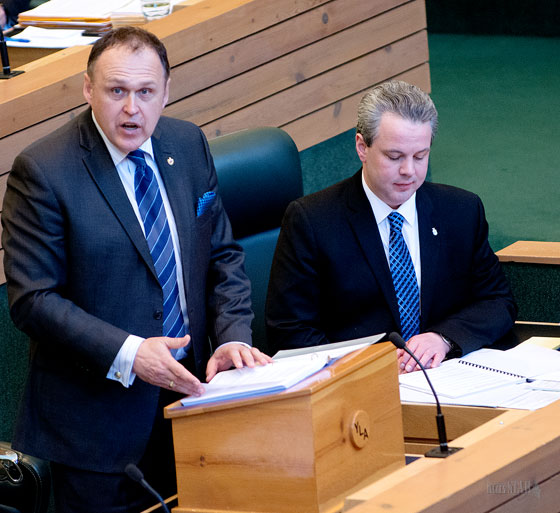
Delivering his third budget speech Tuesday afternoon, Premier and Finance Minister Darrell Pasloski spoke for more than 90 minutes during the opening day of the spring legislative sitting.
By Ainslie Cruickshank on March 26, 2014
Delivering his third budget speech Tuesday afternoon, Premier and Finance Minister Darrell Pasloski spoke for more than 90 minutes during the opening day of the spring legislative sitting.
Much of his speech was devoted to recounting projects and programs that either have been or will be initiated during his government's mandate, from ongoing work on the Centre for Northern Innovation in Mining to the completion of Betty's Haven.
The 2014/2015 budget, worth a record $1.3 billion, includes the largest planned capital expenditure in Yukon's history, but the opposition parties aren't offering their praises.
Liz Hanson, the leader of the NDP official Opposition, said the government still hasn't unveiled a long-term economic plan for the territory.
"It's a budget document that's really short on vision, and an awful lot on transaction,” she said. She noted she's still waiting for the government to show a commitment to diversifying the Yukon's economy.
Liberal Leader Sandy Silver offered similar concerns Tuesday.
"Basically, the Yukon Party has stumbled around for the past 2 1/2 years, they didn't listen to Yukoners and they had no vision. Now they're trying to spend their way to a re-election,” he said.
"If you even take a look at their forecasts of spending, after the (2011) election, it drops right off again, so they're ramping up,” he added.
Silver contends that "election spending” leads to rushed, poorly planned, and over-budget projects.
He highlighted the issues with the F.H. Collins Secondary School reconstruction, which was touted during the last election.
The initial design was scrapped when the bids came in well over-budget.
Now the government is touting its decision to move forward with a pre-designed option imported from Alberta as a success. The premier noted in his speech that the government has saved Yukoners $17 million by "right-sizing” the project.
What he isn't saying is that the government had already spent $6 million on the original design work and initial civil engineering work before scrapping it – and the overall budget remains at $51 million, down only $1.5 million from the 2011 cost estimates, which expected the project to cost $52.5 million.
Silver argues the construction industry would rather see an "even-keeled, long-term” spending plan than the majority of government's capital projects crammed into the year before the election.
"You're basically going to increase a lot of companies from down south coming in and taking Yukoners' jobs that way,” he said.
In a release sent out this morning, Silver highlighted what he called the government's rhetoric around growing the Yukon's private sector economy.
But in reality, it's the size of government that's grown, he said.
"The Pasloski government has increased the operation and maintenance cost of government by $100 million in just two short years,” he said in the release.
The Liberal statement also notes that the government generates just 13 per cent of its own revenue.
Hanson took issue with a few other capital projects as well, including the government's plans for a new continuing care facility.
The facility will initially accommodate 150 beds, with the option to expand to 150 more in the future.
"Combine that with the staff or even just the number of beds, it's bigger than most Yukon communities,” Hanson noted.
"This project is out of touch with Yukon seniors,” said Hanson in a release Tuesday.
"I don't know many seniors who dream of living in a 300-bed facility. And what about seniors who live in Yukon communities? Is the government planning to centralize services in Whitehorse once again?”
"I'm quite taken aback by it, and I think we'll be looking really, really carefully at how the government came to this conclusion,” she added.
The NDP's lack of confidence in the government's planning abilities is clear. Hanson highlighted in particular the government's plans to move forward with an expanded emergency shelter run by the Salvation Army.
She questioned whether the government considered if the Salvation Army's model is an appropriate model of care for such a facility and if it considered alternatives that employ a harm reduction model instead.
Hanson also wants more information on the government's "modest” $2-million investment in the planning of a new hydro plant.
"It's my understanding there has been significant amounts of work done by various consultants for the Yukon Energy Corporation on hydro and hydro projects and locations. Keep in mind the final agreements already identified a number of sites, so it's not as if we're having to go searching about,” she said.
The investment, small – relative to the final costs of developing new hydro capacity – displays a lack of commitment, she suggested.
"It's shortsighted and it begs the question: what was the premier told when he went to Ottawa to get support for this project? I don't think he got a good hearing,” she said.
Just one day before the budget was tabled, the Yukon government was given a D on its fiscal accountability by the C.D. Howe Institute.
In a report released Monday, the institute examined whether an average citizen could easily identify key revenue and spending numbers in a government's budget and public accounts documents and what that citizen would find when comparing intention, as outlined in the budget, to results, as shown in the public accounts.
Overall, the Yukon tied the Northwest Territories for third from the bottom out of all Canadian jurisdictions, including the federal government.
The report isn't all critical though.
Colin Busby, a senior policy analyst with the institute, expects the Yukon's grade to improve by at least a letter grade in the next report, given changes made to the layout of public accounts.
Two criticisms the report offered of the Yukon's financial reporting is that the budget uses both consolidated and unconsolidated numbers.
Consolidated figures represent all government departments, corporations and other agencies, while unconsolidated figures refer only to government departments.
The second criticism is the time it takes the Yukon government to release the public accounts – a criticism Hanson has made before.
But the premier expects an improvement in the next report as well. He noted that previously, the government only used unconsolidated figures in the budget and now also includes consolidated figures.
As for the public accounts, it isn't a priority for the government to release them any earlier.
"This is a jurisdiction that's had a 22 per cent increase in population; we've had strong, real GDP growth for 10 years, very low unemployment, the largest capital budget in the history of the Yukon, and we have money in the bank and we have a surplus, I think those are the things that are important to Yukoners,” Pasloski told reporters following the budget speech.
The budget forecasts a surplus of $72.2 million.
See related coverage.
Comments (2)
Up 0 Down 7
Sandy Helland on Mar 26, 2014 at 11:45 pm
If Yukon tourism really does add $2 billion to our GDP, one would think its government would enhance that with more funding. It appears no money is to be invested. Not one penny. Snubbed is the message I get. It's disrespectful.
Up 0 Down 5
Sandy Helland on Mar 26, 2014 at 11:08 pm
Affordable housing gets missed, even though there is a $72+ million surplus.