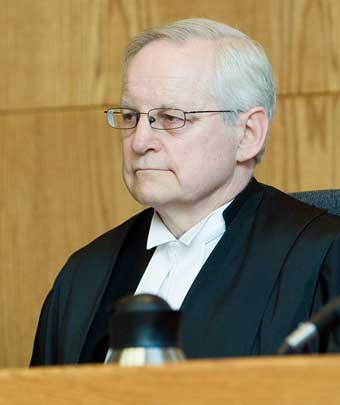
Photo by Whitehorse Star
Photo by Whitehorse Star
When the Yukon Water Board denied a water licence for the Carmacks Copper Project,
When the Yukon Water Board denied a water licence for the Carmacks Copper Project, it was only doing its job, says the Vancouver lawyer representing the board at hearings this week.
Murray Smith said anyway you cut it, the water board is empowered as an independent body to make sure the use and discharge of water in the Yukon will not harm the environment.
The board is not obligated to follow the direction of other regulatory agencies, such as Yukon Environmental and Socio-economic Assessment Board (YESAB) or the Yukon's Department of Energy Mines and Resources, he told Yukon Supreme Court Justice Ron Veale in submissions Tuesday and this morning.
In fact, Smith insisted, the board has a well defined duty enshrined in the Constitution of Canada through the Umbrella Final Agreement (UFA), the blue print for the settlement of aboriginal land claims in the Yukon.
He argued the UFA states specifically that the water board must ensure water flowing through or adjacent to settlement land is "substantially unaltered.”
When the board rejected the licence application, it did so because it did not have enough information to satisfy its responsibility of making sure water used and discharged by Carmacks Copper would not be substantially unaltered, Smith insisted.
He said it didn't matter that the YESAB had already recommended approval, or that the minister of Energy Mines and Resources issued a decision document accepting YESAB's recommendation and approving the project.
It also didn't matter that Energy, Mines and Resources had already issued a Quartz Mining Licence, Smith told Veale.
The water board, he argued, has a specific responsibility in assessing applications for water licences, regardless of what other regulatory agencies are saying or doing.
"I submit that there is no subordinate aspect of the Yukon Water Board when it comes to matters involving water.”
Western Copper and the Yukon Chamber of Mines, however, argued that once the minister issues a decision document approving a project, the water board must follow along. It is free to stipulate whatever terms and conditions it feels necessary, but it must issue a licence, they argued Tuesday. (See story below.)
Western Copper submitted its application for a water licence in 2005. In July 2008, YESAB recommended approval of the Carmacks Copper Project, despite widespread objection from the Little Salmon-Carmacks First Nation, the Selkirk First Nation and the Yukon Conservation Society.
The minister responsible followed with a decision document embracing the YESAB recommendation, and the Department of Energy, Mines and Resources issued a mining licence in early 2009.
But last May, the water board rejected the application for a water licence. The decision abruptly halted the project and sent shivers of uncertainty through the mining industry with what was suppose to be a slam-dunk after five years in the regulatory process.
The ruling was welcomed by the First Nations and the conservation society, which long argued the technology Western Copper was planning to employ was unproven, and potentially lethal to the environment.
In its decision after seven days of hearings earlier this year, the water board agreed the proposed technology was "unproven.”
Under the Waters Act, a decision of the board can only be challenged when there is a question of law or jurisdiction.
The water board's lawyer impressed upon Veale there can be no appeal based on what weight the board gave or didn't give to a piece of evidence.
And once you step back from the seven days of hearings and ask yourself where is the error in law, there is none to be found, he insisted.
Smith said as for the board's jurisdiction to rule as did, it can be found everywhere.
It can be found in the UFA, it can be found in the Waters Act and it can be found in the Devolution Transfer Agreement – finalized in 2001 and coming into force in 2003 – transferring federal authority to the Yukon, he said.
Furthermore, Smith argued, the water board's authority sits at the top of the ladder, not at the bottom or somewhere inbetween.
It cannot be argued that YESAB trumps the Yukon Water Board, Smith insisted.
The board, he said, holds the trump card.
And nowhere, not in any legislation or agreements, is it stated the board must adhere to a decision document issued by the minister of Energy, Mines and Resources or his department, he said.
If it did, Smith suggested, if somewhere it said the independence of the water board was subject to a political decision, then that would be a whole other – and greater – issue.
Imagine, writes Smith in his written arguments submitted to the court, a situation where the water board hears new evidence not presented to YESAB that a project approved by YESAB, and the minister, would have a catastrophic impact on the environment.
"Would the water board in that hypothetical case be obliged to rubber stamp the project because the project had been approved in a decision document?”
The hearing was scheduled to continue for the remainder of the week, with submissions from the Yukon government, the First Nations and the conservation society.
In order to encourage thoughtful and responsible discussion, website comments will not be visible until a moderator approves them. Please add comments judiciously and refrain from maligning any individual or institution. Read about our user comment and privacy policies.
Your name and email address are required before your comment is posted. Otherwise, your comment will not be posted.
Be the first to comment