Board to weigh bid for higher power rates
The Yukon Utilities Board wrapped up three days of hearings Wednesday regarding Yukon Energy's request for a 12.9 per cent electrical rate increase over two years.
By Chuck Tobin on November 15, 2012
The Yukon Utilities Board wrapped up three days of hearings Wednesday regarding Yukon Energy's request for a 12.9 per cent electrical rate increase over two years.
A number of parties, including the City of Whitehorse, questioned Yukon Energy representatives on a variety of issues during the hearing.
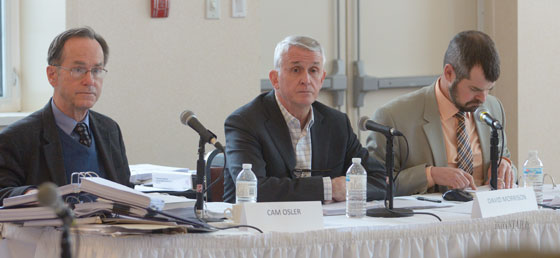
Yukon Energy president David Morrison, the corporation's chief financial officer and its private consultant were asked about everything from personnel costs to their proposal to have consumers start paying for more than $20 million in outstanding research costs.
Morrison and company were asked about why they wanted to re-activate the diesel contingency fund established in the early 1990s to absorb peaks and valleys in the price of diesel and the impact of low water years affecting hydro generating capacity.
Could Yukon Energy not be giving much more priority to advancing wind generation as a viable alternative to hydro and diesel, Yukon Energy was asked.
Representations were made by the City of Whitehorse, the Utilities Consumers' Group, electrical engineering consultant John Maissan of Whitehorse, the Yukon Conservation Society and Yukon Electrical Co. Ltd.
Yukon Electrical lawyer Allison Sears asked Morrison how he thought items included in Yukon Energy's application might affect Yukon Electrical if it brings forward its own application for another rate increase in 2013.
"We are thinking about it,” Dwight Redden, Yukon Electrical's general manager, said in an interview when asked whether Yukoners could be facing a further rate hike next year.
Any increase approved for Yukon Electrical, Redden acknowledged, would be on top of whatever the utilities board approves for Yukon Energy.
The publicly owned utility is requesting a 6.4 per cent increase for 2012 retroactive to Jan. 1, and another 6.5 per cent boost for next year.
The board has provided interim approval of the 6.4 per cent for 2012. The 6.4 per cent was added to the monthly bill beginning July 1.
The board has also provided interim approval of three per cent from of the 6.5 per cent requested for 2013. It is scheduled to show up on the bill beginning Jan. 1.
Yukon Energy spokeswoman Janet Patterson explained this morning if the board approves the full amount and Yukoners owe money for the first six months of this year, it's likely whatever is owed will be spread out for payment over 12 months.
"That's the general practice,” she said. "But the Yukon Utilities Board would typically give us some direction on this.”
Patterson pointed out the door could also swing the other way if the board doesn't approve the rate increase, or only a portion of it, requiring Yukon Energy to reimburse ratepayers.
Board chair Bruce McLennan did not provide any indication when the board might deliver its decision on the rate application as he adjourned the hearing just before 5 p.m. Wednesday.
The parties have until Nov. 28 to file their final arguments, and until Dec. 12 to reply to any of the arguments filed.
In the last rate application back in 2008-2009, the board delivered its decision a little over four months after the public hearing.
Figures provided by Yukon Energy show that if approval is received for the full 12.9 per cent, the average monthly bill for 1,000 kilowatt hours would jump from $136.05 to $154.17 in 2013, before subtracting the Yukon government subsidy and adding the GST.
Currently, the government provides a maximum subsidy of $26.62 per month for 1,000 kilowatt hours consumed.
The subsidy is scheduled to end March 31. Neither Premier Darrell Pasloski nor Energy Minister Brad Cathers has offered any insight about the future of the subsidy beyond March 31.
The president of Yukon Energy told the four members of the utilities board that Yukon Energy has held the line on rate increases for several years.
Time, however, has caught up to the utility, and without an increase, it would be operating in the red next year, he said.
Following the hearings, Morrison said judging from questions by the board's lawyer, he expects the two primary issues on the board's mind are the request to attach $22 million in research costs to the rate base and the diesel contingency fund,
Morrison explained at different times during the three days that conducting studies is an essential component of Yukon Energy's work. Without researching different options to expand generating capacity, there's no planning for the future, he said.
The president said it takes money to flush out an idea, whether it results in a viable alternative or not.
To date, he told the board, the public utility has spent $4.8 million studying the possibility of raising the level of Marsh Lake to store more water to serve the peak loads in the winter time.
Another $4.4 million has been spent looking at reversing the flow of the Gladstone Lakes to expand storage in the Aishihik Lake system, he pointed out.
Morrison said both the Marsh Lake and Gladstone projects are approaching final decisions.
He said the $2.2 million spent researching the possibility of raising the level of Atlin Lake for more storage is on hold and in the can for now, as the B.C. government changed the land use rules while Yukon Energy was midstream with its study. (Atlin residents put up a huge fight.)
Yukon Energy learned very quickly after spending $1.6 million that the possibility of burning landfill waste to create energy in Whitehorse was not viable, he explained to members of the board.
All in all, said Morrison, there's some $22 million in studies on the books that Yukon Energy wants to start paying off. It will be $25 million by the end of next year, Morrison said.
He said those costs can either remain on the books as ongoing work to be paid by ratepayers at some point in the future, or ratepayers can start paying them off now.
"Eventually, you have to pay the piper,” Morrison said.
The board's lawyer, however, pointed out that by putting the cost of the studies onto the rate base instead of leaving them on the books as work in progress, Yukon Energy raises the amount of revenue it's entitled to earn.
Yukon Energy consultant Cam Osler said the diesel contingency fund is meant to smooth out the hills and valleys associated with the fluctuating price of diesel and the varying volumes of water stored in Aishihik Lake at the end of each summer.
The fund, he said, enables Yukon Energy to take money out when it burns more diesel than it has budgeted for, or put money back in when there's money left over in the diesel budget at the end of the year.
Morrison said the diesel contingency fund has not been an issue up until recently, because Yukon Energy had plenty of surplus hydro power following the closure of the Faro lead-zinc mine in 1998.
The surplus, however, has disappeared with rising demand from all sectors, and diesel generation has been relied on regularly during the winter in the last couple of years, he said.
Osler suggested to the board that nobody pays much attention to something like the diesel contingency fund until they need it.
The fund, said Osler, was established in the early 1990s to prevent the utility from running to the board for an adjustment in rates every time they was a shortfall or surplus in the diesel budget.
Osler told the board he was working for Yukon Energy in the late 1990s when the territory experienced its worst years of drought in recent memory.
Had the Faro mine – the largest consumer on the grid at the time – not shut down in 1998, Yukoners would have had a very quick lesson in the cost of running diesel generators 24-7, he said.
"... We would have been in a lot of trouble, and everybody would know about it....”
Osler said the situation would have been so drastic, it would have become part of Yukon history.
Comments (8)
Up 0 Down 0
Max Mack on Nov 21, 2012 at 10:36 am
Nice redirect there, Morrison & crew. Blame diesel and (yet again) residents.
How about the massive cost over-runs on Mayo B??
Up 0 Down 0
Northone on Nov 19, 2012 at 1:40 pm
A 12.9% retroactive rate hike is overkill for ratepayers. It's not our fault that the grid has been over-extended and supply has not been able to keep up with demand. Despite the spin Yukon Energy puts on the situation, diesel is being burned in Whitehorse so the Minto mine doesn't have to. How many times have ratepayers been left holding the bag for the mining industry? Curragh, UKHM, Anvil Range all skipped town on their power bills and left ratepayers to pick up the pieces.
No more subsidies for the mining industry. They can burn their own diesel to generate power. Ratepayers did not create the power shortage so we should not get stuck with paying for a situation that has resulted from Yukon Energy's lack of foresight.
Up 0 Down 0
Jackie Ward on Nov 19, 2012 at 8:28 am
This board is as useless as Yukon Electric/Energy. As well as the utilities board. They put on this face of being neutral and working for the little guy but its all just a smokescreen. Prove to us you are neutral. A 13% increases is unacceptable. People are having a hard enough time with every other increase, from food to housing to gas, etc. it is not our responsibility to pay for your studies. Our responsibility is to pay for the power we use. You people are jackals who refuse to develop any new technologies. Paying millions upon millions on "studies", knowing full well you will never adopt these technologies is an insult to the people who built your company, "US". You whine and cry about how we need to be better energy consumers. I'll assume we are already because its too dam expensive.
Did you approach any of the people who built all these new homes and townhouses in Whitehorse to maybe try and get them to use greener forms of energy? Nope. They all have electric. Give us a break and provide a reliable service at a reasonable price. And you people amaze me. Giving discounts to mines? Faro anyone? We are still paying for that mess. And how you ever got to stick us with that bill is simply stupid and truly unfair. I just shake my head. I would be embarrassed to tell people I work for YE/YE.
Up 0 Down 0
ibex99 on Nov 18, 2012 at 9:03 am
So if I understand correctly, if the rate increase is approved everyone in whitehorse who has received an electric bill will be getting an additional bill totalling 6.4% of the KWh used so far this year. How is this possible that a company can back bill people for energy already used??
Up 0 Down 0
yukonertoo on Nov 16, 2012 at 11:44 pm
Remember when we had a board of directors at YEC who felt honour bound to resign over Fentie's plan to sell off our utility? This government now has complete control of the Board. Any recommendation by any Board is now subject to direct interference by Cabinet. They sell off our power to private interests, create a shortage electricity and make ratepayers pick-up the tab. Don't be too surprised if Cabinet interferes and argue for a "private sector" solution.
Up 0 Down 0
check your facts on Nov 16, 2012 at 8:02 am
Yukon Energy is a wholly owned subsidiary of the Yukon Development Corporation. It is not publicly traded. There is no "stock".
Up 0 Down 0
Atom on Nov 16, 2012 at 7:00 am
Errrrrr....I wanna do the books for YE...I am qualified as I have a calculator.
Yukon owned and Yukon run....Yukon style.
Up 0 Down 0
June Jackson on Nov 16, 2012 at 4:28 am
Before the rate increase is approved, and it will be..I'd like the RCMP to check out the stock portfolios of all the MLA's, Board etc. to see if any of them are holding stock in Yukon Energy and who really stands to gain from a rate hike.
As a rate payer, I didn't approve 25 mil. worth of studies, why am I asked to pay for them? Ask the stockholders to pick up that bill.