Board rejects proposed mining plans
A sweeping rejection of the application for a water licence for the proposed Carmacks Copper Project has been delivered.
By Chuck Tobin on May 11, 2010
A sweeping rejection of the application for a water licence for the proposed Carmacks Copper Project has been delivered.
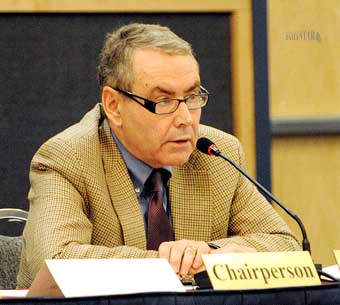
In a 42-page decision issued Monday by the Yukon Territory Water Board, the board finds several critical flaws and voids in the information provided by the Western Copper Corp. to support the application.
The board was provided with nine large volumes of documentation, and held seven days of public hearings this winter.
In its decision, however, it found the company was advancing a mining plan based on unproven technology; that it did not have a handle on its proposed water management system; that its design for the heap leach pads was questionable; and that the method to manage waste material was inadequate.
The board also expressed several concerns with the quality or thoroughness of evidence to support the application.
"The board has found that the application includes the use of unproven technologies to leach, detoxify, and manage discharges from the site,” reads the decision signed off by Bruce Willis, chair of the nine-member board. "Therefore, the applicant is required to provide strong evidence that these activities can be successfully completed.”
". . . Finally, with respect to application of Chapter 14 of the (Umbrella Final Agreement), the board has found that the uncertainty regarding the nature and extent of discharges from this project has not allowed for the board to reach a conclusion on whether the quality of water flowing adjacent to first nation settlement lands will or will not be substantially unaltered.”
While Chief Eddie Skookum of the Little-Salmon Carmacks First Nation expressed relief this morning, Western Copper issued a press release indicating its disappointment.
Company officials could not be reached for further comment.
In a press release, Western Copper states: "The company is concerned that the decision of the Yukon Water Board is inconsistent with previous decisions of the executive committee of the Yukon Environmental and Socio-economic Assessment Board (YESAB), and the Yukon government which, after a lengthy environmental assessment process, determined that the project should be allowed to proceed and issued the project a Quartz Mining Licence allowing construction to commence.
"The Company will be reviewing the decision in more detail and determining its next course of action.”
Western Copper was proposing a large open-pit operation northeast of Carmacks over a period of eight years, next to Williams Creek; the project proposal has been on the books since the early 1990s. The company was planning to pour a sulphuric acid solution over large heaps of crushed ore, up to 30 storeys high, to leach out the copper.
Heap leaching is a commonly accepted practice in the industry, and was employed successfully at the Brewery Creek gold mine with a cyanide solution.
It was, however, argued by several interveners opposed to the application that nowhere in the world is there evidence of sulphuric acid being used successfully in a copper oxide heap leach process under northern conditions.
And nowhere in the world is there evidence of successfully detoxifying a copper heap contaminated with sulphuric acid, it was argued.
The water board rejected a suggestion laid out in YESAB's 2008 approval that the company be directed to work out the proper leaching and detoxifying methods on the first heap, once it gets into production.
There were cries of foul over the YESAB recommendation, and suggestions the environmental screening agency was recommending a giant experiment with an extremely toxic substance in a sensitive ecosystem.
In its summary, the board wrote: "With respect to leaching and detoxifying the heap, the board has found that the ability of the applicant to successfully leach and detoxify a commercial scale heap is not adequately supported in the evidence. The board accepts that proof in the form of successfully testing these processes at progressing scales has not been completed. Moreover, plans to provide more evidence during the course of full scale mining and leaching is not supported by the board.”
The Little-Salmon Carmacks chief expressed concern by phone today that such a proposal would be flatly rejected by the water board but accepted by both the YESAB and the territorial government.
One has to wonder, Skookum said, if the project proceeded as proposed, and there was a serious problem, would YESAB be held responsible.
The first nation spent tens of thousands on a team of experts to guide its intervention into the application. Elders testified before the board about the importance of the land and water.
Skookum said this morning the decision was not just a victory for the Northern Tutchone of Carmacks, but for all of Yukon.
Any environmental issue originating at the mine could potentially affect the entire Yukon River watershed, right down to the Bering Sea.
Junior mining companies, on the other hand, tend to move in, secure the necessary permits and licences, sell the property and then move on, he said.
Lewis Rifkind, mining co-ordinator for the Yukon Conservation Society, said the society was also quite pleased with the decision.
Though he too questioned how only the last of three regulatory agencies could find there was not enough sound evidence to support the proposal.
Issues accepted by YESAB and the government, Rifkind pointed out, included the company's proposal to put the final touches on its water management plan down the road.
The water board rejected the notion, because it doesn't issue open-ended licences, Rifkind said.
On the other hand, he suggested, perhaps the board's rejection is proof the regulatory system as a whole does work in a strange sort of way.
In any case, the decision certainly does send a message, Rifkind insisted.
"I think it is a wake-up call to the regulatory bodies, and all applicants to the regulatory bodies, that it is not necessarily a rubber stamp for these large projects.”
Comments (1)
Up 0 Down 0
JC on May 11, 2010 at 8:52 am
Of course Eddie Skookum is relieved. Now, the 400 plus followers of his little banana republic have a legitimate excuse not to have to go to work. They can just stay home and draw welfare. Whew! What a relief is right. And the tens of thousands they spent on the team of experts, I wonder where that money really came from. I'm guessing the non native governments.